Perhaps Providence will provide America with its own kind of President Khrushchev
"We are getting richer, and when a person has more to eat he gets more democratic." N.S. Khrushchev May 1959
David Satter, in his article, 'What Gulag?' (May 16, 2005, New York Times), reported that the 60th anniversary of the Allied victory over Nazi Germany had "unleashed a wave of Soviet nostalgia. The great belief of the Russian veterans in the righteousness of their cause, reported the Russian press, had helped the Soviet Union survive the worst war of the 20th Century. At last year's Victory Day ceremonies, Vladimir Putin had said, "We were victorious in the most just war of the 20th century. May 9 is the pinnacle of our glory." More recently President Putin referred to the Soviet breakup as "The greatest geopolitical catastrophe of our times."
"This nostalgia," Mr. Satter writes, "is not harmless. Not only does it ignore the fact that the Soviet Union was just as terroristic as Nazi Germany, it also reflects what Hannah Arendt called 'pervasive, public stupidity.'" Mr. Satter believes in history as our teacher; if only we would learn its lessons, we might not make the same mistakes. We are all familiar with the platitude, yet we usually repeat the mistakes time and time again, as if they were warranted by divine or diabolical providence, and that history simply teaches us that we are natural born killers destined to kill each other despite our ideals or because of them. Technology simply makes us more efficient; perpetual innovation will lead to total annihilation in the near future, or at least drastically reduce the population, the growth of which is, according to some experts, the greatest long-term threat to humankind.
In any case, no national 'race' is exempt from public stupidity and mass-organized, paranoid terrorism against enemies, not even the United States of America, patriotically self-described as "the sole superpower in the world on which an attack is an attack on civilization itself." American stupidity and violence is merely more sophisticated or "civilized". Americans who fund their military-industrial complex certainly do not deem themselves responsible for the "collateral damage" of war and economic sanctions: nearly a million deaths in Iraq alone since the First Bush War on Iraq. The most bellicose and mendacious of all presidents are celebrated accordingly, as "great men", instead of being impeached for their lies to the American people and their crimes against humanity. They are, after all, representative men; they represent those who admire them for the power that human beings have always respected, to the point of projecting, personifying, and worshipping divine Power despite its ambiguity and ambivalence when applied on Earth..
Notwithstanding the fall of the Iron Curtain and the disintegration of the Soviet Union, we hear that photographs of the brutal dictator Stalin are being taken out of the closet, dusted off and hung on the walls. Statues of Stalin are also being polished and erected around the country. We are not certain of just how many millions of deaths Stalin is generally responsible for; 40 million might approximate the total. Mr. Satter reports that the town council of Orel demanded of President Putin that Stalin's "honor" be restored to the revised history books, that statues be erected and his name applied to streets. Communist Party leader Gennady Zyuganov said Russia "should once again render honor to Stalin for his role in building socialism and saving human civilization from the Nazi plague." Of course Stalin's nation-building role included economic policies that starved millions to death. His use of slave labor is well known: the "best" intellectuals, those who resisted totalitarianism with individualism, were consigned to slave camps, where their suffering gave them even further cause to appreciate liberty and to publish tracts on the subject if they survived.
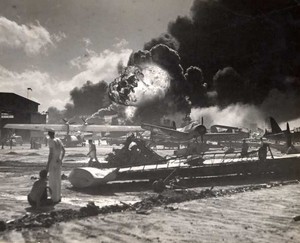
Russian lives lost in the Second World War numbered 27 million. Most people living today, particularly Americans, do not have the slightest notion of the horrors and suffering experienced by the Russian people, of the native lands and lives wasted at the hands of their arch enemy, the Huns. Pearl Harbor and September 11 are insignificant in comparison. 9/11 was no doubt a terrible criminal attack, but the hysterical reaction, fear mongering, and rush to war against Iraq was a monumental demonstration of public stupidity and official mendacity.
Recent reports on the revival of Stalin's prestige are somewhat deceptive in the sense that Stalin's numbers have always been as high as the most recent poll - the majority of those recently polled believed Stalin was a "great man." Stalin, as a matter of fact, despite the fact that it has been politically incorrect to openly admire him, has always enjoyed a relatively high standing among his people; for, as awful as he might have been to them, he belonged to them. Besides, universal human nature respects awe-inspiring men.
Edward Crankshaw wrote several books about Russia from personal experience; he was attached to the British Military Mission in Moscow from 1941 to 1943, and visited Russian thereafter. One most interesting book in the context of great men is his Khrushchev's Russia (1959) - the book is must reading for all those who are still concerned with the eventual realization of social utopia. Stalin drastically diminished agricultural production with his murderous collectivization program: he cared less about the plight of the starving farmer and most about feeding the urban industrial worker the bare minimum needed to ramp up to the modern industrial world. Khrushchev did his best to undo Stalin's mismanagement and to revive agricultural and industrial production. He succeeded in part on the agricultural front, which had not changed much since the Dark Ages, by personally touring the farms with an expert (Lysenko) whose theories were absurd - but he had a treasure trove of commonsense farming wisdom at hand; although his famous maize-growing program earned him the pejorative name 'Maize', it had a good effect on morale and agricultural production; and his Virgin Lands settlement program pioneered the development of large regions of uncultivated land. As for industry, he decentralized top-heavy industry and broke up the managerial class that was most interested in preserving the status quo in its own interest.
"At a single blow," observed Crankshaw, "Krushchev took control of industry away from the new managerial class, atomized the powerful bureaucratic concentration in Moscow, drastically reduced the Council of Ministers [industrial tsars) in size and in importance, and put the power into the hands of his own agents in 105 separate regions."
Khrushchev, we recall, blew the whistle on Stalin in his famous speech and proceeded with radical reforms - Kruschchev of course had participated in the Stalinist policies he criticized; of course he did not mention that in his speech. Krushchev's predecessor, Prime Minister Malenkov, deserves a great deal of credit for instituting many important reforms; Malenkov felt the new business class should lead the country, whereas Khrushchev emphasized political leadership and selected the moribund Party as his tool for radical reform . Khrushchev wanted to transform the Soviet Union into an enlightened society in accord with the Leninist ideals. He was a "crude" man, a verbose drunk, a champion of poor people, appeared to be a clown at times; but he was a consummate politician, organizer and manager. Although popular among the poor, he was mistrusted and unpopular among the more comfortable, conservative classes, who wanted more and more for themselves.
Khrushchev was not popular with patriotic Americans who feared communism; they counted his demerits to the exclusion of his merits. He preferred gentle purges - retirement instead of liquidation or exile - but his occasional backsliding and crackdowns were high-handed if not brutal. Still, he had his fans in America, especially after he banged his shoe on the table at the United Nations. I remember him well. The first time I got drunk, the police stopped me, I ran my mouth off, and they threw me in the tank. I refused to give my real name lest my father be alerted; I said I was 'Nikita Khrushchev'. No, I am not a communist - I am a welfare capitalist. But hardly any one in the world dared to publicly admire Stalin, not after his myth had been debunked, thanks to Khrushchev's famous speech.
Most recently, Saddam Hussein idolized Stalin. But the majority of Russians still admire him - Hitler is also highly regarded but in much smaller circles. Stalin is responsible for the creation of the modern phrase, "the personality cult" - the heroic cult is ancient history. The Russian people, we were taught, love strong men at their head, no matter how cruel and immoral they might be - Russians may not be peculiar in that respect - were not all the old gods at once merciful and cruel? Edward Crankshaw explains from his perspective in the 50s:
"For most Russians, in spite of the hot denials of refugees and 'defectors', have a deep hankering after a stern, remote father-figure, standing high above the hurly-burly of ordinary life. If he is terrible and cruel they will still respect him even as they hate him, as witness the ambivalence of their feelings about Stalin: Stalin may have been the most terrible man-eater in the world; but at least he was our man-eater! One of the most interesting aspects of the reaction to Khrushchev's attack on Stalin was the exaggerated impact of that part of his speech which dealt with Stalin's shortcomings as a war-leader, at any rate among the young. The recital of Stalin's crimes against his one-time colleagues and subordinates they took more or less in their stride; of course we all knew terrible things were going on; but nevertheless, he was a great and strong man, and we needed a great man! ... On the other hand, the revelation that this great man had failed abjectly in the early days of the war was almost too much to bear; and even today it is the thing that rankles the most."
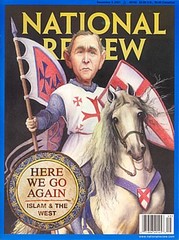
Even if we know only the most recent history of the United States, we know that great men do not admit to being foolish or to misleading people into a disastrous war based on a pack of lies. That is not to say that we would necessarily classify the second President Bush, for example, with Stalin, in the great-man category.
First of all, Stalin's great defensive war against the Nazis was just in all respects. His sacrifice of humanity to achieve his ends - a modern industrial superpower - were far more brutal than the civilized methods now employed by President Bush to spread his elite version democracy and to enrich the elite, worsening the disparity of income. President Bush's democracy is a democracy among the rich and powerful served by a huge underclass. Aristotle noted well that a large middle class is essential to social democracy.
Stalin demanded from subordinates everywhere an uncompromising aggressiveness, toughness, and eagerness to achieve ends by any means available. High intellect and competence were not required. When subordinates rose to high positions, he set them against one another and exterminated them at will. But President Bush is loyal to his ministers, and he rewards them for their loyalty no matter how badly they behave on his behalf. Integrity therefore is defined in Bush quarters as uncompromising loyalty to one's own, no matter how right or wrong one or his own might be. Krushchev, by the way, did not mind liquidating a friend or two in order to accomplish his public ends, but he was not nearly as ruthless and arbitrary as Stalin..
No matter how foolhardy and deceptive and even malicious the American neoconservative militarists and their commander-in-chief might be, President Bush can do no wrong, and in that respect he suits the popular definition of a great man. The more warlike and mighty he appears to be, the more beloved he is; even greater things might be said about the great actor Ronald Reagan, who is considered to be a much greater man than President Bush, who lacks communication skills, including the appearance of sincerity.
President Bush's brand of integrity does not wash among his political opponents. True conservative democrats, in spite of their perversity, hold to the view that integrity means an uncompromising adherence to high morality and sublime principles of ethics. Incidentally, Khrushchev returned to the Leninist line, which he considered to be on a higher moral ground than the business line derived from special selfish interests.
Interestingly enough, the president's most ardent supporters can be found among the young, whose hormones are wont to clamor for violent competition - that is why the elders of old sent them out of the village to prey on strangers instead of the local folk
We shall see how the historians shall treat President Bush, whom some of us believe should be impeached. Chances are he will go down in the history books as a great man, and might even take precedence over George Washington some day, provided that his pre-emptive war against Iraq turns out relatively well - the rest of his agenda has been less than mediocre as well as anti-democratic.
An eclectic French philosopher by the name of Victor Cousin (1792-1867) expounded a Great Man Theory. Cousin, who was influenced by his German friend Hegel, called his philosophy "spiritualism" because of its romantic or spirit-over-matter bent. His views were popular among the New England Transcendentalists. He identified three types of individuals in his Course of the history of modern philosophy (New York: Appleton & Co.1857)
Ordinary Individuals: "There are individuals who have, so to speak, a general character only, that of their age and of their country, mere echoes of the voices of their times; they form the crowd, and are, thus to call them, the anonymous beings of the human species.... ordinary men, a numerous class, honest, useful... excellent soldiers of the spirit of the people; the form the army of every great cause that finds sufficient captains; it is with them, and them only, that one can perform great things: they know how to obey."
Original Individuals: "At the other extreme are the friends of individuality... who seize for a moment upon their poor individuality... cling to it... proudly insurgent against all authority. The mania of individuality is to cut the knot which binds the individual to common sense by authority. There are the originals of the human species: they form a class apart: the give themselves out as the heroes of independence, and are, in general men without energy and without character; they are agitated for a moment without doing anything, and pass away without leaving any trace in history... (They are) unsusceptible of discipline, unworthy to command, incapable of obeying... their great aim upon this vast scene of the world is to represent, what? Themselves, and nothing more."
Great Individuals: "A great man is equally removed from the original and the ordinary man. He is the nation, and he is himself too; he is the harmony of generality and individuality... the spirit of his nation and of his times is the stuff of which the great man is made... it is from the height of the spirit, common to all, that he is great and commands all."
Warriors are the first and most popular rank of great men, followed by Cousin's own class, the philosophers - Cousin was world-famous in his time; he received a standing ovation for the lecture here quoted.
"It is upon the field of battle that energetic and faith representatives are necessary, and there they are never wanting. Glory is an unexceptional witness of the importance of the true greatness of men. Now, what are the greatest glories? In fact, they are those of warriors.... Nowhere do the masses identify themselves more visibly with the great man than on the field of battle; but if this identification is more brilliant in the great captain, it is more intimate and more profound in the great philosopher.
The highest lip-service must be paid to Philosophy:
"...it must be observed that nowhere are there more great men than in philosophy. The highest degree of individuality is reflection, which separates us from all that is not ourselves, and puts us face to face with ourselves; at the same time the object of philosophical reflection is what is most general in thought. Reflection has generality for its foundation, and individuality for its form. It is precisely the highest alliance of these two elements which constitutes the great man."
Great political leaders and heroes govern and defend their respective nations and find glory in getting deeds done or in doing them. Although reputation is a paltry and petty thing, glory is glorious:
"...whatever is human is made so by humanity; to curse power... is to blaspheme humanity; to accuse glory, is simply to accuse humanity that decrees it. What is glory? The judgment of humanity upon one of its members, and humanity is always right.... There are a thousand ways to acquire a reputation; it is an enterprise just like any other, it does not even suppose a great ambition. What distinguishes reputation from glory is, that reputation is the judgment of the few, while glory is the judgment of a great number... With the masses, deeds are everything.... (Humanity) wishes great results.... Great results cannot be contested, and glory, which is their expression, can none the more be contested."
We find in Cousin the ancient militant feeling that might is right, or, at least might is required to make right. Force must be exerted to accomplish anything at all; in order to perform his work, the great man must move ahead and take all - he must win, and no matter what happens we should be on the side of the winners, not the losers:
"...the strife of nations is sorrowful, if the vanquished excites our pity, our greatest sympathy must be reserved for the vanquisher, since very victory infallibly draws after it a progress of humanity... we must be on the side of the victor, for that is always the side of civilization, the side of the present and the future, while the side of the conquered is always that of the past. The great man conquered is a great man out of place in his times; and his defeat must be applauded, since it was just and useful, since with his great qualities, his virtue and his genius, he marched contrary to humanity and the times."
When we evaluate great men, we should ignore their sordid individuality and ask, What did they do for the nation?
"The fundamental rule of philosophy in regard to great men is to do as humanity does... to neglect the description of weaknesses inherent in their individuality and which have perished with it... to fasten itself upon the great things which they have done, which have served humanity, and which still endure in the memories of men... to search out what has given them power and glory, namely, the idea they represent, and their intimate relation with the spirit of their times and their nation...."
Furthermore, great men are called by the times and do not come into being unless there is something for them to do: their work - Cousin notes that many of them are fatalists, superstitious, hesitant and inactive until definitely called.
"It is the fortune of a great man to represent better than any other man of his times the ideas of those times, their interests, their wants. All the individuals composing a nation have the same general ideas, the same interests, the same wants, but without the energy necessary to realize and to satisfy them; they represent their times and their nation, but in a powerless, unfaithful, obscure manner. But as soon as the true representative shows himself, all recognize him distinctly what they have confusedly seized upon in themselves; they recognize the spirit of their times, the spirit even which is in themselves; they consider the great man as their true image, as their idea; and under this title they adore and follow him who is their idol and their chief...."
And what is the objective of the general Spirit of History? Liberty, of course. Liberty - call her Democracy if you will -would encompass the global if great men have their way. Alas that the means to that end have so often been dictatorial where Hegelian Great Men have been involved; according to Hegel, individuals are mere grist for the Spirit's mill. The end justifies any and all means. Might not only is right, might makes right.
And it seems that the end in America, as well as the end of the United States if the trend continues, is to broaden the great divide between rich and poor, so that the rich, democratic among themselves, have the lion's share of liberty, while the democratic dust below divide the scraps equally.
Khrushchev is not considered to be a great man today, although he was a greater man than President Ronald Reagan. As Michail Gorbachev pointed out in October 2004 (www.project-syndicate.cz) when he bemoaned the fact that Russia replaced its discredited communist model with the Harvard-designed blueprint that threw the country on its back:
"The pro-democratic policies of glasnost and perstroika that I unveiled in the mid-'80s did not appear out of thin air. They arose from Nikita Khrushchev's reforms of the '50s and '60s...."
The dissolution of the Soviet Union came from a disease within and not from a threat without - such is the course of history according to Arnold Toynbee. President Reagan's bellicosity abroad and anti-social programs within did not bring down the Iron Curtain. Khrushchev accomplished more in his great seven days than any U.S. president accomplished in seven years. As for the ultimate disposition, Michail Gorbachev's contribution was greater than President Reagan's. Still, we should remember that the leaders were riding the tail of a tiger - or bear if you please.
American might make good use of its own kind of Khrushchev at this juncture in history. Perhaps Providence shall provide a representative man or woman competent to the task in his or her own crude sort of way, preferably someone who drinks vodka and swears on the cross. He may be a true conservative and real republican.
|