 Response to friendly adversary's identification of communism with fascism
“I give you too much credit,” said my friendly adversary, who identified fascism with communism and not with the fascism he had just espoused, “for understanding the difference between an economic system and a type of government.”
To imply in a leading remark that one’s interlocutor is stupid is a typical fascist tactic, seldom used by socialist intellectuals because of their superior intellect.
I disagreed with the notion that there is in reality a disjunction between politics and economics: the differences drawn are merely formal. Economics in its basic sense appertains to the relationship between the organism and its environment, the utilization of resources for maintenance of life. The foundation of human economics is in ecology and biology. The intentional (human) social allocation of resources is political. Whereas religion worships absolute power, politics distributes power, material possessions being one its fundamental forms.
Man will not survive absent socialization. That is why man is essentially a socialist, and why, for instance, the nuclear family early on evolved from a communal or communistic structure, a structure that private or authoritarian capitalism, tends to destroy because it is insane, unwholesome, not-whole, unholy hence antisocial or immoral individualism,. Since man needs power, and is a social creature, and is conscious of his need, in his primitive stage his attention is more obviously devoted to group survival, and this devotion takes the form of the organized worship of absolute power ('god' is the pagan term). Religion is, at the same time, concerned with Politics, or the structured, practical distribution of that Power theoretical.
The rudiments of this natural process in animals of higher intelligence can be observed in the food-sharing rituals of apes, which developed not according to economic theory, but according to political-economic practice, into the religious rituals around the fires of the humanoid groups. These latter customs of course developed into pathways or social habits and were gradually intentionally modified during the evolution of cultural (moral, i.e. mental) development, It was from these observations and the like, at length, that I concluded, for instance, that religion and politics, church and state, are in reality inseparable.
In modern times, where it is said church and state are separate, both politics and religion exist in church and state, wherefore on the state side we speak of 'political theology', and on the church side we speak of 'church politics.' Hence there are two religions, one 'secular' and the other 'spiritual.' Every organization is concerned with its power over the communal means of subsistence: man cannot live on bread alone; neither can he live without it.
Rather than delve into the causes and consequences of the formal separation of church and state, and provide a lengthy explanation as to why this separation is a really subterfuge for atheist religion, I pointed out to my interlocutor that that the distinction he had made between politics and economics, was fundamentally specious, meaning that it is a scientific pretense pretty to ideologues for their special purposes which in practice are merely rhetorical justifications for their specie of political economics.
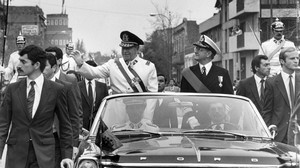
My friend, your expressed admiration for the policy of the brutal dictator Pinochet and his U.S. prostitute of neo-conservative economics, Friedman, because, you say, it puts economics first. You infer that economic reform must preceded political reform. We should not here that the Pinochet-Friedman plan has proven to be a dismal failure - as can be proven after the purchase of a plane ticket to South America. Yet you put forward only one kind of economics, that of private capitalism, which you feel should be unrestrained or unregulated. The minimum restraints you advocate, in order for your economics to function ideally, you identify with Libertarianism, and you associate same with the fundamental concept of classical laissez economics: free exchange (internally) or free trade (externally). But of course your proposal is not merely economic as you assert, but is rather, and unavoidably, political-economic. Furthermore, in political-economic terms, the specific you propose would not result in the realization of more private freedom according to the Libertarian ideal, but would, by repudiation of governmental interference, leave the field free for Big Business to exploit.
Yet, ironically, the choice not to interfere would be an interference, for, as you say, "socialists", including priests and nuns, which you have equated with "terrorists," should, following Pinochet, be murdered and buried; the only mistake, as you said, would be to get caught doing this. Indeed, that policy was in accord with the covert schemata of the Reagan-Bush fostered crimes against humanity in Latin America.
The ideology you have favored, of putting economics before politics, as necessary to reform, a policy that gained momentum during the Clinton administration, then, was not merely economic. In fact, where it was implemented, it was done so by Big Business supported by its cabinet of running dogs in Washington, and it was destructive to many local economies, despised as 'traditional' or 'anti-modern', throughout the world, creating untold human misery.
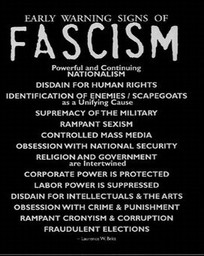
In fact, that destructive form of big-business exploitation, supported by government under the mantle of business is our government and government is our business (note the unity of political-economics), is the post-modern form of fascism. It is nihilistic in the sense that it destroys all traditional economies, which are despised; local economies which do, after all, represent local mores, i.e. moral, political, etc VALUES (note the plural 's'). Contrary to being "libertarian', it is anti-liberal. Contrary to being democratic, it is anti-democratic (the people do not vote for directors, officers as their representatives, the corporation is run like a military organization with a top-down command structure, basically a dictatorship). It is anti-parliamentarian.
And it is anti-social and sociopathic; while it may provide subsistence via the regimentation of society around false pretenses of liberty, of equal opportunity, and the absurd idea that everyone can get filthy rich or be an aristocrat, its structure is becoming so intolerable that a steady increase in "anti-modern" violence may be expected.
Unfortunately, when things are done wrongly long enough, people think they are doing them rightly. Scatterbrained people, whose brains have been scattered by "pragmatic" political-economics, think they are being logical, for they feel secure in their faith in some 'ideology', the political equivalent of religious dogma or propaganda, which is, more often than not, nonsense. It's feel-good atheism. Everyone is really adrift without a will of their own because they are not free; they are totally dependent on the machine, which is manned by morons. And what else do they dare to propose, except more of the same? to make sure everyone else in the world is flattened by the steam roller.
It would be exceeding amusing if it were not so tragic, my firefighting friend, that your solution is the problem. But I think you are beginning to recognize that.
Yours Truly
Your Adversary may be a frustrated Bolshevik, a dictatorial authoritarian, historical materialist, and economic determinist, as you indicate, but he is a long way from taking the leap to faith in the nationalization of property, or absolute state capitalism. No, I think your Adversary is a fascist according to the loose definition, of a proponent of right-wing authoritarianism, and part of being on the right wing is maintenance of private property interests. He is an enemy of communism, and would resort to right-wing dictators such as Pinochet maintain and develop capitalism, and would of course have to rely, like Pinochet, on the financing and cooperation of Big Business to do so, while, as is customary among pseudo-conservatives everywhere, claiming that he is for the little guy, for small business.
To speciously separate politics from economics, as your Adversary does, we might say that he is a political Bolshevik and an economic capitalist; a political Bolshevik being a left-wing authoritarian who would socialize politics, usually around nationalist symbols - there is nothing like aggressive national competition and it ultimate form, of war, to politically (spiritually) socialize a nation, providing every one, whether rich or poor, with an undivided interest in imponderables, such as the national glory (power). The nation religiously unites in the self-worship of power, claims that it is a free-standing individual, demands a right to "free" trade and is willing to destroy other nations for it, resorts to law of the jungle or evolutionary propaganda, and so on, in what is actually the perfection of capitalism on an international scale, via international capitalistic anarchy, each national capitalist supported of course by its right-wing government.
Adversary reminds me somewhat of the French fascist intellectual Pierre Drieu La Rochelle. He, like your Adversary, tried to separate politics and economics. Like other fascists, he spoke of the "slide to socialism", meaning materialism, which he would offset by dictatorial political spiritualism, leaving capital its capital, however, to finance same:
“We will leave the bourgeois their skins, we will leave them their positions in the economy, and we will leave them their money. We will only demand they forswear their little individual souls. At the same time we will deprive them of the spirit of the system which has begun to slip toward socialism.”
Drieu like other fascists rejected the economic determinism or materialism of the communists; yet, since capitalists are in fact materialists too, whose greed in the early pirate phase has more latitude or flexibility, we find the fascists like the communists bad-mouthing capitalism including its economic liberalism - a liberalism which is immoral, since it reduces all traditional values to a commodity fetish circulated around its great abstract god Money. Still, the fascists, regressive as they are, admire the anarchic pirate-phase or robber baron-phase of capitalism.
Hence the fascists tried to deny their own materialism, taking up irrational barbarisms, NOT coherent traditional usages; the raw, brutish feeling, because unorganized, of spiritual freedom - although they were actually evolutionary materialists, monists of Haeckel's crude rationale - in fact made them sympathetic to capitalism, especially Big Business, which is after all socially closer to the absolute Power really worshiped in its inchoate, particularistic origins. In any case, access to private capital was needed to defeat the communists.
Thus we see the fascists, who were virtually nihilists in many respects, disparaging Whore Liberty, Capitalism, Communism, Democracy - everything. But in fact they love capitalism, the bigger the better, and not the proletariat, the struggle against classes etc - Drieu for one disavowed class warfare, and advocated a dictatorship of the bourgeois. Drieu, like your Adversary, was starry-eyed over the elite few who were allegedly the only ones, always a small minority, competent to dictate the national and business aims - but Drieu certainly did not demand that the upper crust give up their wealth and privileges, no matter how much they were hated below.
The priority of fascism was to demolish the leftist parties: to accomplish this, the plan was to unite the old parties of the right with the capitalists; one the left had been crushed, the fascists would absorb the right and build a collaborative society; i.e. not one based on class conflict. The American fascists, a power elite presiding over big corporatism public and private, under a false cloak of "democracy", have managed to take the U.S. far in that direction. The voter feels he has an undivided interest in the imponderables of the commune, the national power and glory, and s/he believes that it is organized naturally, hierarchically.
And, as long as an authoritarian president is in the White House, backed up by the largest military machine in the world, and his campaign is amply financed by Big Business, that another term as king might be had, and the Dynasty continuing apace thereafter, no god is really needed.
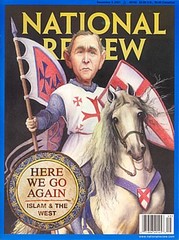
To lampoon, then, this and other national symbols, is in very bad taste, for it insults every spiritual investor, particularly cloaked fascists who need this faith to offset the fact that, no matter how glorious they might feel, they are relatively powerless. The "little guy" is the biggest advocate of the very policies that diminishes him, but in exchange for keeping the Kept Class of parasites intact, he is also relatively secure. To lampoon or lambast with lies is one thing, as people toss off lies as ridiculous, pay no mind to them. But the closer the lampooning and lambasting gets to the truth, the angrier will the fascists become. They will insist that truth is a perversion, and they will be correct as far as they are concerned.
Lawrance G. Lux
|