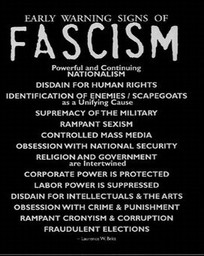
 Includes opinions of Authorsden's Lawrance G. Lux (R.I.P.)
FASCISM RATHER LOOSELY DEFINED
BY
DAVID ARTHUR WALTERS
Fascism given its various historical forms may be rather loosely defined. For example, the unabridged Oxford English Dictionary defines the term as “the principles and organization of Fascists. Also, loosely, any form of right-wing authoritarianism,” and provides these usages:
"1921 19th Cent. July 148 The Fascismo was born in the provinces, where the extremist menace was stronger. 1922 Q. Rev. Jan. 148 A section of the Press now veered completely round to the cause of Fascism. The Fascist terror increased in intensity. 1923 Contemp. Rev. Jan. 44 We do not want Fascismo in this country. Ibid. Nov. 557 Fascism in Germany will never be more than one of several factors. 1925 Weekly Westm. Gaz. 10 Jan. 320/2 The outrages which have been associated with Fascism have gradually alienated much of the support which it won two years ago. 1934 tr. K. Heiden's National Socialism xvii. 354 The electoral victories all over Europe with which the Labour Parties have replied to German Fascism. 1936 Discovery Dec. 378/1, I have strongly criticized modern education and the methods of handling youth generally as inculcating excessive respect for authority and thereby conducing to the growth of Fascism. 1939 A. COBBAN Dictatorship v. 124 In March 1919. Fascism was still a revolutionary and socialist movement, hostile to the monarchy, to finance, and to parliamentary government, demanding social reform and workers' control, but separated from the other branches of the socialist movement by its intense nationalism. 1965 L. VENNEWITZ tr. Nolte's Three Faces Fascism II. ii. 87 Maurras was the first man in Europe who as a thinker and a politician drove conservatism beyond the limits dividing it from incipient fascism. 1971 Tablet 26 June 616/2 (title) The ghost of Fascism."
Raymond Gram Swing, an influential American journalist whose voice was broadcast from Britain during the World War II, defined fascism in Forerunners of American Fascism as “a reorganization of society to maintain unequal distribution of economic power and a substitute of barbaric values for individualist civilization."
Benito Mussolini, master proponent of Italian fascism, eschewed ideology, as would anti-intellectuals dubbed neo-conservatives would later do in the United States, associating the term with practicality or pragmatism: "Fascism, which did not fear to call itself reactionary when many liberals of today were prone before the triumphant beast (Democracy), has not today any impediment against declaring itself illiberal and anti-liberal... Fascism knows no idol, worships no faith; it has once passed, and if needful, will turn to pass again over the more or less decomposed body of the Goddess of Liberty." (Gerarchia, March 1923)
To intentionally confuse the issue, neoconservatives mistakenly attempt to identify fascism with both left- and right-wing authoritarianism, when in fact the wings are mortal enemies.
George Seldes laid out, in Facts and Fascism (1943), the background of the crucial difference between Fascism and Communism, wherein Mussolini the pragmatic opportunist, fails to recruit unions to Communism, therefore veers from Left to Right:
"When the factories of Milan and Turin were occupied by the workers, Mussolini held a conference with Bruno Buozzi, who held a place equivalent to that of Sam Gompers in our American Federal of Labor. He proposed using the factory occupation as the beginning of a military movement to seize Rome and establish a dictatorship of the proletariat. Buozzi indignantly kicked Mussolini out; labor believed in the democratic political processes, and the main proof was that not a single act of violence marked the factory seizures, although the press of the world for a month ran daily lies of bloodshed and terrorism.
"Within a few days Mussolini had sold the same idea to the owners of the occupied factories - only this time the same Blackshirts were to be used to create a dictatorship of Big Business, rather than of workers.... [Adriano] Olivetti and company put up the money, Mussolini took Rome. And in payment of the subsidizers his first important act was the abolition of all labor unions.... From the day he became dictator Mussolini began paying back the men who pained him in 1920. He abolished the tax on inheritance, for example.... His chief opponent was the Socialist deputy [Giacomo] Matteotti. The reason Matteotti had to die was because he committed the one unforgivable crime in a Fascist nation: he exposed the profits in Fascism.
"There is no program, no policy, no ideology and certainly no philosophy back of Fascism.... It is nothing but a spoils system.... Fascism is a system whereby a handful of ruling families get the entire nation...."
The late military historian and economist Lawrance G. Lux said that the neoconservatives’ tactic equating fascism and communism “is often employed by Big Business capitalists to conceal the fact of their close association with and support of the fascists, and the fact that fascism is big business capitalism ruthlessly perfected.” (Authorsden Roundtable on Fascism)
Other historians have noted the fascism’s association with big business, and the ties between banking, Fascism and Nazism, including the banks run by the Bush Family that were eventually shut down by the U.S. government. President George W. Bush reportedly received income in a blind trust from the residue of the family’s banking interests, and he was allegedly friendly with surviving Mussolini fascists serving the Italian government during his war presidency.
According to Lux, “studying ideologies in terms of economic impact is often best:
Fascism: 1) always initially funded by wealthy interests; 2) uses slogans appealing to middle class values to gain support, easily dropped if conflicting with wealthy interests desires—consider term limits, and the rant against the national debt; 3) economically, wages always drop, profits always go up, as do product prices; 4) the percentage of wealth held in the hand of the few always increases, while the standard of living on average drops; 5) unionism and worker unrest condemned as unpatriotic; 6) middle class values are always touted as superior, while the economic base of this same class is eroded.
Communism: 1) belief in development of ideology, rather than mass collective action like the fascists; 2) persecution of the wealthy in order to economically fund the substitution of a class of communist bureaucrats; 3) product prices are locked in, worker standard of living is locked in, and profits of enterprise directed towards provision of salaries and benefits for the new class of bureaucrats; 4) economic performance is geared solely to provision of a good life for bureaucrats, with these Individuals able to use patronage system to gain allegiance from worker elements.
5) Long-term standard of Living average goes down, as diseconomies of production appear.
Both systems deny personal liberty. Both systems develop secret police systems to control the masses. Economic performance suffers because both ignore supply and demand functions. Fascism is controlled by the wealthy property and industrial interests who prosper along with the police machine. Communism is run by ideological bureaucrats developed in a tight cell system
Eric Hoffer in "Today's Isms" commented on the like mentality of individuals attracted to ideologies which provided a template Ideal Citizen that the individual could identify with. I have some reservations about this casualty. Fascism remains a form of tribalism underscored by a military regimen of top-down authority. Communism seems a form of banditry, in the terms of Band [“bond, tie, ribbon’], based upon a claim of moral or ethical superiority defined by Intellectual elitism. The only real unitary thread between them lies in violence, and the presentation of an Ideal Citizen concept.
Again, Fascism has been long associated with wealth and the military. It particularly represents a transfer of military regime to politics. Communism, on the other hand, represents a true revolutionary spirit of anarchism with desire to destroy established wealth and power, but originates not in actually oppressed people, only in an educated elite that cannot seem to function in an ordinary economic milieu. Actual oppressed peoples opt for forms of unionism, simply to better their immediate economic position.
Modern corporatism is essentially unlike either, though it mostly closely adheres to the fascist pattern. It is a corruption of both capitalism and fascism. It violates capitalism as it replaces free market with corporate price schedules designed to produce economic profits. It corrupts fascism as it abandons the welfare of the Tribe for the simple enrichment of the corporate leadership, much like the Communist mentality.
Both movements sought to improve the materialistic life patterns of their supporters. A pattern of individual corruption remains obvious in both movements, much higher than in union/socialist or republican forms. I believe the extreme forms of Fascism and Communism is simply the expression of corruption in corporate and union/socialist models.
As confusing as the loose definitions may be, it is plain that Italian Fascism, unlike Communism, clung to the profit motive. Fascism, unlike Communism with its cogent ideology, was pragmatic, had no definite ideology, and was early on a system of capitalist exploitation led by the government which kept labor in line.
Another important difference between Fascism and Communism is its basic social formula, adopted from Saint-Simon, that workers will be rewarded according to what they produce, in contrast to Communism's "from each according to their ability, to all according to their needs."
Fascists often have genuine difficulty distinguishing between their right and left hands, just as they confuse good and evil, and claim to be beyond both. What they really abhor is good because 'good' has something to do with the social or altruistic nature of humanity at large, in contrast to the strictly selfish 'evil' of the individual.
Therefore, although they may lay claim to fundamental Christianity, fascists love to deny the existence of universal love, and, instead, to affirm the brutal aspects of life as the general rule. Their love for their own kind, however they define that kind, it is hate-based love, i.e. the love of their own band with them in it, in reaction to their hatred of others.
It is clear that the more intelligent and devious fascists will deliberately confuse opposites or identify right with left in order to hide behind the scabs of political correctness. They will foreswear fascism while identifying it with communism, insisting that both Stalin and Hitler were really communists. For the sake of argument, they would be better off to refer to Mussolini in his early career, when he was actually a socialist, and ignore Hitler altogether, and then take up the socialism of National Socialism while ignoring the predominating character of its nationalism.
One may eventually arrive at a definite definition if, in the interim, he places his copy of Das Capital on the left, and relegates his copy of Mein Kampf on the right.
Fascism and Communism as terms do not describe actually contradictory opposites separated by a middle ground in reality. The absolute freedom craved at the left and right ends of the social continuum tend in practice to evolve to the same self-destructive result, just as the ends of a straight line extended forever meet.
For now, we may temporarily and for the sake of convenience even more loosely identify 'fascism' with the authoritarian politics of private capital on the extreme right, and loosely identify 'communism' with the authoritarian politics of public labor on the extreme left. The differences between the existential individual and essential society are one in the “person,”
A bird flies with two wings. A nation dies with only one.
|











thought provoking read
I really love that last line.
Ron