The Ancient Doctrine of Eternal Recurrence and Ouspensky's People of Byt
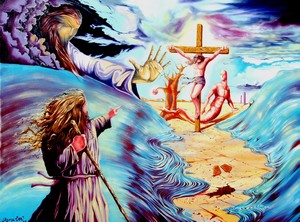
Every one knows Sisyphus' pathetic story. Sisyphus cheated time by tying up Death, at least for the time being; that is, until the god of war hauled him back to the underworld because Hades had complained of the shortage of bodies in the interim; from whence Sisyphus escaped by breaking his oath to Persephone that, if he were allowed to ascend to the surface to make sure his body was properly buried, he would return to shady hades; but the paroled perjurer did not return, hence Hermes hauled him back to hellish haunts; and there Sisyphus the Runaway, now Sisyphus the Rock-Roller, is seen to this very day, serving his sentence of eternal repetition, rolling his shameless stone, hard evidence from the scene of a crime against Zeus, to the top of a hill; whereupon, rather than rolling down the other side, the stone rolls back down his side again - maybe there is no other side; thus is labor lost and Sisyphus must begin anew while the gods laugh at his miserable plight.
The late Albert Camus lately said Sisyphus has turned the tables on the gods: that he runs down the hill laughing at them all the way, then sets his shoulder willingly to the futile task in order to mock them yet again. Thus does the rolling eternally recur, just as some men naturally expected the Sun to forever rise and fall and hailed it as their god.
P.D. Ouspenky wrote about the ancient doctrine of eternal recurrence and drew some vicious circles for us to contemplate, each one spinning in its respective place in the vertical fifth dimension, each said place or point being a moment along the horizontal continuum of the fourth dimension, allowing him to conjecture that we each might be reborn again at the moment of death, to live the same life over again, and again, and again, so on and so forth, until, perhaps with his help, of course, we become aware of our habit and are saved.
Yes, saved, for even Ouspensky will not abandon the psychological essence of time, which is not the past exactly repeated, but is rather the expectation of something in part unknown and new, namely the future life, which so happens, as some of us have noticed, to fly from its past like a bat out of hell but with an eye to the past; there are certain differences between birds: the Jayhawk flies backwards because he loves the past and doesn't give a damn where he is going.
The doctrine of eternal recurrence is absurd because time moves in one direction only along its line; or so ordinary people think. That is, history does not repeat itself - time reversed would destroy the universe. But Ouspensky conjured up some sort of clearing house where times speed up and slow down and all times are instantaneously adjusted after each death, so that the relationships between people's deaths are kept constant - if I die two years before my eighty-year-old mother expires, I will still be born again to her as I was born before, when she is twenty. Alas, the infant who dies in a car accident will suffer an infinite number of such deaths. And so on and so forth according to the respective fates. There are better reconciliations possible, but we might want to drop the doctrine of eternal recurrence altogether, for it is a stumbling block in several ways. For instance, if it were true , if we knew we were doing nothing but repeating ourselves, life might be hell indeed without the possibility of parole or salvation.
Now if Ouspensky had said that his doctrine was a merely a metaphor for bad habits, together with lessons on breaking them with new works, we might thank him very much and proceed. But he is pushing this rolling stone at us as if he wants us to embrace it. No thank you, Mr. Ouspensky. Maybe we do not want to repeat ourselves eternally, so why keep reiterating the doctrine?
If there is a life after this one, who wants to take herself along just as she is? We dream of better conditions, yet each person is one of the conditions. And despite the apparent progress we seem to enjoy in a lifetime, many are those who would start anew with a clean slate if only they could. And if they did start afresh, they would not know their previous life, so why all the fuss? What is the difference between a clean slate and eternal death if one has no memory of a previous life? All do not fear death; many behold it as the ultimate salvation. Not that suicide is the solution. Hamlet's theological studies included a course in eschatology; he then had reason to worry over the question, To be or not to be - his sighting of a ghost gave him even further cause for concern.
A Christian at least has a future for good or ill, and is not consigned to eternal repetition of the past. Ouspensky noted that Christians speak of a life after death but not of a life before birth. He found hints, however, of the doctrine of eternal recurrence in the New Testament. He claimed that the doctrine was known to the ancients; they knew it well but could not communicate the occult knowledge to others because those others were still dead caterpillars in contrast to wise butterflies who are in the know because of their transformation into a new life.
"The idea of recurrence cannot be popular in its pure form," wrote Ouspensky, primarily because it seems absurd.... According to the ordinary wisdom of the world 'nothing ever returns' .... Buddhists have rejected the 'absurd' idea of a return into the past, and their 'wheel of life' rolls along with the calnder.... We are one-dimensional beings in relation to time; we have no knowledge of parallel lines.... In my book Tertium Organum I described what the universe of one-dimensional beings must be. These beings know nothing besides their own line.... There can be nothing parallel to us.... It is very difficult to accept the idea of the absolute and inevitable repetition of everything."
Of course it is difficult. And Ouspensky has a way out, a "necessary" way out at that. "The idea of absolute repetition does not agree with the idea of growing tendencies, which is also necessary."
He does not propose that the growth itself might repeat itself; that everything possible whether growing or decaying has already happened countless times and is being repeated endlessly. According to him, "It must be recognized that as regards the character of the repetition of their lives people fall into several types or categories."
Now we discover that only certain, "unsuccessful" types of people are subject to inevitable eternal repetition. Let's mention only one type: consider the "people of byt." The Russian word is difficult to translate. It can mean a habitual lifestyle, say peasant-life, merchant-life, rut-life and so on; or, in theatrical life, the typical voice or tone, the typical bit part, and so on.
"There are, first of all, people of byt, of deeply rooted, petrified, routine life.Their lives succeed one another with the monotony of the hand of the clock moving on the dial. There can be in their lives nothing unexpected, nothing accidental, no adventures. They are born and die in the same house where their fathers and grandfathers were born and died and where their children will be born and will die. National calamities, wars, earthquakes, plagues, sometimes wipe thousands and hundreds of thousands of them from the face of the earth at one stroke. But apart from such events their whole life is strictly ordered and organized on a plan.... It is just this absoluteness of repetition that creates in them some vague consciousness of the inevitability of everything that happens, a belief in fate, fatalism and, at times, as strange sort of wisdom and calmness, in some cases passing into an ironical contempt for people who are restless, seeking for something, striving for something."
Ironically, like other Russians of literary note, Ouspensky seems to have a certain occult admiration for this repetitious type of person, the "unsuccessful" person whose consciousness of repetition seems to save him from fate by resigning him to it. But Ouspensky is divided against himself. He seems to push the doctrine of eternal recurrence to rid himself of it, but it rolls right back on him. Maybe he was a Russian fatalist who dreamed of the New World. East looks West, West looks right back.
|