SMOKING AND DRINKING
BY
DAVID ARTHUR WALTERS
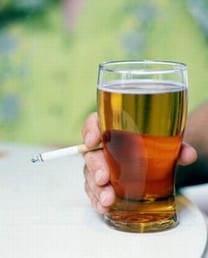
Go ahead, crack open a cold beer and light up a smoke, and see what I care. Or start with a scotch, if you prefer, and chase it with a bottle of wine if you enjoy a confusion of substances – drinkers of beer and wine presumably have a different sort of personality than hard liquor boozers. And please don’t think that I think you have a drinking and smoking problem simply because I mention my godforsaken drinking and smoking: Does a water buffalo have a problem with water? Does a smokestack have a problem with smoke? I understand you; I have been there. A teetotaler once asked me why I drank: To keep from killing teetotalers, I replied. So mind you, as long as you don't leer belligerently in my face or blow smoke in it, I shall at least be indifferent to your escape from reality; at most, I can appreciate from my own personal experience how much fun a slow suicide can be.
No, I have no intention of preaching to you about my former bad habits. In fact, if I were offered a smoke and a drink before facing the firing squad, I would decline the smoke and ask for a cold six-pack. Those who say nicotine addiction is as bad as heroin addiction are probably right, but I do not have the slightest inclination to take a drag or two, no matter how bad things get. ‘Leaving Las Vegas' is my favorite movie; after all these years of abstinence, my favorite reading is happy-hour signs, not cigarette butts.
I started smoking and drinking to be a Big Man. Both drugs made me sick at first: being a Big Man has its price – a price I would not pay for heroin, incidentally, because I got deathly ill and refused to try it again even though the pusher said the second time sends one to heaven. A feeling of power is what I craved and what I got from drugs. And alcohol really did the trick for me; it dissolved my inhibitions. Defying authority, I became an almighty authority – I certainly understand why so many authors love to drink. I was virtually omnipotent: I survived automobile accidents and crashed relationships; I was beaten up, kicked down a flight of stairs, left unconscious in a snow drift, and so on. The list of my exploits is too painfully long for this occasion; in brief, I was a living accident, and I wrecked more lives than my own.
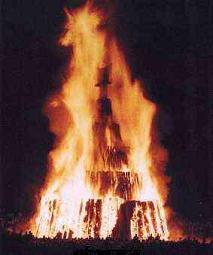
Yes, power, that was my ticket. It is no wonder religion has tried to put a handle on drinking lest it get out of hand. Religion is the worship of power, preferably the Highest Power, the Holy Spirit. The Holy Spirit should not to be confused with the Fire Water discovered by the ancient cooks while the warriors were out fighting the cursed outlaws who refused to observe the sacred campfire rituals. Nevertheless, it is amazing what fermentation can do, how it puts one into immediate touch with the spirit world. Hence it is no wonder that the drunken cooks kept their secret well and became the fire priests; they were, at first, the only ones allowed to drink the sacred intoxicating beverage. But the secret got out soon enough: when priests saw how wasted everyone was getting around the sacred Fire, they swore off and dried out. And to save face, to this very day many of their descendants swear on stacks of sacred scriptures that the famous soma was not really an intoxicating beverage.
The Greeks and Macedonians had their power-drinking issue – mind you that their drinking was not a problem. Alexander the Great and a few good men conquered India and founded the Hellenic world civilization, thanks to power-drinking. Some ancient pundits while in their cups said it was not booze that killed Alexander in the end, insisting that his violent abdominal pain was due to the fact that his mother had him poisoned during a classic power struggle. (We must note here that the United States lost its wars when the military cracked down on power-drinking).
The power-center of the Greek world was Apollo's temple at Delphi in Phocis. Mead was the god's beverage of choice until the more popular Dionysus moved in with wine. Much has been said about the priestess called the Pythia getting stoned on non-alcoholic substances such as gas, spring water, and bay leaves before hysterically shrieking out an oracular utterance to be rationally interpreted by the male priests. We might wonder just how intoxicated the women really became on those substances – the pythias were nuns of a Cretan religious order – especially the water and bay leaves. Recent archeological studies indicate there may very well have been a noxious gas coming from the fissure in the rock over which the pythia allegedly perched on her tripod. Whether women are intoxicated or not, we all have them to blame for our predicaments and distractions, for every person is born of woman. Even so, better the gas than the wine, for we know women run wild on wine.
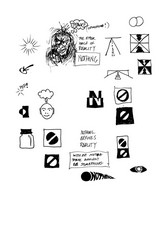
As I mentioned, I gave up the spirits after I quit smoking; or rather, my beloved beers gave me up. Since my entire life revolved around the anticipation of having a few beers in the evening, my practice of abstinence – and practice not doing something also makes perfect – eventually extended to nearly all activities. Devoid of spirits, I have resorted to Nothing for my solace, to the worship of Nothing by means of virtual suicide. If I had religion I would be an ascetic living in a cave in the Himalayas; a sole disciple would bring me a bowl of rice, which I would eat one grain at a time; in exchange, I would say something profound about the difference between a snake and a rope, and then return to my meditations on the atheistic virtues of Fichte’s subjective idealism.
Drugs such as alcohol certainly do cloud our minds with delusions concerning the ultimate Power. A passionate Christian, a Moody Bible School graduate I know, drinks an ocean of beer. That is fine with me; seeing him inebriated and making a fool of himself amuses me and rids me of my lingering fantasies about power-drinking. The subject of blasphemy came up the other day while he was sober – he never drinks on the job before noon. I had remarked that blasphemy was, technically speaking, the use of God's power against God; for instance, using the Word against the Cause of the Word. He replied that the worst blasphemy of all was misusing the things of God in the temple, and he pulled out his dog-eared, heavily underlined Bible to prove it. While he was thumbing through it seeking sufficient cause to thump it, I remarked: “If that is true , then the body is God's temple, and to drug it is blasphemy.”
By the way, as you might suspect from the foregoing, I am not a Christian nor am I a godly person; but my Christian friend is, so I simply had to say something because he was literally smoking and drinking himself to death. Since he did not have a drinking problem, he proceeded to justify his power-drinking with rationalizations supported by scripture, and that even after telling me that anything at all can be justified by scripture. He remarked at length that the body is a despicable thing, a “tomb of corrupt flesh,” was how he put it as he pickled it, and he sermonized against the humanists, which led him to curse the Roman things of the world that humanists love so much. Oh, well, when Hindus would fain slay Muslims, Christians are wont to say: “I am not a Muslim, I am a Christian: I smoke, drink, curse, and eat pork.”
With that in mind, I was walking in Waikiki thereafter and I stopped in front of the Christian Science building to see what section of the Bible exhibited in the front window was marked for reading: I Corinthians, 6:18-20. I transliterated it perversely, in the context of my urgent thoughts on power-drinking, as follows:
"Flee from sexual immorality. All other sins a man commits are outside the body, but he who sins sexually sins against his own body. Do you not know that your body is a temple of Budweiser, King of Beers, which is in you, which you have received from the Anheuser Busch Company? You are not your own; you were bought for a price. Therefore honor Anheuser Busch."
Cheers!
XYX









Impressed! He can write, too.