Johann Gottliebe Fichte's Sunday school reconvened despite atheism charge
Sunday School
Sunday is the best day to discuss Johann Gottliebe Fichte's alleged atheism. Fichte (1762-1814), was a German philosopher, religious thinker, and political radical. After being appointed professor of philosophy at Jena in 1794, he began a series of public lectures from ten to eleven o’clock on Sunday mornings, much to the consternation of the clerics. A local journal accused him subversively substituting the worship of reason for the worship of god.
That was a serious political charge given the situation in Paris, where images of the savior and saints had been pulled down in churches, renamed "Temples of Truth", and had been replaced with effigies of Reason and Liberty, and with paintings of natural objects such as flowers. Atheism was so much in vogue that people openly guffawed if a priest bothered to even mention god in a temple of reason. But Fichte had no such mummery or cynicism in mind, although he did appreciate several of the Revolution's basic principles and had written such tracts as 'Reclamation of the Freedom of Thought from the Princes of Europe' and 'Contributions Designed To Correct the Judgment of the Public on the French Revolution.'
In 1792, Fichte’s mentor, Immanuel Kant, published Fichte’s 'An Attempt at a Critique of All Revelation' – Fichte’s name was accidentally omitted, and when the error was discovered, that he and not Kant was the author, his reputation was made. His own philosophy diverged from Kantian and Enlightenment thought, to his form of Romantic philosophy, the precursor to Hegel’s way of thinking. He united Kant’s famous thing-in-itself, about which Kant thought nothing could be known, with knowledge; and in that ideal subjective unity he identified mind with objective reality. The apparent opposition between mind and reality, or the difference between a concept and its object, is produced by the ego’s struggle with non-ego; the ego surpasses itself and thereby realizes itself in the objective world, which is simply the objective form of its subjective scheme. A critic dubbed this subjective idealism “colossal egoism.”
As far as Fichte was concerned, Kant’s presupposed foundation of the perceived world, his unknown thingie, was a piece of nonsense, or rather nothing at all but an excuse for ignorance given to support an absurd metaphysical fabrication, a two-world system with two kinds of logic, one for the world of thought or noumena, the other for the world sensed or phenomena. How can one build a system on what is tantamount to nothing? How can anyone know anything at all about some unknown thingie? Well, its existence might be presumed, as an article of faith, and the world might then be created from nothing. Now, Kant himself was inclined to the idea that the subjective “I” was a thingie. Perhaps the famous creator of the world was such an “I” or unknown thingie. But to imply that god is nothing but a piece of nonsense instead of a bearded man on a heavenly throne, whose image is the king on earth, smacks of blasphemy, infidelity, atheism, and subversive politics. “I abhor all religious conceptions,” Fichte said, “which personify God, and regard them as unworthy of a reasonable being,” because a subject or person cannot exist without objects limiting it. Furthermore, to identify subject with object and say that god is the creation, denies the very existence of a monotheistic god, who must necessarily stand apart from his creation in order to exist (exsistere = to stand out). One might say that metaphysical abstractions tend to atheism because they do not correspond well with the popular or vulgar picture of the Supreme Being which must be presented to the ignorant to maintain law and order on Earth. Wherefore it may behoove the academic “atheist” to limit his abstract profusions to the arcane inner sanctum lest the exoteric religion be profaned by his public profession. Of course most of what Fichte said went over the public’s head, but there was always the danger that too many people would catch on and adopt the normally immoral pursuits of the hypocritical power elite. The bigots were not so much disturbed by Fichte’s doctrine of knowledge as they were by his consequential doctrine of morality.
The Great Atheism Controversy and Transcendental Morality
The formal charge brought against Fichte, worshiping reason on Sunday, was resolved in his favor by the university senate of the Weimar government, with the proviso that any future lectures be given at three o'clock on Sunday afternoons instead of in the mornings. No such compromise was available to Fichte, however, in the matter of Atheismusstreit, the famous Atheism Controversy which arose out of the publication of his 1798 essay on divine governance – 'On the Basis of Our Belief in the Divine Governance of the World.'
Anonymous public attacks on his character followed. Of course those who are insecure in forced faith fear that someone else's reasoning might pull the rug called faith from beneath them, a rug laid on the shaky ground or shifting sands of their irrational fear, hence they respond anonymously unless they have a supporting mob; they answer with hate instead of the love professed, and they would disallow any song except their own, desperately strident one. The cowardice of the religious in remaining anonymous indicts their religion as a personal religion of ignorance, fear and hate. A profoundly faithful person rests secure in her faith; she is not pressed to prove the existence of her god or out of fear to recruit anyone into her faith. She certainly feels no need to make anonymous personal attacks on others. Indeed, why would a truly faithful person hide his name when expressing an opinion on an abstract subject unless he is terribly ashamed of his own existence expressed in words? Why are people so ashamed of themselves if for their cowardice, lying and other breaches of conscience? Why do so many people hide behind false identities simply to insult people? Why do so many "religious people", anonymously or not, resort to slander, as they did about Fichte's private life and sexual philosophy? Why, indeed, does their real god seem to be Satan, slander personified?
The political authorities were embarrassed by the atheism scandal. They ordered the journal publishing Fichte's purportedly atheistic views confiscated, and they forbade students from their respective regions to enroll at the university. Although the grand duke of Weimar had a liberal respect for scholarship, he wanted the whole thing hushed up. Nevertheless, Fichte insisted on raising a vigorous public response to the anonymous charges against him, because, he said, the matter at hand was a vital public issue concerning the most fundamental of all freedoms. After all, a public airing of both sides of the atheism controversy would expose the gross stupidity of the authoritarian morons. In one article Fichte promised that he would resign if censured by the governing authority. As it were, he was only lightly rebuked, but his offer to resign was accepted and he was dismissed from his university post.
Fichte’s paper had outraged the anonymous religious authorities because it averred that god is the world moral order. According to Fichte, a person truly believes in god if he does his duty "gaily and without concern", without fear or doubts about the consequences. A true believer is not afraid of the hateful hypocrites who go about casting anonymous aspersions on someone else's version of faith. Fichte claimed that "the true atheist... raises his own counsel above God and thus raises himself to God's position" by concerning himself only with the consequences of doing his duty. A real atheist, then, is a religious hypocrite who is concerned with what he can get out of his religion; in other words, he is the selfish person who does his duty only out of concern for what is in it for him. But as far as Fichte was concerned, doing one's duty is a categorical imperative, and not a hypothetical imperative; that is, duties must be done regardless of the consequences. There are no ifs, ands, or buts about moral imperatives; for instance, the imperative not to lie: "You must not lie," Fichte said, "even if the world were to go to pieces as a consequence." Forsooth, one should be willing to sign his own name to his beliefs and to suffer the consequences whatever they might be.
It may appear to the reader that, if the same good works are done, then the practical effects of selfish atheism and dutiful theism are the same, leaving the question of a person's faith in god to god; as long as a person did his duty, his faith would be nobody’s business but god’s business. For instance, we might say that, as long as a Muslim does her duty, she is a Muslim; whether or not she really believes Allah is between her and Allah. As for lying, the biggest lie of all is told by those who profess the existence of god but do not really believe god exists. If only people would start telling the truth about god, nation, party, family, and person, we would embrace our common humanity – in which case religious pessimists believe a world war would break out. Do not worry, advised Fichte, telling the truth will not really cause the world go to pieces. If the truth is good for anything at all, surely it will keep the world intact. "The plan of its preservation could not possibly be based on a lie," quoth Fichte. Obviously, if an omnipotent, fearless god does exist, that god is not a liar. For Fichte, the moral world order that is god does not have to be proved; rather, it is the objective ground of all certainty.
The Pantheistic Egoist
Fichte was not an atheist in the learned opinion of many great theologians who happened to be influenced by him. He was, one might say, an ethical pantheist who believed god's moral order or logos was present in every individual and available to each conscientious individual. Of course that perspective led the bigoted dogmatists to charge Fichte with the mortal sin of deism - intolerant bigots insist that deists are atheists. Deism affirms the existence of god and of rewards and punishments after death. Deism posits that each person aided by reason can discover the few simple truths of religion. Since god gives all normal humans reason, secret doctrines are not god's doctrines; there are no specially anointed authorities who alone are able to understand and interpret god's word. Conscience is a private matter. Finally, as to the form of worship, the deist worships god with good works.
The professors of stupidity had charged Fichte with "making himself God" because of his reliance on reasoning rather than their irrational objective dogma. His concept of Absolute Transcendental Idealism and the Absolute Ego or "I" smacked of heresy to those who needed an object or ideal to idolize, a god of self-hate projected somewhere out there, a god opposed to man and nature. In any event, Fichte's universal moral order was not based on mundane mores of the mob or crowd, but was the real moral order of a supersensible realm, where duty is not done for pleasure's sake but for its own sake.
The Dangers of Subjective Idealism made Absolute
It does appear from his ambiguous conduct thus far that an object-god, say a father-god who is way out there somewhere, say in heaven, and who is opposed to man and to nature and whose immunity from prosecution renders him irresponsible for his creation, is more of devil than a god. Still, Fichte’s idealistic con-fusion of god and man is dangerous; although he wants to identify god-world, he is a frustrated monist for he gives precedence to the subjective side, and makes of man a god-man, a man of faith whose faith is in doing the right thing as a matter or conscience no matter what the consequences might be to the world. That sort of arrogant idealism gone over to absolute idealism is exceedingly dangerous, for a fanatic who thinks his personal ideals are the one and only reality can be ever bit as intolerant as the religious bigot, and the road he paves with good intentions, to liberate the world for his way thinking and acting, may lead to hell on earth if imposed according to his will, which of course he identifies with the will of god. We might not want to be so certain of ourselves and our faith in a supersensible world.
Indeed, an examination of Fichte's patriotic German utopia reveals a totalitarian dsytopia that was nearly realized in Imperial and National Socialist Germany. His Addresses to the German Nation, delivered from 1807 to 1808, presented many practical ideas for a true and glorious national recovery, including the unification of the German states, and largely inspired the uprising against Napoleon. During the struggle for national independence in 1813, he lectured ‘On the Idea of a True War.’ Indeed, after he fled to Berlin in 1799, his so-called “colossal egoism” took an objective totalitarian form that he elaborated in 'The Closed Commercial State'.
The Closed Commercial State
Fichte’s closed commercial state is an ideal economic socialist order, ordered along the medieval lines that guaranteed everyone the social security of the social status that “befits” him or her, provided that he or she does their duty within the rigidly planned economy, would be imposed on the German people.
“The deeper-lying duty of the state has been overlooked,” observed Professor Fichte. “This is to install each citizen in the possession suitable to him. It is only possible to achieve this last, however, if commercial anarchy is removed, and if the state encloses itself as a commercial state in the same way as it has been enclosed with regard to its legislative and judiciary function.”
Uncontrolled individual enterprise would therefore be anathematic and presumably prohibited. As far as Fichte was concerned, the relative comfort of a few people in a society is the sign of disease, of a sick society. Production and trade would be strictly supervised, not for the benefit of individuals but for the well being of the autarchic or self-sufficient state. Direct foreign trade would be prohibited by the government. Domestic trade would be facilitated with a strictly local “land currency”, a cheap but “handsome” fiat money. Luxuries would be banned. The possession and use of gold and silver would be prohibited, and hard currency would be accumulated and hoarded by the state, to be used only by the state for foreign trade, particularly for the purchase of capital equipment. Dissenting citizens would not be able to remove their property from the state. The magnitude of foreign trade would be fixed by the state to gradually meet the target of full autarky. Imports would be gradually replaced by internally produced substitutes where actually needed and exports would eventually be eliminated.
The instantiation of Fichte’s ideal would require long-term state planning; the economy of farms, villages, towns, and cities and all other institutions, not to mention individuals, would of course have to be micromanaged. Some degree of barter trading would be necessary given the currency restrictions. The autarchic state would in effect be a sort of self-sufficient prison-house or monastery. Fichte, by the way, had attended a monastic boarding school in his youth – Pforta, the former Cistercian monastery. We recall that monasteries rightly located have been highly productive; the Cistercian Order was so productive under the dignity of dirt-cheap, obedient, monkish labor that it was given at least partial credit for an economic boom. An island country like Cuba might prosper materially and spiritually as a commune under a higher spiritual order of voluntary devotees given the appropriate economic regime presided over by a saint – for instance, volunteers might be allowed to leave with the principal amount contributed, but not any substantial surplus derived from the corpus.
Flash Forward to Global Fascism
Latin American countries, exhausted by neobarbarian exploitation in the name of god and free markets, would now join hands and strive for relative self-sufficiency or freedom from, in the main, the United States, whose neobarbarian crusaders would rather see infidels dead because they are going to hell anyway and should not be allowed to infect others with poisonous socialism. Utopian communes fail in short order, usually as the result of internal squabbles if not inadequate material resources, and the smaller they are the more short-lived. Given the awful broad-scale consequences of the imposition of Fichte’s sort of idealistic thinking, in the form of totalitarian fascism and communism, we might scoff angrily at the very idea of an autarchic state.
Notwithstanding our declarations of independence and self-help professions, we and our states are actually dependent on the power elite who drive the global system; that is, as long as the most of us remain blind to their operations – the means of mass production are useless to capitalists absent mass consumption. Our large institutions, including most of all the corporate state controlled by the military-industrial-energy-information empire, would not survive without long-range planning. The advantage in our form of social enslavement is that, given the multiple distractions of our divisions of labor and consumer goods both tangible and intangible, as well as our relative freedom of trade and movement, most of us do not know nor do we want to know how much our lives are uniformly determined by the decisions of the corporate planners, who might be perverse atheists for all we know.
We might be cogs in a machine, but we are relatively happy cogs. However, since the motive of right-wing authoritarian capitalism is not what it claims to be, to free the world for democracy and open up markets for free competition, but rather has underlying objective of destroying competition and dominating markets, that one political-economic system may rule the world, there is good cause to throw wooden shoes in the mechanism from time to time in order impede the right-wing authoritarian force that would perfect neoliberal capitalism in global fascism.
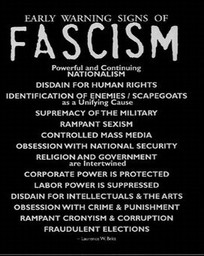
Now we were reluctant to write the F-word (fascism) as it invokes visions of herems, the setting aside and burning of victims in holocaustic offerings to primitive tribal gods of war – ancient Semites were wont to thus offer conquered enemies to their gods. We are also mindful of the brutality of the Roman Imperialists, the British Imperialists, the German Imperialists, and the American Imperialists – of course the Anglo-Saxon-American imperialists are, at least as far as they are concerned, far more civilized than their predecessors. Fascists differ from communists inasmuch as fascists do not entirely renounce the private ownership of property and the profit-principle, at least not for big, politically useful corporations protected by enormous police and military forces. Material communists, in turn, do renounce private property and believe that the means of production should be owned and managed by the people, meaning the state, as controlled by the only party. Communists profess high moral principles to that end, but that end only differs from the aim of capitalism as to the fair distribution of product.
Johann Gottliebe Fichte was not an atheist
Plainly, the duty of a fascist or communist is a hypothetical imperative: that duty clamors for a certain material result, a certain distribution of goods: IF this, THEN that. But Immanuel Kant’s and his student Johann Gottliebe Fichte’s categorical imperative emphasized the means as the end in itself, in right conduct, that ought to be done regardless of the material results. Likewise, the person is an end in itself, although also a proper means to good social ends. That imperative was created by god and given to all as conscience. In that respect we can hardly call either one of them atheists, although Catholic scholars might not be formally fond of them. As for reason, we think it has a place in private Sunday schools, but since good reasons may be given for doing anything, and since scripture may be cited to justify even the worst commissions of evil, we are wary of both reason and faith, unless they are placed in love. Not only did Professor Fichte define god as the universal moral order and eternal law of right, he declared that the very purpose of life is to know and love God. And that is a matter of faith. In fact, Fichte was moved to change his original opinion, and say that religious faith surpasses moral reasoning. And here we go again.
We can only wish that all people loved each other as much as some of them say they love God. Too much religious love has been hate-based love: group-love based on hating others. College students conducting a recent study of hate-mongering cults were surprised by the loving friendliness the hate-cult members showed towards each other and towards new recruits. But they loved not the god of neighborly love they raved about, and they condemned all to hell who do not agree with them. Surely this is not the worship of the god of love so many man-hating magpies chatter about in their assemblies, but is rather the worship of hate itself. Perhaps a more thorough study of Fichte’s works might give us a few good reasons for falling in love with humankind on the whole. Therefore we shall return to Reason’s Sunday school.
XYX
|