The Messalians or Massalians first appeared in Mesopotamia about 360 A.D. "Messalians" is derived from a Syrian word meaning "those who pray." Our primary sources of information on the Messalian beliefs are authors who denounced them as heretics; for instance, Theodoret, Timothy Constantinople, and John of Damascus. And Maximus the Abbot said the Messalians practiced abominable infamies and still existed in the 7th Century. Photius witnessed its resuscitation and usual corruptions during his days in Cappadocia. Photius said John of Antioch wrote against them. Harmenopulus remarked that a certain Eleutherius of Paphlagonia had added new crimes to the heresy, and that in part it became the source of the sect of the Bogomiles, well known during the decadence of the Greek empire.
The first Messalian writers were identified by Christian authorities as Dadoes, Sabas, Adelphus, Hermes, and Simeon among others. Adelphus was neither monk nor clerk, but a layman. Sabas had taken the habit of an anchorite and was surnamed "the Eunuch" because he had castrated himself. Adelphus, from Mesopotamia, as their leader, so they are sometimes called "Adelphians." And they were called "Eustathians." "Euchites" is the Greek equivalent of "Messalians" in Hebrew. They were also named "Enthusiasts" or "Corentes" because of the agitation the devils caused them, an agitation they themselves attributed to the workings of the Holy Spirit.
We cannot be certain that the Messalians were a distinct group. The term "Messalians" was generally applied to religious people who loathed manual labor and sacrificial ordinance as unspiritual works: manual labor and charity were anathema to Messalians for they believed they were the authentic "poor in spirit", the true "spiritual" beings. After supposedly three years of preparatory asceticism, they were never seen fasting. They reputedly placed emphasis on the experiential, emotional aspects of religion, and believed prayer would render the soul divine and immortal. They reportedly wandered from place to place, their men and women sleeping together in the streets. It was said that they slept most of the day, believing their sleep to be a form of prayer. They slept to dream, dreamt to prophecy, and, having been deceived by dreams, prophesied to deceive: "They see things to come." They actually saw the invisible Trinity as One. The Cross of Light was also visible to them. But they had a reputation for fortune-telling frauds.
Epiphanius said the Messalians appeared in the time of Constance, although Theodoret did not place their appearance until the time of Valentinian. We find ancient references to their existence, in Mesopotamia, around 360: they apparently hailed from Mesopotamia, and spread as far west as Antioch by the year 376. They were reportedly present throughout Asia Minor during the 420s and 430s. Epiphanius distinguished two kinds of Messalians: the more ancient were heathen; those who came later claimed Christianity as their faith, albeit in name only, for he said the so-called Christian Messalians had no fixed faith. Harmenopulus said the Messalians held the Cross in horror, that they refused to honor the Holy Virgin, or St. John the Baptist, or any of the Saints unless they were Martyrs; that they mutilated themselves at will, that they dissolved marriages, that they foreswore and perjured themselves without scruple, that women were appointed as mistresses of the sect to instruct and govern men, and even served as priests.
According to the most pious orthodox authorities, Messalians merely pretended to renounce the world and give up their possessions. Disguised as Christian monks, they allegedly taught Manichaean and other, even more detestable impieties. They believed the best road to salvation was prayer. Constant praying also had the benefit of keeping them from talking wildly, which they are otherwise wont to do. Messalian doctrine specified that zealous prayer rooted out the indwelling demons who urge humans to do evil deeds. Said demons are inborn into every person descended from Adam. Even Jesus and the Apostles were born with demons within: Their doctrine allegedly stated “that the divinity changed itself in different manners to unite itself to their souls. They held that the body of Christ was infinite like his divine nature; they did not hesitate to say that his body was at first full of devils which were driven out when the Word took it upon him. They claimed that they possessed clear knowledge of the state of souls after death, read the hearts and desires of man, the secrets of the future and saw the Holy Trinity with their bodily eyes. They affirmed that man could not only attain perfection but equal the deity in virtue and knowledge.”
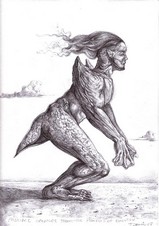
Baptism might wash away superficial sin, but it could not rid the soul of the demons within; therefore baptism was practiced in vain; the demons must be cast out by praying. Jumping over demons or shooting them with pointed fingers is a handy way to destroy them once they were cast out. Since demons were known to reside in snot and spittle, Messalians would fain jump over snot and spittle after blowing their noses or spitting. Moreover, cast-out demons might appear in fire, in smoke, and in serpents, providing many good occasions for jumping and finger-shooting.
When the demon within was finally expelled, the Holy Spirit descended and gave signs of His presence, delivering the body from undue passion, and the soul from the inclination to evil, so that afterwards there was no need of fasting nor of controlling lust by the precepts of the Gospel. In other words, Messalians employed prayer to achieve apatheia (apathy), making room for the reception of and marriage to the heavenly Bridegroom. Once a Messalian had achieved apatheia, his or her body was freed from passion and released from bondage; wherefore the saved Messalian needed no further restraint or teaching: any wantonness or licentiousness thereafter was no longer sinful because it was done apathetically, that is, without passion.
Messalians might go along with the Christian sacraments from time to time as an hypocritical expression of Christian faith. They make such outward displays in all good conscience because they believed the conduct itself was harmless. Nonetheless, John of Damascus wrote, "Among them they have contempt for the churches and their altars, as it were fitting for ecclesiastical ascetics not to attend synaxes, and yet to hold prayers in their oratories: for they say that such is the power of their praying that the Holy Ghost appears perceptually to them and those instructed by them... Those who come to them without any fruit of repentance from various sins, without authority of priests, without the stages which are prescribed in the ecclesiastical canons, they promise to take away every sin immediately, only if someone undertakes the prayer which is much spoken among them, and thoughtlessly becomes an initiate of their trickery."
The Council of Ephesus condemned Messalians in 431. We find this “Definition of The Holy and Ecumenical Synod of Ephesus Against the Impious Messalians who are also called Euchetae and Enthusiasts” in Labbe and Cossart’s Concilia, Tome III:
“When the most pious and religious bishops, Valerian and Amphilochius had come to us, they proposed that we should consider in common the case of the Messalians, that is the Euchetes or Enthusiasts, who were flourishing in Pamphylia, or by what other name this most contaminating heresy is called. And when we were considering the question, the most pious and religious bishop Valerian, presented to us a synodical schedule which had been drawn up concerning them in the great city of Constantinople, under Sisinnius of blessed memory: What we read therein was ap-proved by all, as well composed and as a due presentation of the case. And it seemed good to us all, and to the most pious bishops Valerian and Amphilochius and to all the most pious bishops of the provinces of Pamphylia and Lycaonia, that all things contained in that Synodical chart should be confirmed and in no way rescinded; also that the action taken at Alexandria might also be made firm, so that all, those who throughout the whole province are of the Messalian or Enthusiastic heresy, or suspected of being tainted with that heresy, whether clerics or laymen, may come together; and if they shall anathematize in writing, according to the decrees pronounced in the aforesaid synod [their errors], if they are clergymen they may remain such; and if laymen they may be admitted to communion. But if they refuse to anathematize, if they were presbyters or deacons or in any other ecclesiastical grade, let them be cast out of the clergy and from their grade, and also from communion; if they be lay-men let them be anathematized.
“Furthermore those convicted of this heresy are no more to be permitted to have the rule of our monasteries, lest tares be sown and increase. And we give command that the most pious bishops Valerian and Amphilochius, and the rest of the most reverend bishops of the whole province shall pay attention that this decree be carried into effect. In addition to this it seemed good that the filthy book of this heresy, which is called the "Asceticon," should be anathematized, as composed by heretics, a copy of which the most religious and pious Valerian brought with him. Likewise anything savouring of their impiety which may be found among the people, let it be anathema.
“Moreover when they come together, let there be commended by them in writing such things as are useful and necessary for concord, and communion, and arrangement (dispositionem vel dispensationem). But should any question arise in connexion with the present business, and if it should prove to be difficult and ambiguous, what is not approved by the most pious bishops Valerian and Amphilochius, and the other bishops throughout the province, they ought to discuss all things by reference to what is written. And if the most pious bishops of the Lycians or of the Lycaonians shall have been passed over; nevertheless let not a Metropolitan be left out of whatever province he may be. And let these things be inserted in the Acts so that if any have need of them they would find how also to expound these things more diligently to others.”
Many persons called Messalians were persecuted by bigoted Christians and even put to death by Christian magistrates. Letoius, Bishop of Militene, for example, burned monasteries where "Messalian" quietism was found, "driving the wolves from the sheepfold." Writings about Messalians circulated widely thereafter, playing a key role in the Byzantine monastic revival of the 8th and 9th centuries, and in the Hesychast movement of the 14th century.
¥
References:
The Catholic Encyclopedia, 1911
Columba Stewart, Working the Earth of the Heart, The Messalian Controversy in History, Texts, and Language to AD 431, Oxford: Clarendon: 1991
Tillemont’s Memoires, Tom. VIII., Seconde Partie, Condensed.
Harmenopulus’ Basilicoe Tome. I. Lib. ix.
Theodoret, H. E., Lib. iv., cap. xi.
John of Damascus, De Haeresibus











Best regards,
Leland