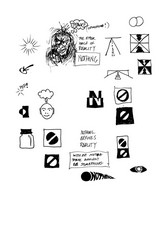
I paused this morning from working on Vol. VII of My Suicide Note - an Elaboration of My Favorite Theme: Nothing-Something-Nothing to brew a pot of coffee. I soon found myself meditating on Arnold Toynbee's Study of History, which comes in ten volumes, plus Reconsiderations.
Toynbee’s Study is a labyrinthine maze of incongruous tapestries. However, his theme is quite simple. Indeed, the most cutting criticism is that he knew where he was going and how he would get there before he started his long and arduous trek, then he stuck with it over the years as if he had learned nothing new along the way.
First of all, we have the Beginning, or the Source, and we continue on from there to the End, or the Goal. And during the course of his universal history, Toynbee did learn a major lesson: he encountered a Crisis in the Middle, whereupon he turned from Civilization to Religion as the proper unit of historical study.
Now the Source and Goal is God, and the middle is History. According to Toynbee's Study, "History is a vision of God's creation on the move, from God its source towards God its goal." Therefore I begin this meditation with the end in mind, In the Name of the Past, the Present, and the Future, as One.
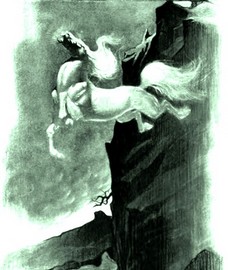
As Toynbee flies over History in his Platonic Chariot of the Gods, he resorts to his own Platonic myth, that of the Ledge: Humankind is climbing God's mountain from ledge to ledge; the ledges above and below are invisible except from the advantageous vantage of the universal historian who serves therefore as our guide and prophet.
"In earlier volumes of this book, I have compared the situation of mankind in the present age to a climber's pitch. Below us lies the ledge that our pre- human ancestors reached in the act of becoming human. In the Age of the Civilizations mankind has been making a number of attempts to scale the cliff-face that towers up from the ledge reached by Primitive Man. The next ledge above, unlike the ledge below, is invisible to climbers who are striving to reach it. All that they know is that they feel compelled to risk their necks in the hope of gaining the next ledge and in the faith that the endeavor is worthwhile."
We proceed to the Goal for its own sake, yet we have a utilitarian motive, the fear of death: the "wages of sin is death." And the original sin, if it is not simply being born into individual existence hence divorced from the One, is the sin of pride in self called hubris by the Greeks, or the self-love described by the holy fathers as the ultimate adultery, i.e. cheating on God.
Thus the law of human nature, the original sin evident in self-consciousness and the necessarily rebellious reasoning mind, is contrary to the genuine self-discipline that would return to unity in the One. The power of the human mind, which is a defense mechanism disobedient in its craving for existence contrary to divine will, is antithetical to the power of the spiritual soul. The human being’s power over physical nature is distinct from the soul's spiritual power over itself. Since the emergence of self-will and -consciousness, our progress (some would call it regress) towards merger (unity) with the In-Dwelling God that (not who) is our ultimate Goal has been minimal:
Toynbee states that there is no historical evidence of an increase in the spiritual power of our species. As far as we know, human beings are no better off spiritually today than ever, and saints are no more frequent in the present-day world than they were, say, in the Lower Paleolithic Age. Nonetheless, the progress of collective human power over the minds and bodies of individuals and over non-human nature is obvious. Now that our collective brute power is capable of extinguishing not only human life but life altogether from the face of the Earth, works of righteousness are urgently required not only for their own sake as duties but for survival of life as we know it.
Toynbee’s position is ambiguous: His "higher" religion invokes direct individual revelation; it is mystical or intuitive. Yet, the individual, in his or her quest for freedom from the human authority that is increasingly based upon reasoning, rebels against the rational collective and its representative men. That very rebellion is based on the previously denounced sin of individual pride or self-love; the Devil hates socially conditioned humans. Toynbee, who deplores the concept of God, yet utilizes it to his own ends, smoothes over the apparent contradiction, excusing himself as an "ex-Christian" and an "ex-believer." For the sake of argument, he may have been better off as a Protestant resorting to Luther’s apology, that any and all logical contradictions are merely “God’s mysteries.”
The mountain that the race climbs, God’s Mountain, is within – God is "In-Dwelling." No doubt that the deity may be viewed the apex of the mountain before taking the leap into faith, and metaphysical climbing is the true or highest religion, as the Arab philosophers held, for only at the peak is everything boiled down to One.
Toynbee was influenced by Jung; aspects such as the collective unconscious and the primordial archetypes are noticeable in his internal landscape. Forsooth, men and wo-men have gone from the worship of Nature to the worship of Man, and are finally getting in touch with the spiritual Reality "behind" all phenomena, by means of a "higher" religion. Humans emerged from sub-humans into self-consciousness and self-will, where they are tormented by intellectual and moral relativity.
Toynbee declares in 'The Next Ledge' of his Reconsiderations that: "(Human nature's goal is) to transcend the intellectual and moral limitations that its relativity imposes on it. Its intellectual goal is to see the Universe as it is in the sight of God, instead of seeing it with the distorted vision of one of God's self-centered creatures. Human nature's moral goal is to make the self's will coincide with God's will, instead of pursuing self-regarding purposes on its own."
Human freedom, then, is disobedience, or so the Fathers argued; the virtue of free will, then, is in realizing that it is contrary to the divine will but of course is still in accord with Providence; we shall know the Lord only too well, and hopefully his mercy, when we are crushed by his foot on our necks. After we stick our necks out, our task is to prepare our heads for the axe. At least this is my take on Toynbee’s mysterious God. No wonder that the faithful resort to the irrational Spirit in order to maintain faith when logic fails casuistry.
I am unable to make heads or tails of the Beginning and End of Progress, as everywhere the Tail is in the Mouth of the Snake; mind you, Toynbee says it is a Wheel rolling forward. Whether the Unknown God is "behind" or "ahead" of the Universe, I cannot say. Nor do I know whether we are ascending to a summit of omniscience or descending to a unconscious hypostasis of blissful ignorance: in the interim, I, for one, shall climb up the triangle of induction and climb down the triangle of deduction at once, with the double-triangle "Star of David" as my guide. I intuit that Toynbee was on the right track, the rolling track of poetic fiction, so continue with my meditation, In the Name of the Beginning, the Middle, and the End, as ONE.
No doubt Toynbee's materialistic affection for structural complexity can be perplexing. And his fact-laden, empirical method can be rather boring not only because of his prolixity but because of his abstract elevation from the scene. Nevertheless, the layout of his metaphysical airplane is assuredly familiar. As we have seen, the passenger who has conducted preliminary investigations has comfort in knowing his flight plan despite the complexity of the dirty details passing by below. The flight from Reality to Reality might take each passenger over eighty years; therefore, rather than rush to his destination, he is advised to keep the world tour in mind as he takes little jaunts into chapters having subjects which might interest him from time to time. There is plenty in store for him at History's bar. To slake the passenger's thirst, Toynbee pours facts into a prefabricated glass through which the world is observed; and at times, according to the best pessimistic tradition, it is observed very darkly. In the final volume of the Study, under the heading 'The Quest For A Meaning Behind The Facts of History', he quotes Gibbon's famous phrase that History is "little more than the register of the crimes, follies, and misfortunes of Mankind," and he cites the "All is vanity" of Ecclesiastes. And here is something from Herman Melville's epic of the monumental struggle between the forces of good and evil, Moby Dick:
"The Sun hides not Virginia's Dismal Swamp, nor Rome's accursed Campagna, nor wide Sahara, nor all the millions of miles of deserts and of griefs beneath the Moon. The Sun hides not the Ocean, which is the dark side of this Earth, and which is two-thirds of this Earth. So, therefore, that mortal man who hath more of joy than sorrow in him, that mortal man cannot be true – not true , or undeveloped.... The Gods themselves are not forever glad."
Philosophy, who is still Queen of the sciences notwithstanding the scientific contempt for her divine graces, is poetry. Toynbee above all spins a philosophy of history. He views the facts of history poetically - his passion for poetry is obvious, although, when stated in his own words, it is prosaically posed and done so within a whale of a history with a moral lesson coursing the deep. In his reflective Reconsiderations, he confides his mystical experiences as an historian: he is miraculously transported to certain scenes entirely obscure and trivial to the layman, but of magnificent import to the mystic historian.
In any event, for those of us who would embark on the universal voyage, whether by land, sea or air, Toynbee reveals our destination and warns us of the dangers along the way; for example, in the leading paragraph to "The Quest..."
"The meaning behind the facts of History towards which the poetry in the facts is leading us is a revelation of God, and a hope of communion with Him; but in this quest for a Beatific Vision that is visible to a Communion of Saints we are ever in danger of being diverted from our search for God to a glorification of Man; and this sin of associating the creature with the Creator precipitates the man-worshipper into a continuing fall from idolatry through disillusionment to an eventual depreciation of Man which almost as excessive as the adulation to which it is the inevitable sequel here."
We are in familiar, monotheistic Space here, absolutely nothing, a fictitious enterprise which will surely alienate people who need to worship something in particular, perhaps something most like them, a divine or ideal man incarnate – the rub is in the carnal, in mortality. Indeed, Toynbee, the religious historian of our age, alienated many pious people, but perhaps not as many a Hegel did with his great spirit of history.
Toynbee, the subtle iconoclast, like the great encyclopedia pioneer Pierre Bayle, found fewer logical obstacles in Dualism than in monotheistic religion despite monotheism’s attempts to justify evil and therefore rid itself of logical absurdity by resort to casuistic theodicy; but Toynbee objected to Zoroastrianism's conclusion, that good is finally triumphant over its evil twin. The scholastic argument, setting thesis against antithesis until a reasonable synthesis emerged, was doomed from the outset: the one-god’s Dom was bound to condemn Reason no matter how logical. As Bayle fearlessly said of his reasoning, Reason is an acid that eventually eats through its own foundation; therefore, we ask: How can the dialectic cease short of dropping into Chaos or Nothing? Only by being set in dogmatic tombstone, the cornerstone sealing the Abyss. Dare not behold the face of the Unknown God lest thy perish at the sight. A sacred cloth was hung on the ramparts; it was believed that it rendered the vicinity invincible to attacks by infidels because Jesus had pressed it against his face to absorb the sweat, leaving a true image thereon; the faithful men and children were put to the sword, their women ravaged, murdered and enslaved, and the iconoclast said, “I told them so.”
A little digression on good and evil is overdue here, in lieu of an Talmudic excursus or lengthy Baylean footnote: Life requires a contest between two distinguished forces, portrayed by the imagination as good and evil entities, say, God and Devil. The dichotomy along the continuum is fictitious; it is neither here nor there, but is conducive to leading a creative life. There must be some mistake in the translations and interpretations of the old texts taken from the cowhides. Indeed, why would Zarathustra take back his greatest gift to humankind, the clear distinction between God and the slanderous Liar? Evil had been identified not as some shortage or vacancy of positive Good, but as a real entity in itself. Zurvanism, the Zoroastrian cult which made Time or Zurvan father of both Good and Evil, was a Greek corruption rightly put down in Persia as a most pernicious heresy. But the Devil had his way with the Parsis in India who, under the monotheistic pressure of the Mogul Muslims, allowed the Devil to be whisked away and confused with God again, hence now they consider themselves along with Christians as monotheists. But are they really monotheists? Is not Satan the only true monotheist, the Evil One who loves only God therefore hates Man? Therefore must not Satan be contested? We leave the caviling to the litigating theologians with this maxim in mind: He who ignores evil is good for nothing.
However that may be, Toynbee believed higher religion is the only means to achieve a peaceful universal order. By "higher" religion he meant a direct, individual relation to God. Toynbee himself was an agnostic who believed in an unrestricted spiritual Reality. He had no faith in idolized churches or nations or, for that matter, in idolized Man. Man is his own worst enemy. He tends to exalt himself over God because he was presumably exalted by God to lord it over the creation; and in the lordly process man begins to idolize Man as God incarnate; he eventually forgets God and thinks Man is self-created – which is another way of saying the same thing, that Man is the Creator. Either way, Man falls short of the Absolute Power he worships, then despises himself for what he is, even if he is a humanist who professes love for abstract humanity – a profession that is yet another sin of pride, albeit perhaps not as grave as the love for humanity crucified. Since agnostic Toynbee does not own an anthropomorphic god, it is hardly surprising he also disowns humanism; it seems hypocritical for those who worship God in human form to despise humanists altogether.
In any case, whether we study History with a short or a long attention span, we understandably seek a Cause for what has transpired in hopes that knowing the Cause will be useful if not entertaining. Even professors with inflated minds will confess in weighty tomes that brevity and simplicity are the essence of science if not of life. And what could be simpler than a single Cause for all effects? If "God" – which is actually a pagan term – does not exist, at least "God" is a favorite symbol for optimistic pessimists who unconsciously want to exist ad infinitum. Idealists want an ideal reason or Cause for complexity, an ideal meaning of life. Humane idealists want human ideals to be real, with human superiority given to the Ideal of ideals which allegedly informs and encompasses the material details, In the Name of the Cause, the Force, and the Effect, as ONE.
As we have seen, Toynbee has much more going for him than his voluble volumes of facts followed by his afterthoughts. He has the Cause of volume in mind; to wit: God. Toynbee's personal, unrestricted and seemingly impersonal spiritual Reality is, nevertheless, for many believers the Eternal Almighty-I, the Omniscient Unity of Consciousness, the Universal-I of "i think therefore i am"; the Capital-I who does not have to think the Universe in order to be Being, in order to be I AM WHO I AM, or, better yet, simply I-AM.
Be that as it may, can we justly blame the historian of a universal history for coming up with God, for coming up with avowed order instead of disavowed chaotic disorder, with God instead of the unruly Devil? Surely the individual relation to God demanded by Toynbee is something besides his relation to unrestricted Reality, which methinks would be total disorder or chaos; to wit, Nothing. Never mind; even the devout atheist can reflect phenomenologicallly, and construct his own psychology of memory; he discovers that he has perceptions or intuitions of things upon which he makes judgments concerning their respective relations, similarities and differences; he finds that he ranks things according to his preferences; and with his generalizations of particulars in mind and his memory at hand, he faces the future and conducts his experiments.
Again, can we justifiably castigate Toynbee for taking the process of generalization to its logical conclusion embedded in the premise, the absolute presupposition it proceeded with as its Leading Principle? After all, the leading principle of a line is its non-dimensional point, and the point is found throughout the line. Can we blame him for being a theologian instead of a historian because he comes up with an indefinite spiritual God instead of the decadent materialistic Devil who constantly leads us on to deceive us yet again and again, proving in his unmitigated hate for humankind that he the Devil is the only true monotheist in his refusal to love man let alone deify him, in his unadulterated love for God? The Devil divides us for war with slander; since Nothing is perfect, it seems the perfect religion would be the worship of Nothing, which is finally achieved in the utopian State of Absolute Rest – as the homely Utopians say, cognizant of the ambiguous etymology of Utopia: There is no place like a good place."
Speaking further of the monotheistic Devil, does not that Devil give us diabolical cause to wonder at the prophecies of Toynbee and holy men who ambiguously warn us about the human brand of love which is based on self-love, who admonish us to love indefinite God only, not the individual who is to be saved by direct revelation? Nor are we to love collective human society to be saved by contractual socialism. But is not all love self-love at its root? Even altruism is self-love. As Swedenborg said, "Love is your life." Do we fear death therefore instinctively love death to appease death and thereby save ourselves from destruction: do we call death "God"? Do we, like Faust, contract with the Devil that we may have some little happiness in the lives between deaths? Well, then, if death be God, we should not love God too much. Maybe we should take the one and only God with a grain of life.
As the destructive pessimist and the iconoclastic prophet employ their mallets rational or irrational to destroy every particular definition asserted as a universal, they prognosticate that the simple, unitary explanation, the conceptual image, is for Naught. In the final analysis, there is a perverse truth to their mutual assertion of Nothing under illusory, variegated veils, a Nothing which in negation has rebellious power over the All. For what is the difference between Being stripped of all we can say about it, and Nothing, about which only silence suffices? Hardly anything at all: except faith.
Faith is a great feeling. Life demands feeling. The faithful have a vague, incomprehensible feeling that God or Nothing really exists. True faith needs no herd-gathering, dogmatic defense. But since faith is usually mingled with fear for its loss, what often follows in the wake of faithful feelings are various, unsatisfactory ethical definitions, theistic and atheistic, all supported by a generalized feeling, an oceanic feeling sometimes called Love.
Some say God is love; others insist Love is god: there is a serious dispute between the two parties to that seemingly non-commutative difference, and for very good reason. In any event, there is nothing more pleasing than a feeling of security based on Love, in contradistinction to the fragile security of the political contract made in response to hate, to the war of all against all which might unexpectedly break out in a nuclear blast through a breach in uncertain etiquette at any moment. If humankind were only to love itself in a love of all for all, Law would be superfluous. Yet this may be an impossible dream given the very human nature Toynbee reminds us of: it is our nature to make differences, to be different, for the sake of definite identify. What? Are we to give up our humanity, are we to die in order to live free of ourselves?
Toynbee's arid abstractions bring him to favor universal Love as the felt Goal of humankind. For Toynbee, Love is "the only god that we know from human experience." Regardless of the consequences, we should devote ourselves to "that" (not who) without which there is no God. "I believe that the dweller in the innermost sanctum of a human being is identical with the spiritual presence behind and beyond the Universe, and I believe that this ultimate spiritual reality is love," quoth Toynbee.
If we boil off the theosophies, then the essential experience of many modern religions might be described as a pleasant, almost mindless, cosmic feeling. Psychologically, Toynbee's universal history of civilizations culminating in higher religion appears to be a recapitulation of his psychic genesis from the oceanic womb towards the painful realization of his inevitable demise as an individual whose original sin is individuality. He provides his justifications for the inevitable extinction of the human burden ("I think and will therefore I am") by subconsciously reasserting the original cosmic feeling of oneness with the womb and the postpartum vestiges of motherly love.
Our psychological musings would be inconsiderate without direct reference to Sigmund Freud: In Civilization and its Discontents, Freud reluctantly admits there is an "unusual" non-pathological state called "love" wherein there is no apparent demarcation between ego and id, nor between "I" and "you", when, "against all the evidence of the senses" we believe we are "one" and are prepared to act on it. But this personal love, which should not be "stigmatized", is peculiar and momentary, and obviously not to be universally realized. Freud, to the dismay of many professionally good people, made much of the "illusory nature of religion."
As for the discontentedness of civilization, Freud's sympathies are with Toynbee and the rest of our anxious lot. Yet Freud says he personally had no experience of the "sensation of eternity, a feeling as of something limitless, unbounded, as it were, 'oceanic' feeling", mentioned by a self-proclaimed friend of Freud's who agreed religion is an illusion as Freud had defined it. Yet the friend insisted everyone who feels this "energy", which is the subjective basis of religion, has a right to call himself religious. Freud did not deny that others felt what he did not feel, but as a scientist he was rather worried about the scientific or objective interpretations of same, that they be scientific rather than subjective delusions or common illusions. Interestingly enough, he says of the illusory ego:
"Normally, there is nothing of which we are more certain than the feeling of our self, of our own ego. This ego appears to us as something autonomous and unitary, marked off distinctly from everything else. That such an experience is deceptive, and on the contrary the ego is continued inwards, without any sharp delimitation, into an unconscious mental entity which we designate as the id and for which it serves as a kind of facade - this was a discovery first made by psycho-analytic research...." Emphasis added In the Name of the Superego, the Id, and the Ego, as ONE.
Jung sloughed off Father Freud and delved deep into that Unconscious Mental Entity with at least a thousand and one names. Toynbee followed suit – Jung was his favorite psychologist. Toynbee proclaims that the subconscious is "the organ through which Man lives his spiritual life," and it is our quest to obtain a "vision of God, the Dweller in the Innermost." In this quest he names as guides, Jesus, Francis and Buddha, whom he claims are not guides to ascetic rejection but guides to accepting Love.
My impression of Toynbee's religion is that he used religion to hang his hat on Love. After the French Revolution, certain philosophers of humanistic love recommended the Restoration not of the King but of God for the good of the people that the people were running amok against. Yet Toynbee is no outspoken Machiavellian, although he desires the same end as Niccolo: Peace. He sincerely loves God. His unrestricted Reality is God. God is freedom and freedom is his frequent cry. He wants freedom from national wars due to the worship of national idols. He wants freedom from the threat of a climactic, mutually assured destruction of all social boundaries, the sadomasochistic nuclear meltdown of our differences. To that end, he wants the frightening Cold War duality to end in the safe and secure monistic pluralism of a universal federal government with a basic constitutional structure similar to that worshiped in the Name of God in the United States.
Furthermore, Toynbee wants freedom from the psychological conditioning converting civilization into a high-technology insect society. "Conditioning is an attempt to destroy human nature itself," he avers, complaining about the "devilish devices" of psychologists. He fears we might in our supposed great leap forward find ourselves clinging to a sub-human ledge so desperately that we become paralyzed or arrested there. Fortunately, he says, the conditioning might not turn us into insects; for humans are more like stubborn mules than compliant sheep.
And Toynbee would be free of much more besides. In the end I think Toynbee would be free of everything, but only by virtue of a natural death after a vigorous life including a great deal of independent thinking, reading and writing. Until death, which we cannot directly experience while living or dead, civilized life is a sort of virtual suicide, of rebelling against oneself as it were, of freeing oneself from all obstructions to universally independent yoga with the In-Dwelling Love. Yet asceticism per se is not the goal, says Toynbee; I think he means to focus not on the personal noun Love, as if Love were a god set apart from the universe, and end in itself, but on the verbal means: on loving, a process called "Love."
May we therefore all dwell equally in the light of Love and be free from our wars over superficial differences. But, to confound us, the oracle utters the maxim: He who loves everybody equally loves nobody in particular. Therefore, if we be lovers of equal light, we might, for example, mark the poet Paul Valery's words to see what we might glean from them:
"The physicists tell us that if the eye could survive in an oven fired to the point of incandescence, it would see... nothing. There would be no unequal intensities of light left to mark off the points in space. That formidable contained energy would produce invisibility, indistinct equality. Now, equality of that kind is nothing else than a perfect state of disorder. And what is that disorder in the mind of Europe? The free coexistence, in all her cultivated minds, of the most dissimilar ideas, the most contradictory principles of life and learning. That is characteristic of the modern epoch." ('The Crisis of Mind').
Are we actually living in the Theatre of the Absurd instead of visiting it, that we can posit equality and inequality as equal? Valery's propositions are good food for thought, but cancel each other out when digested, adding up to the very chaos or Nothing he would deplore. Nevertheless, we go on bowling on different lanes, pausing to complain, when the score is unsuitable, that the lanes are unevenly oiled – maybe they are or maybe not, but Nothing is perfect.
Our friend rants at length for and against the same thing, not knowing he is harping on the same subject under different names. Is he mad? I mean insane? Perhaps not, for if he were consistent we would be very worried about him; that is, unless he were well aware of the ambiguities of his positions. And that is a problem today, not a mere issue, that few people are aware of the Ambiguity.
Now Valery complains that people who think differently are actually subject to a kind of equality that results in chaos. Those with a superior cast of mind, who have climbed up the slippery, bloody slopes to the apex of one pyramid or another, know equality is a very bad thing. But are we not to think independently for ourselves, and might not our thoughts be dissimilar and contrary? While pondering the Next Ledge, Toynbee declares, "Our free selves are ours to be used by us, not for self-centered purposes of our own, but in God's service." Who? Sometimes I think everyone wants to have it both ways, hence they then wind up with Nothing in the end.
Valery and Toynbee had a similar, universal perspective on History. They saw civilizations and their idealistic abstractions sinking into it its abyss. Valery said Babylon has become just a beautiful vague name. A poet or an enthusiastic historian might wax poetic about Babylon and other idols long gone. Today many of us think the disasters that sent the arks of civilization to the bottom are not really our affair – who needs History when we have Science? Those senile fools, from desert caves and mountain caves and other secluded studies, who dare posit the Cause of causes, are shouted down because every fast-talking city slicker has many mouths and only one deafened ear, and total disrespect for extended traditional rhetoric or much ado about Nothing in voluminous virtual suicide notes. Most of the holy men have moved into the city where they became salesmen. Farmers used to call the cosmopolitan hucksters "con-men" or "hypocrites" – no wonder so many took up acting careers – and now the experienced hypocrite has talked himself out of faith in his own product – Toynbee wanted freedom from advertising.
Freedom indeed! Like moths to the Flame, freedom fighters, wanting Freedom from everything except God or Nothing, fly into the Sun. Of course only fools worship fool's gold. In his 'Meaning Behind the Facts of History' (meaning God) Toynbee referred to Jalal Rumi's verses for Sun worshippers; we select one:
"The Sun, by command of God, is our cook: 'twere folly that we should say it is God. If thy Sun be eclipsed, what will thou do? How wilt thou expel that blackness from it? Wilt thou not bring thy headache (trouble and pain) to the court of God, saying, 'Take the blackness away, give back the radiance!' If they would kill thee at midnight, where is the Sun, that thou shouldst wail (in supplication) and be protection of it? Calamities, for the most part, happen in the night; and at that time the object of thy worship is absent." (Mathnavi, Transl. Reynold A Nicholson).
Who is afraid of the dark except those accustomed to light? We are still imprisoned by our senses, hence trapped by figures of speech. We are in a metaphorical cave, as it were, wanting illumination; we see some escape into the sunlight; since all life naturally worships the Sun, we fly to the Sun. But what does the blind man know of the "light" in contrast to the "dark" he lives in? Yet he has the feeling upon which space depends: he knows the vacancy between touch and touch. He cannot see the Sun, but he can feel it, relate the heat within to the source without; and he just might love the felt Sun much more than a confounded metaphysical index for Being or Nothing.
Sun-worship is as old as life itself: life IS Sun-worship. Akhenaton is known as the Sun-worshiper par excellence if not (according to Freud) the Pharaoh who rediscovered primitive monotheism and inspired his priest Moses with it. In fact, Akhenaton forbade the perennial worship of the Sun per se, in favor of "Heat-in-the-Sun" and Light-in-the-Sun. Today, he might reword his philosophy to state that the perceived forms of energy should be regarded as the manifestations of the Original Cause. Note well the felt importance of the effects without which the Cause is good for nothing or god of nothing. Incidentally, the discoveries and inventions of our modern solar physicists would certainly fascinate Akhenaton and provide him with even further verification of the wonders of Aton. Enthusiasts have credited him with the discovery of the "principle of equivalence" of heat, light, and other forms of energy, as well as the equation of matter and energy set forth in the modern theory of relativity.
Love is the "fire" between the poles. Zoroastrians are called fire-worshippers, yet Zoroastrians did not worship the fire itself but kept the fire lit because they believed fire to be the purest element; and why is that? Probably because real fire, which like the Sun provides heat and light, is at the origin of both material and spiritual civilization.
If, instead of the actual Sun, the sages would give me Nothing instead of the Brightest Being, I may quote Rumi against himself:
"He (the ill-fated man) has forsaken the world of sunshine and moonlight and has plunged his head into the pit, saying, 'If it is true , where is its radiance?' 'Lift up thy head from the Pit and look, O miserable wretch!'"
Thus ends this morning's meditation on Arnold Toynbee's universal history with a pot of coffee. I still feel a need to fully express a good reason to live, a meaning of life, a simple explanation for it all. I must get back to outlining the seventh volume of my own swan song: My Suicide Note- - an Elaboration of My Favorite Theme: Nothing-Something-Nothing. But right now I am so hungry that I could eat a horse, so I must go out and get something to eat.
David Arthur Walters
Honolulu
December 23, 2001
-XYX-