INTRODUCTION TO THE FIRST SOVEREIGN EMPEROR OF CHINA
by David Arthur Walters
The “First Sovereign Emperor” who unified China's feuding feudal states and reigned supreme for fifteen years was from the little state of Ch'in (Qin). His given name was Chao Cheng. His mother, Zhao Ji, an excellent dancer and extraordinarily beautiful courtesan, one of the best-educated women in society, was born into a wealthy family in the state of Chao. She became the concubine of Chao Cheng's father, Lu Pu Wei, a great merchant. He gave her away when she became pregnant with Cheng, to Prince Tzu-ch'-u of Ch'in, a lesser son of Chin’s royal family who had been sent to Chao as a hostage. Lu Pu Wei used his resources to attach himself to the court and establish Tzu-ch'-u as Crown Prince of Ch'in. He succeeded to the throne; when he died, Chao Cheng, then thirteen-years-old, took the throne. King Cheng honored Lu Pu Wei, appointing him Councilor of State and honoring him with the title, “Second Father,” although he was his natural father; his mother had concealed the fact from Prince Tzu-ch'-u.
At least that was the account circulated among merchants and courtesans, the lowest classes of the day. The scandalous tale continued, with allegations of sexual relations between the Councilor of State with the Queen Dowager—his former concubine—and a cover-up involving her and Lao Ai, a man with a huge sexual appendage.
King Chao Cheng took the imperial title ‘Shih Huang Ti’ when he became emperor of all China. His ministers had carefully considered historical precedent. They recommended that he call himself "Great Sovereign", the illustrious title of the legendary sovereign who succeeded the "Celestial Sovereign" and the "Terrestrial Sovereign," but that was unacceptable to King Cheng. Instead, he chose a name more befitting to his imperial aspirations: Shih Huang Ti, or "First Sovereign Emperor." ‘Ti’ signified “sacrifices,” or, the divine beings to whom sacrifices were made, one of whom was the highest ti (shang ti), i.e. “Highest God,” an entity astrologers associated with the Pole Star. The term’s political connotation was 'king' or 'emperor,' about whom the world naturally rotated. ‘Huang’ means "majestic," and ‘shih’ means "first." Shih Huang Ti provided that his royal line be continued with the titles "Second Sovereign Emperor", "Third Sovereign Emperor", and on down.
According to the Rectification of Names doctrine, a man must live up to his name. Cheng no doubt believed he had devised the grandest of all titles for the 'Son of Heaven', creator of universal order or Peace, a task necessarily taken up in the Warring States Period by means of incessant warfare.
The word 'China' is derived from 'Ch'in'. Ch'in was already the most powerful state when Chao Cheng became King Cheng; hence his personal role in the unification is discounted by some historians. The small state occupied the Wei river valley, strategically situated on the mountainous, extreme northwestern periphery of the country. It was difficult for invaders to gain access to the valley except through well-guarded mountain passes.
The Grand Historian of China, Ssu-ma Ch'ien (BCE 145-90), explained in the Shih chi, or “Records of the Historian” would not give the entire credit for the mightiness of little Ch’in to its terrain: “Ch'in was originally only a small state in a distant and out-of-the-way place, rejected by the feudal lords of the Middle Kingdom and regarded the same as the barbarians. But after the time of Duke Hsien it was always one of the leaders of the feudal lords. The best Ch'in had in the way of virtue and honor could not compare even with the worst in violence and cruelty of Lu or Wei; in arms it could not weigh up to the strength of the three states of Chin. And yet in the end it conquered the world! This was not necessarily because of the advantages of steep and secure terrain or the result of fortunate circumstances. Rather it was as though Heaven had aided it.”
Ch'in was the least Sinicized state and the most martial one, with a reputation for superiority in agriculture and war. People in the central states thought the inhabitants of Ch'in were barbaric and the state "a ferocious beast." Moreover, Ch’in was "the state of tigers and wolves." It was in fact surrounded by barbarians; its struggles with them and against the various warring-states’ alliances helped made it the great power it was, the power upon which the central areas became increasingly dependent. By the 3rd century B.C., the tough little state had proceeded with a militant centralization program said to give the lie to Mencius' famous statement, that "those who do not delight in killing will unify the country."
Given those precedents, historians are wont to remark that the unification of China under Chao Cheng would have been highly probable under any king of Ch'in: the Grand Man simply appeared at the right time and place as the inevitable result of the historical forces in play.
Yet we must not underestimate Cheng's role in the unification of China and the foundation of a two-thousand year empire. And we should keep in mind that his biography was mainly written by his bitterest enemies, the Literati he literally tried to put out of business. Their propaganda was in part responsible for the popular perspective, that Cheng was an evil man as well as a passive, do-nothing Taoist. Marcel Granet amongst other sinologists disagreed with the negative assessment: "In order to blacken the man with quite easy consciences, the historians concealed the greatness of his achievements." (Chinese Civilization).
We do know that Cheng was deeply influenced by Taoism, and that he and his right-hand man, Li Ssu, a staunch Legalist, went along with the Tao as they saw fit, and by virtue of force of arms, bribery, espionage and Legalist ideology, the Ch'in empire was founded in 221 B.C. Taoism, with its individualistic doctrine arising from a belief in man's innate goodness, and Legalism, with its reward and punishment doctrine arising from the belief in man's innate evil, seem far apart on the continuum except where they conjoin in recognizing the importance of doing nothing, just being. Yet the extremists disagree as to who should do nothing. The Legalist compromise, that the emperor should have to do nothing himself under the rule of law except to have the right officers appointed and rewarded and the wrong ones removed and punished, and that his subordinates, to the contrary, should do everything else, is apropos of the hypothetical philosophical relation between the First Sovereign Emperor and Prime Minister Li Ssu.
Yet the emperor, who had been king for twenty-five years and who would rule China as emperor for eleven years, was in fact an active man: He busied himself with one hundred and twenty pounds of bamboo reports every day; he preferred to make his own decisions after consulting with his seventy "scholars of wide learning"; he provided for the standardization of writing, transportation, weights and measures; he took five awesome tours of his empire over a period of ten years; he often disguised himself and conducted personal inspections of his empire. As a matter of fact, exhaustion from overwork may have contributed to his death.
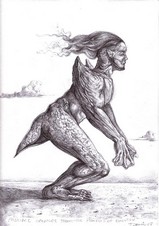
Shih Huang Ti was a Dragon-man. The dragon is a totemic conglomeration of features, the epitome or highest example of the integration of apparently disparate spiritual forces and material elements. Western political philosophers have called the state, 'Leviathan.' In any event, China's "First Sovereign Emperor" would have agreed with Louis XIV's dictum: "I am the state."
When Shih Huang Ti, the Dragon Man or True Man, ascended to Heaven the final time on his tripod, he left a grandiose, twenty-square mile mausoleum complex behind, representing the best of his empire including pavilions, offices, fine furnishings, the ocean, the sky above, and the earth below, replete with an army of eight thousand full-sized replicas of soldiers and horses to guard it.
Excavations of the True Man's mausoleum proceeded in 1974. Visitors are astonished by the breathtaking "spectacle." The Tiger of Ch'in certainly has put on a magnificent show for us whether or not he intended to do so. Hu-hai, his favorite and youngest son, buried him, and had the doors of the tomb sealed upon the Emperor's wives and concubines inside, leaving them to starve to death. The workmen were finally killed by an "infernal machine." The grave was covered up and disguised as an ordinary hill. Hu-hai would participate in the conspiracy led by the prototypically evil eunuch, Chao Kao, to establish Hu-hai as successor instead of his eldest brother Fu Su.
Fu Su had been working on the Great Wall, to which he had been sent as punishment for criticizing his father's policies. While working there he received a sword along with a forged letter, said to be from his father, commanding him to commit suicide: he dutifully obeyed. But the original letter had simply instructed him to attend to his father's burial; meaning he was the legitimate successor. Hu-hai's involvement is made apparent by the selection of those buried alive in his father's grand tomb: the discrimination was intended to protect him from suspicion. Ironically, the tomb was broken open later and robbed of iron weapons by the rebels who overthrew Hu-hai.
We wonder if the First Sovereign Emperor believed that the structure of the hidden mausoleum would help maintain the proper relation between Heaven and Earth after his departure to Heaven, or whether he really believed that he could, at least figuratively speaking, take the best of his empire with him. His desperate search for the Elixir of Immortality in his later years seems to belie faith in an after life.
The enormous grave dug out of the side of the mountain was not all the emperor left behind; the monumental tomb was dwarfed in size by the legendary palatial complex he had extended over a distance of one-hundred miles. It comprised two hundred and seventy royal residences, filled with gorgeous furnishings and people, including a harem of 13,160 beautiful women. It would have taken the mobile Emperor thirty-six years to "feel at home" in all the palaces—many of them were replicas of the palaces of the states he had conquered.
Legend holds that the First Sovereign Emperor roamed about his far-reaching palatial estate in secrecy, in due accord with the regular cosmic order, never sleeping in one place two nights in a row, not only to avoid the mounting number of would-be assassins, but to occlude himself according to occult Taoist doctrine. Curiously, despite the astronomical regularity of the True Man's movements as he "followed the Sun," few knew his whereabouts at any given time. As a matter of course, anyone who revealed the Son of Heaven’s location was duly executed.
-T-