I was chagrined when I read the article, ‘Colorful Personalities,’ in the April 7, 2005, edition of Village Voice’s Miami New Times, about the personality clashes at Art Center/South Florida, an art colony located on South Beach's famed Lincoln Road Mall. The focus was on the personality clashes and bickering at the art center. Little was said about the art itself, other than that it was of poor quality due to the authoritarian regime of the institution’s current chairman. Needless to say, The New Times is an anti-authoritarian, counter-cultural publication.
What the reporter failed to expose was that newly wealthy people with mediocre taste are celebrating trash in order to appear popular and commonplace themselves, which only serves to increase the popularity of postmodern junk. Collectors who count on their riches alone have never been famous for their aesthetic judgment. Art collections are too highly regarded for the wealth of their owners, for the money they conspicuously waste, and not for any beauty evident in the works themselves. What the art world needs is a new set of Medicis. The renaissance of the Spirit of Art will not occur absent their patronage.
I have visited Art Center/South Florida many times. I do like some of the art, but the most of it is worthless to me inasmuch as I would not have a bit of it in my hovel. I do not care for the bizarre coloring of the works of one of the most successful resident artists who specializes in faces, yet I believe he deserves his success. At least he can draw a face. I recommended that he find and paint the perfect Ass for a change. Curiously, the female derriere men admire today resembles the male warrior’s firm buttocks in old paintings.
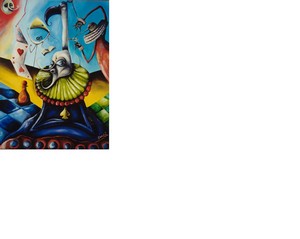
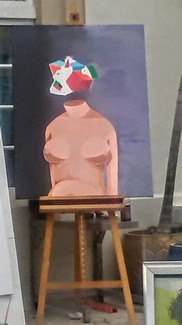
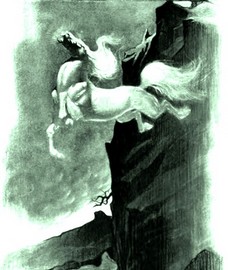
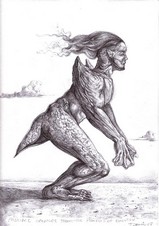
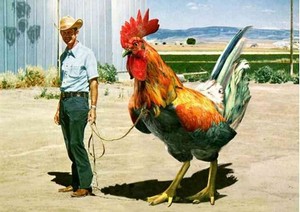
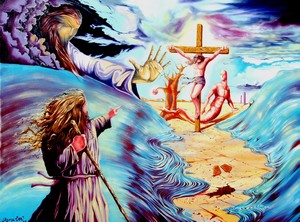
Darwin Leon, my favorite artist at Art Center/South Florida, is not a resident there because he can draw very well, and his liking for Classical and Renaissance principles are evident even in his most surrealistic work. He teaches drawing to the few outside students who care for the subject, and works at the front desk.
Although Darwin is the center’s Cinderella, he is devoted to the institution. He worried that the bickering reported by The New Times would damage its reputation. I had to disagree with him on that point. The bickering amongst the artistic personalities would do no more harm to the center than their anti-art does, and that can be seen displayed in the windows at the mall. Of course the authoritarian governance reported on by The New Times would discredit any institution if based on bad taste.
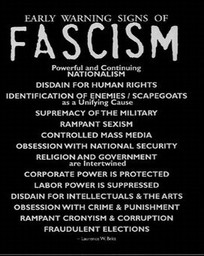
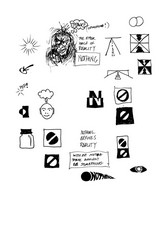
I noticed that Darwin was sketching something at the front desk when I first visited the center, in 2004, so I asked him for permission to look through his sketchbook. The cubo-surrealism sketches therein amazed me. I asked him why he did not have a studio at Art Center/South Florida. He said his application had been rejected. I asked him for his manifesto. He declared himself to be anti-anti-art. I figured that the product of the two negatives is positive art. On my next visit to the center, I mentioned Darwin’s name when I was asked which artists I like best. I said I thought Darwin’s art was excellent. My opinion was pooh-poohed. “Darwin is just a college student,” I was told. “He’s a fascist, into classical art, you know.”
People put each other in categorical boxes and then do their best to keep them there until they are crushed by their illusions. Everyone feels they are secure in their respective boxes. Even the “innovative” artists are working in boxes today. No wonder people inside the boxes are raving about the best seller, Thinking Outside of the Box, by John and Jane Doe, doctors of modern philosophy. Ironically, innovators and creators outside of the boxes want to get into the boxes so they can make a living too. Good grief! Whatever happened to Cubism’s hypercube, inspired by Ouspensky’s mystic Fourth Dimension beyond time and space?
My own access to Miami’s boxes has been so panoramically denied that I have become resigned to what must be my fate, the effect of a form of social and economic homicide. As I beheld the downtown Miami skyline from the bus after viewing Darwin Leon’s work the previous day, Miami appeared to me ala Cubism. The towers of stacked boxes were leaning and twisting. The towers of Babel competed for a place in the Sun, a blazing cube. Each brick or office-box in the box-towers was slightly different than the other boxes. Each variance under the Sun constituted the name and competing argument of its occupant. The arguments were variations on the same theme - a river of hundred-dollar bills sparkling with some sort of white powder. I envisioned said boxes, on the whole and individually, from various perspectives at once as the scene fragmented before my eyes. Somehow the bus I rode and the causeway as well wended through the towers. One tower was an ocean liner standing absurdly on its stern.
Of course words cannot adequately describe the images I beheld from multiple perspectives outside of the box. Wherefore I sought out Darwin Leon the next day and told him about the vision of Miami his work had inspired in me. I said I wished I had the money to commission him to do such a work, dubbed, ‘Miami’s Towers of Babel.’ I secretly hoped he would take the suggestion to heart and pick up his brush gratis.
If he composed such a work, who would buy it given today’s arty Miami scene? Darwin Leon has been virtually rejected and ignored by the powers who preside over Miami's artéworldé, because, said one power, he, like Picasso, is not "consistent", nor he is "modern" enough, meaning he does not suit their definition of the "market needs" of their artémarket. Poor Darwin Leon does not have access to a box, a wall or stall in the artsy artégallerie or artéshow, where his work would stand out and sell out if reasonably priced and fairly criticized.
Darwin Leon is not alone although he is given reason to believe that he is. There are many Darwins out there, many Refusés whose fine art is ignored as if it were refuse while small fortunes are made on refuse. Instead of being treasured for what they are, they are treated like worms. Some do manage to worm their way into the most precious woodworks and live in luxurious boxes, but not many so succeed.
Art is almost dead because the soul is dying: hysterics of old had paralyzed limbs; postmodern hysterics have paralyzed souls. Alas, Art’s demise would be the death of humankind. A resurrection of the Spirit of Art is overdue. If we would live creative lives, if we would live artfully, we must begin to savor fine art once again, savor it in the galleries and at the shows and at home, and enjoy the art of cooking in dining rooms. And that is why I think media like The New Times should focus on the art and not on the artistic personalities who are bound to clash because of their creative dissatisfaction with what is, compared to what could be.