 A history of the Early American Congregationalism of Orestes Brownson's family
THE CONGREGATIONAL ROCK
BY
DAVID ARTHUR WALTERS
Orestes A. Brownson was not really the “wild man” he was called by clergy for running through the gamut of Protestant denominations into politics and winding up in the arms of the authority whose sublime succor he had unwittingly craved all along, the Mother Church, insisting that Protestantism was not even a religion but religion melted down to democratic politics. Only she is authorized by the Holy Father to pick up and hold every bawling babe in the name of the triunal nuclear family: the Father, the Son, and the Mother. Only in her embrace is liberty and justice for all secure. Or so he concluded.
Not that we intend to convert to Catholicism. Yet a sketch of a few of the conversions of our intellectual pilgrim may provide us with a better understanding of our spiritual progress as well as his, keeping in mind that conversion from one faith or denomination to another often has political implications when religion is the worship of absolute power and politics its relative distribution. Religion and politics overlap to a confounded extent in the United States, despite the formal separation of church and state.
Brownson had what fathers might call a problem with authority, a problem children have had from time immemorial, as can be seen from the ancient commandment to obey one’s parents or else be stoned to death at the village gate—Jewish casuists say the injunction was meant to scare kids into obedience, the punishment never being carried out. Orestes was born the son of Vermont farmers in 1803. His father died when he was six-years old. His mother gave him up for adoption to another Vermont family some time after whipping an unforgettable lesson into him about authority. He reflected on it in ‘Conversations of An Old Man and His Young Friends’ (1860)
“All authority appears to us in youth very hateful. We see not its reason or necessity, and we fancy that it only creates the crime that it punishes. I thought my mother was exceedingly tyrannical, when she gave me, then a boy some four or five years old, a severe whipping for telling a lie. I have lived long enough to thank her for that whipping over and over again; for it impressed indelibly upon my memory this important lesson: If you speak at all, speak the truth. Indeed, all authority that restrains us, or hinders us from doing whatever we wish, seems to us tyrannical. Tyranny is always odious, and so we conclude that we ought to be freed from all restraint and at liberty to follow our inclinations. Since our inclinations, instincts, feelings, passions, resist whatever resists them, we conclude that they are intrinsically opposed to tyranny, and that whoever would restrain them is a tyrant, deserving of universal execration. God, indeed, gives us no faculties that it is unlawful to exercise-in a lawful manner, and he requires the physical destruction of no element of that nature which he has created. All the several elements of our nature may be exercised, but they are to be exercised in the order the Creator intended, in due subordination, the lower to the higher; or, in other words, order and harmony are to be maintained in the bosom of the individual, and between individual and individual, and you will need very little experience of practical life to learn that this is impossible without authority and self-denial. We see not this at first, but gradually it dawns on our minds, and bv and by becomes clear to us, and from hot-headed radicals, clamoring for liberty, seeking the elevation of mankind and social progress by removing all restraints, and giving loose reins to appetite and passion, we become sober conservatives, insisting upon submission to authority, obedience to law, as the first lesson to be taught, and the first to be learned.”
Brownson’s foster parents were Congregationalists. The Anglo-Saxon Congregational churches arose from Puritan attempts to reform or purify the Church of England of its popish forms of worship and certain purportedly pagan or heathen traditions. Puritans preferred Calvinist theology, with its alleged misinterpretation of Augustinian doctrine to the effect that humans are totally depraved hence they cannot save themselves; they are only free to sin; only the elect will saved by God’s grace, their fate being determined before their sinful birth, their sin being that they are born individual, having fallen from the whole, are innocent in not knowing God when born, and are subjects of desire especially concupiscence. Hence may no one exalt themselves, thinking they are saved by their works. Lutherans, on the other hand, may insist that justification by faith simply allows for redemption to anyone who accepts Christ as their savior, and that the works of those who voluntarily accept Christ will naturally improve as a consequence. After all, Luther’s protest was not against doing good works but rather against the doctrine that salvation could be bought by contributing property to the Church and by doing severe penances.
Despite Calvin’s rational spin on predestination, the Puritans did not grow lazy, and considered their success in America as hard evidence that God had indeed had chosen them as his people therefore their work was inherently divine. In any event, Puritans were called sticklers for sticking to the sacred scriptures as the sole legitimate expression of the Word that they would live by. Puritans were sometimes called independents or separatists in England to distinguish them from the Presbyterian majority who wanted a national church instead of independent congregations. The independents, some of whom sailed over on the Mayflower, preferred to be called Congregationalists in America, and as such they established themselves at Plymouth and the Massachusetts Bay Colony, immigrated into New York, and spread out westwards. Today they are credited for their involvement in democratic reforms such as women’s suffrage and the abolition of slavery, despite their early theocratic tendency and reputation for intolerance. American schoolchildren used to hear much a great deal about the role of Puritans and too little about the contributions of Lutherans and Anglicans as founders of American democracy and its version of capitalism, as if credit for American democracy along with capitalism belongs to Protestantism alone, forgetting the contributions of other persuasions including but not limited to Roman Catholicism, Mormonism, and atheism. In truth, politics, which is concerned with the distribution of absolute power rather than with its worship, should get more credit for the liberal tendency of history than religion, which is loath to change its mind without a strong political or economic motive.
Congregationalism is a form of ecclesiastic polity that affords self-government or autonomy to religious congregations. The official polity of Congregationalist churches and their relationships with one another is ostensibly democratic, said to be based on the primitive Christian tradition whereby people assembled to reflect on the life and teachings of Jesus, and to worship God as they saw fit, electing leaders for the sake of convenience. We have this more definitive description provided by a contemporary of Brownson, George Punchard, in his View of Congregationalism, its Principles and Doctrines (1844):
“Congregationalism is that system of church government, in which the Scriptures arc recognized as the only infallible guide respecting church order and discipline; and which maintains, that, according to the Scriptures, a church is a company, or congregation, of professed Christians, who, having voluntarily covenanted and associated together to worship God and to celebrate religious ordinances, are authorized to elect necessary officers, to discipline offending members, and to act, authoritatively and conclusively, upon all appropriate business, independently of the control of any person or persons whatsoever.
“It should never be forgotten, that Congregationalism is a spiritual system of church government. It is designed for, and adapted to spiritual persons—those who have been taught, and are now led by the Spirit. Its strength depends and permanence depends on the spirituality of those who adopt it. It controls them by no other power than that which is moral; it inflicts no other pains and penalties.”
Modern American Congregational theology and doctrine is Calvinist Puritan, an Anglo-American-Saxon reformation of the English Reformation; that is, a strain of Christianity purified of certain Roman and Anglican traditions that arguably have no basis in scripture. Retained, however, were the theological Trinity, with its important implications for the personal nature of Jesus, and the doctrine of Original Sin, rejected by other sects that also claim to strictly adhere to scripture. How can three things be one thing? Still, despite the logical absurdity of a three-in-one god, what good is Jesus to Christians if he is not the one-god incarnate? Would a mere man, no matter how presumptuously divine, suffice for anything else but the epitome of mankind’s universal narcissism? We hear from the ancients that the god of elephants is an elephant, and a large and old female elephant at that. And why would God bring good men to ruin on this Earth if everyone had not sinned just by being born individual, which is to be born ignorant of the knowledge of God and into the sin of concupiscence proceeding from the snake in the garden and so on? Such absurdities are left to theodicy to work out synthetic hypotheses.
We emphasize the Puritan aspect of Congregational theology and doctrine lest we suppose that Congregationalism is nondenominational and merely denotes a form of polity common to several sects. If anything, the Calvinist polity is quasi-theocratic, despite denials that John Calvin absolutely dictated policy in Geneva, a so-called Sparta whose severe discipline was imitated thereafter by some over-zealous Puritans. We recall that the Trinity, for example, was especially sacrosanct, and that no one in Geneva might speak out against Calvin’s Institutes, deemed by the city council to be “holy doctrine,” lest they be subjected to torture, imprisonment, and execution. Needless to say, since hypocrisy is the underlying crisis of human nature, Calvin’s deeds sometimes belied his words. However that might be, what is the consequence of separating church from state and placing state over church if the state is purported Christian? And how would anyone know for sure if it was really Christian if scripture is the only reliable authority, its interpretation by fallible mortals no matter how learned being naturally subject to a great deal of error? Never mind: we need our premises, something stable to stand on. The Congregational rock will do, at least to begin with.
In 1865, nearly a dozen years prior to Brownson’s death, and shortly after President Lincoln was assassinated, an advisory council of Congregationalist churches published a declaration of faith, the Burial Hill Declaration that reaffirmed previous affirmations such as the 1648 Cambridge Declaration, and the 1680 Confession of Faith, both of which were verisimilar to the 1658 Savoy Declaration approved at Westminster in England.
The 1679 synod that led to the 1680 Confession observed that confessions are necessary to root out sin, and cited various sins, such as wearing unseemly clothing and adornments, a sin that the Lord punishes with sword, sickness, and loathsome diseases. After all, “Our Fathers neither sought for, nor thought of great things for themselves, but did seek first the Kingdome of God, and his righteousness, and all these things were added to them came not into the wilderness to see a man cloathed in soft raiment. But that we have in too many respects, been forgetting the Errand upon which the Lord sent us hither; all the world is witness.”
There existed a want of good order in the community, associated with a decay of godliness among professors of faith. The sin of pride was ever present, therefore God has loosed wolves upon the straying sheep, wars and fighting proceeded, and, again, the “Lust of Pride” was demonstrated in respect for apparel. Quakers and Anabaptists were about, receiving into their midst Satan’s scandalized brood. Swearing and drunkenness, the frequenting of public houses, were all too prevalent, and people were falling asleep during prayers. The Sabbath was oft broken. Many families were not praying to God constantly morning and evening. Promises-breaking was a common sin. Back-biting, gossip, and lying were prevalent. The problem with apparel was reasserted more explicitly: “And there are other heinous breaches of the seventh Commandment. Temptations thereunto are become too common, viz. such as immodest Apparel, Prov. 7. 10 Laying out of hair, Borders, naked Necks and Arms, or, which is more abominable, naked Breasts, and mixed Dancings, light behaviour and expressions, sinful Company-keeping with light and vain persons, unlawfull Gaming, an abundance of Idleness, which brought ruinating Judgement upon Sodom, and much more upon Jerusalem. Ezek. 16. 49. and doth sorely threaten New-England, unless effectual Remedyes be throughly and timously applyed.” (sic)
Various steps were recommended, such as closing down disreputable public entertainment houses, and licensing the rest. Most importantly, there must be renewed confession of faith.
The Savoy Declaration followed by the 1680 Confession asserted the sine qua non of Puritanism, the primacy of scripture: “The authority of the holy Scripture, for which it ought to be believed and obeyed, dependeth not upon the Testimony of any man or Church; but wholly upon God (who is Truth it self) the Author thereof; and therefore it is to be received, because it is the Word of God.” Of course, “We may be moved and induced by the Testimony of the Church, to an high and reverent esteem of the holy Scripture.” As for the Trinity, there is no need to reinvent the wheel, as it is inherited from the Roman Church: “In the Unity of the God-head there be three Persons, of one Substance, Power and Eternity, God the Father, God the Son, and God the holy Ghost: The Father is of none, neither begotten, nor proceeding; The Son is eternally begotten of the Father; The holy Ghost eternally proceeding from the Father and the Son. Which Doctrine of the Trinity is the foundation of all our Communion with God, and comfortable Dependence upon him.”
Nowadays the sins abhorred by Puritans in 1680 are the common custom; we have a right do as we please and a duty to let others do as they like providing that no one spoils the fun. We are not either/or dualists: there is only one superpower or supreme being, the creative-destructive world spirit that synthesizes good and evil hence is essentially beyond both. We too are gods, beyond good and evil. Good may be evil and vice versa; even lying has been extolled as a virtue ensuring the privacy of individual conscience hence is purportedly the psychological basis of every person’s independence.
The 1860 circumstances warranting a reiteration of faith were also different than in colonial days when the sight of a fulsome bosom might destroy an entire village: of course there had been considerable backsliding from the “ancient” Puritan morality by then. In 1860 the representatives of Congregational churches thought that a declaration of national unity would serve them well in converting the freed slaves to the path of righteousness in the South, where there were few Congregational churches since most Congregationalists had opposed slavery, and in spreading the Word westwards. There was some debate over whether Calvinism should be explicitly expressed, since any doctrinal declaration might be divisive. One Rev. George Allen’s protest was entered in the minutes, that, “Standing over the ashes of the Pilgrim Fathers, and on the summit of this Hill consecrated to their memory, I solemnly protest against the adoption of the paper here and now presented, as being too sectarian for their catholic spirit, and too narrow to comprehend the breadth of their principles of Religious Freedom.” The word ‘Calvinist’ did not appear as originally proposed, but Calvinism won out without it being said.
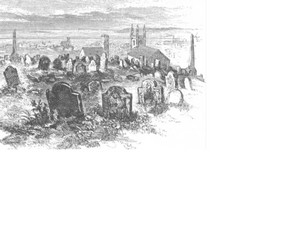
Rev. Alonzo H. Quint, who had written the introduction to the Declaration on his tall silk hat as his train approached Plymouth, read it to the delegates assembled on Burial Hill, where once had stood the fort of the Pilgrims which also served them as their church:
“'Standing by the rock where the Pilgrims set foot upon these shores, upon the spot where they
worshipped God, and among the graves of the early generations, we, Elders and Messengers of the Congregational Churches of the United States in National Council assembled, like them acknowledging no rule of faith but the Word of God, do now reiterate our adherence to the faith and order of the Apostolic and Primitive Churches as held by our fathers, and substantially as embodied in the confessions and platform which our Synods of 1648 and 1680 set forth or reaffirmed.”
The document further states: “We declare that the experience of the nearly two and a half centuries which have elapsed since the memorable day when our sires founded here a Christian
Commonwealth, with all the development of new forms of error since their times, has only deepened our confidence in the faith and polity of these fathers. We bless God for the inheritance of these doctrines. We invoke the help of the Divine Redeemer, that, through the presence of the promised Comforter, He will enable us to transmit them in purity to our children. In the times that are before us as a nation, times at once of duty and of danger, we rest all our hope in the gospel of the Son of God. It was the grand peculiarity of our Puritan Fathers, that they held this gospel, not merely as the ground of their personal salvation, but as declaring the worth of man by the incarnation and sacrifice of the Son of God; and therefore applied its principles to elevate society, to regulate education, to civilize humanity, to purify law, to reform the Church and the State, and to assert and defend liberty; in short, to mould and redeem, by its all-transforming energy, everything that belongs to man in his individual and social relations. It was the faith of our fathers that gave us this free land in which we dwell. It is by this faith only that we can transmit to our children a free and happy, because a Christian, commonwealth.”
The Calvinist Puritan confession follows: “…we extend to all believers the hand of Christian fellowship, upon the basis of those great fundamental truths in which all Christians should agree. With them we confess our faith in God, the Father, the Son, and the Holy Ghost, the only living and true God; in Jesus Christ, the incarnate Word, who is exalted to be our Redeemer and King; and in the Holy Comforter, who is present in the Church to regenerate and sanctify the soul. With the whole Church, we confess the common sinfulness and ruin of our race, and acknowledge that it is only through the work accomplished by the life and expiatory death of Christ that believers in him are justified before God, receive the remission of sins, and through the presence and grace of the Holy Comforter are delivered from the power of sin, and perfected in holiness. We believe also in the organized and visible Church, in the ministry of the Word, in the sacraments of Baptism and the Lord's Supper, in the resurrection of the body, and in the final judgment, the issues of which are eternal life and everlasting punishment. We receive these truths on the testimony of God, given through prophets and apostles, and in the life, the miracles, the death, the resurrection, of his Son, our Divine Redeemer, — a testimony preserved for the Church in the Scriptures of the Old and New Testaments, which were composed by holy men as they were moved by the Holy Ghost….”
Thus we may speak of the Congregationalist Rock or popular foundation for the development of Christianity, in distinction from the elitist or authoritarian Rock of Peter. Long before Christianity and even before Judaism evolved, humans took to swearing on rocks, perhaps drawing a cross or some other symbol on a large stone as a permanent reminder of a covenant to do or not to do something. Even before then, stones marked the graves of loved ones or other important persons, or certain gods, providing a certain place to commune with the spirits, and perhaps make a promise to be kept in this world. In a relatively civilized society, the stones marked off the boundaries or terms of real property. Now a community is an invisible rock. Congregationalists entered into a covenant to commune together in the sight of the Lord that he might reveal his blessed truth to them. Qualified officers were elected by members. Authority was found in revelations made directly to the local assemblies through examination and discussion of scripture. So it was the rejection of imperial authority that loosely bound the “orthodox” independent parochial religious societies or congregations together in what was referred to, especially when supported by governments as public utilities, as “the Standing Order” or “the New England Way.”
That being said, Brownson’s elderly foster parents seldom attended the meeting-house, which was in the middle of the town of Royalton, Vermont, four miles away from their farm. Royalton has a population of around 3,000 today, and is known as the birthplace of Mormonism’s Joseph Smith, although he was actually born outside of its limits, and for the revival of Austrian economics that took place at the now-defunct Royalton College. Murray Rothbard, the libertarian “dean’ of the Austrian School who gave substantial credit for the growth of capitalism to the influence of Catholics instead of the Protestants to whom Max Weber gave most of the credit, was from Royalton. He pointed out, for example, that “the most ‘dogmatic’ laissez-fairists in the 19th century were not the British, but the French (Catholic) economists. Bastiat, Molinari, etc. were much more rigorous than the ever-pragmatic English liberals. Further, laissez faire theory was developed in fine flower by the Catholic Physiocrats, who were directly influenced by natural law-natural rights thought.” Werner Sombart argued that the Jews founded capitalism.
Chief Justice Salmon Chase among other notables also hailed from Royalton.
Brownson apparently considered the Congregationalism of his foster parents as an ecclesiastical polity rather than a particular religious sect. “They had been brought up in New England Congregationalism, were honest, upright, strictly moral, and far more ready to suffer wrong than to do wrong, but had no particular religion, and seldom went to meeting,” Brownson disclosed in his autobiographical work, The Convert. “They taught me to be honest, to owe no one anything but good-will, to be frugal and industrious, to speak the truth, never to tell a lie under any circumstances, or to take what was not my own, even to the value of a pin; to keep the Sabbath, and never to let the sun go down on my wrath. In addition they taught me the Shorter Catechism, the Apostles' Creed, the Lord's Prayer, and a short evening prayer in rhyme…”
He was brought up as if he were already an old man, without the usual amusements children enjoy. His temper was violent at times, and had to struggle to make sure the Sun never set on his wrath. He preferred to be alone, to meditate, and pretend that he was in the presence of Mary and the angels. His adoptive family had a little library of books, mostly religious in nature, including, for example, Franklin’s Primer, Edwards’ History of Redemption, Davies’ Sermons, Watt’s Psalms and Divine Songs, a History of the Indian Wars, and a novel imitating Robinson Crusoe, and, of course, the Holy Bible. He had read through the scriptures by age eight. On a trip to town, at age nine, he was not much interested in watching the soldiers muster, and instead participated in a discussion with two old men about free-will and the election of saints. He decided that he wanted to be a minister when he grew up—he would leave home at fourteen, at which time he knew most of the scriptures by heart.
There were a few Universalists and Baptists in his town, but more numerous were those who called themselves Christians, pronounced “Christ-yans,” and the Methodists, who preached hellfire and damnation. He liked the Methodists best because they made the most noise. However, “The more I listened to them, the more I feared hell, and the less I loved God.”
The Christian Church was the result of a protest against the hierarchical polity of the Methodist Episcopal Church in American. Reverend James O’Kelly, a veteran patriot of the Revolution and one of the most famous travelling preachers of his day, withdrew with several sympathetic companions from a conference of Methodists in 1792 after their efforts to obtain a more democratic structure failed. Subsequent efforts to obtain a compromise were to no avail due to the dictatorial disposition of Bishop Francis Asbury. The secessionists formed the short-lived Republican Methodist Church in Piney Grove, Virginia. Growing disgusted with the contentions between nominal sects over creeds and their respective identification with mere names, they dissolved their “Republican” church in 1794 and adopted the simply name “Christian” for their nondenominational denomination. The Christian Church and Church of Christ to this day have no creed but Christ, no book but the Bible, no name but the name Christian. O’Kelly was rather dictatorial himself, a poor administrator, but a damn good preacher. No doubt a Christian as well a Methodist preacher could scare the hell out of a youngster like Orestes Brownson.
Terrified by the thought the devil would come and carry him off, Brownson sought the counsel of an elderly friend when he was twelve-years-old, an intelligent and refined Congregationalist who strictly adhered to the Standing Order. She personally knew the founders of Methodism, George Whitefield and John Wesley. Do not go with the New Lights, she told him, for they are not to be trusted.
“When you join any body calling itself a Christian body,” she advised, “find out and join one that began with Christ and his apostles, and has continued to subsist the same without change of doctrine or worship down to our own times. You will find the true religion with that body, and nowhere else. Join it, obey it, and you will find rest and salvation. But beware of sects and New Lights: they will make you fair promises, but in the end will deceive you to your own destruction."
-XYX-
To Be Continued
|