 People whose faith is perfect do not beg askance of their faith
FAITH, BELIEF, AND KNOWLEDGE
BY
DAVID ARTHUR WALTERS
"For we must not build temples according to the same rules to all gods alike, since the performance of the sacred rites varies with the various gods." --Vitruvius—
The communication or confession of faith can be beneficial to everyone concerned, yet people whose faith is perfect do not beg askance of their faith nor do they feel a need to press their faith on others, as insecure people in want of the safety of numbers are wont to do. We of lesser faith might wonder at the confidence of people who happen to have the quiet courage of their convictions, and therefore we might ask of them: What is faith? We discover from their various responses that faith may be the belief in the reality or existence of something that does not immediately appear to the senses, or the belief in the value, truth, meaning, or trustworthiness of an idea, thing, or person. And what is belief? We believe that belief accrues to the perfection of knowledge: the more we know about something, the more do we believe it. But belief is usually defined as faith in the reality or existence of something, and so on, so that in the ordinary sense of the term we have a circular definition: Faith is belief and belief is faith. Yet the terms were not always synonymous; according to the lexicographers of the Oxford Unabridged English Dictionary:
Belief was the earlier word for what is most commonly called faith. The latter originally meant, in English as well as in Old French, ‘loyalty to a person to whom one is bound by promise or duty, or so to one’s promise or duty itself,’ as in ‘to keep faith; to break faith,’ and likewise in the derivatives, faithful, faithless, in which there is no reference to ‘belief’; i.e. ‘faith’ was synonymous with fidelity, fealty. Since the word faith in Old French, faith or fei, the etymological representative of the Latin, fides, it began in the 14th century to be used to translate the Latin term, and in course of time almost superseded ‘belief,’ especially in theological language, leaving ‘belief’ to mean the merely intellectual process or states of the dictionary’s second definition, thus ‘belief in God’ no longer means as much as ‘faith in God.’ So one might believe in God existence but not be absolutely loyalty to the Supreme Father Figure.
Now the Oxford gives the second or modern sense of faith, i.e. belief, as: “Mental acceptance of a proposition, statement, or fact, as true , on the ground of authority or evidence; or to the assent of the mind to a statement, or to the truth of a fact beyond observation, on the testimony of another, or to a fact or truth on the evidence of consciousness.”
We further notice that the state of being of lief, or belief, is rooted in Teutonic terms such as galaubin, “to believe, probably to hold estimable, pleasing, or satisfactory, to be satisfied with.” Furthermore, the Aryan lubhis “to hold dear, to like, whence also LOVE, LIKE.” We find Caxton faithfully quoted from the year 1481, for example: “Ther ben many thynges in the world whiche ben byleued though they were neuer seen”; and Swift is quoted from 1708: “Whoever professes himself a member of the Church of England ought to believe a God.” And we learn that believe is a misspelling of the historical form, beleeve.
So what was believed was that which was beloved regardless of facts, and the term faith implied what one ought to do, to believe in a powerful or superior authority whom one might not love but to whom one made a pledge or promise of faith and thereby incurred an obligation or duty.
The poet Ovid (43 B.C.E. – 18 C.E.) is translated into English as saying, “We are slow to believe that which if believed would hurt our feelings.” And the Greek orator Demosthenes (384-322 B.C.E.): “Nothing is so easy as to deceive one’s self; for what we wish, that we readily believe.” The great English poet John Milton (1608-1674) penned this rebellious observation: “A man may be a heretic in the truth; and if he believes things, only on the authority of another without other reason, then, though his belief be true , yet the very truth he holds be heresy.” Finally, the American educator Noah Porter (1811-1892) indited: “Remember that what you believe will depend very much upon what you are.” We might add that you may become something other than what you presently are by loving or believing in another state of being and therefore coming to know it according to your capacity, for knowledge is in “truth” the unity of the knowing subject and object known, a unity or identity impossible without correspondents, a relationship that is, in a word, love. For instance, as far as Narcissus is concerned, you may become the reflected god you believe in or project although there is necessarily a fatal difference in the identification, thou art that, in which both will necessary perish.
But far more interesting are the statements of faith that were made once the Latinate term faith was perverted – from the meaning of necessary duty towards the lords of the land to whom one swore fealty, to the cause of belief in things unseen yet beloved, especially in accord with faith in a personal form of deity set forth by religion: French emperor Napoleon Bonaparte (1769-1821) declared, “All the scholastic scaffolding falls, as a ruined edifice, before one single word – faith.” Edward Young (1683-1765), the English poet, sacrificed understanding at Faith’s altar, promising his fealty to the unseen Lord: “Faith is not only a means of obeying, but a principle act of obedience; not only an altar on which to sacrifice, but a sacrifice itself, and perhaps of all, the greatest. It is a submission of our understanding; an oblation of our idolized reason to God which he requires so indispensably, that our whole will and affections, though seemingly a larger sacrifice, will not, without it, be received at his hands.” And we have this confusion of faith and belief from the English divine, Richard Cecil (1748-1777): “Faith makes all evil good to us, and all good better; unbelief makes all good evil, and all evil worse.” Better yet, or even worse if you prefer, the English poet Thomas Russell (1762-1788) rendered faith thus: “The errors of faith are better than the best thoughts of unbelief.
Now we do not here intend to unravel faith and belief from their presently confused synonymy in order to adhere to the original distinction of their roots; rather, we endeavor to draw our own semantic distinction between the two terms as a matter of art in accordance with what one might playfully call our faithless belief or reasonable faith.
We propose that, whereas knowledge is not a prerequisite of faith, belief is perfected by knowledge. The more evidence we have of the truth of a proposition or existence of something, the more shall we believe in it and the less shall we need rudimentary faith. But the ultimate truths of religious faith are derived from a secret source, which is to admit that there is no certain sensory evidence that corresponds to the truths allegedly known.
Thomas Aquinas held that “the object of knowledge is something seen, whereas the object of faith is the unseen.” His faith is forced faith or willed faith, “an act of the intellect assenting to divine truth at the command of the will moved by the grace of God.” But such an assent if it be not sheer nonsense would require previous knowledge of the existence of God and his intentional revelations through miracles and other supernatural modes of communication, the truth of which cannot be verified. As John Locke noted in his essay on human understanding: “Though faith be founded on the testimony of God (who cannot lie) revealing any proposition to us, yet we cannot have an assurance of the truth of its being a divine revelation greater than our own [rational] knowledge; since the strength of the certainty depends upon our knowledge that God revealed it.”
If we adhere to the old meaning of “faith,” religious faith would be fealty towards an imaginary or unseen lord whose alleged commands are uttered by earthly usurpers who attend to hierarchical authority. Man’s original sin is in individuality, of being divided from the whole with an inborn difference that sets him in opposition to the authorities the helpless infant needs to survive, the representatives of the terrifying world whom he must love or else, in monotheistic terms the Terrorist Almighty upon whom one depends on for salvation. A high education may substitute sublime principles for the awful impersonation.
Faith is then reserved for what we do not know but what we wish for and want to believe; and we make believe and argue that our wish has come true for fear that it is not really true or might become falsified by the loss of our power. Hence faith’s harshest critics believe that blind faith in the unseen is the first and last resort of fear and ignorance, and we confess that their unwanted opinion is warranted. We are confident that the Sun will rise in the morning. Strictly speaking, we do not have faith in its rising; rather, we believe it will rise because it has risen so many times before, and we are better able to fall asleep knowing that we shall regain consciousness and arise. And we become so accustomed to rising with the Sun that we might prematurely conclude that death is a sleep from which we shall also awake one day but somewhere else again, despite the fact that we have no firsthand evidence of anyone’s resurrection. Thus do we have belief in this world, but our faith rests in the next.
Certain primitive folk grew so confident in the continuation of daily life that a natural death seemed to be an unnatural event to them: It was imagined that the person who died naturally must surely have been killed out of vengeance by the ghost or spirit of someone murdered by him or somehow gravely offended by a member of his kin, tribe or clan. Eventually a god of death was blamed for taking vengeance on all humankind for the original sin of not believing in god, hence in that god their faith was placed and clung to regardless of the mounting evidence against the existence of such a god, evidence that led others not to believe in such a god at all.
Imagine that you are minding your own business during your lunch break, enjoying a strawberry-flavored sucker for dessert on Main and Walnut in downtown Kansas City, Missouri, while basking in the Sun, when a bible-thumping evangelist accosts you, leers in your face and asks, “Son, do you balee,eeve in God?” You are rightfully annoyed. You pull your sucker from your mouth and ask him what in Sam Hell he means by “God,” and he is convinced by your question that you are avoiding his god, and that you need to be converted to his faith in order to be saved from your avoidance so that he and his flock might be further secured by an even greater number of suckers, so to speak. He tells you that you should be contemplating your death instead of sucking on your sucker, imagining how you shall burn forever in hell for your sins unless you have faith in Jesus Christ our Lord and Savior, who loved you so much that he committed suicide-by-tyrant for your sins instead of running the bloody tyrant through with a sword. The protection-racket preacher wants to put the fear of the Terrorist Almighty in you in order to convert you to the faith he professes. Apparently sucking on suckers and basking in the Sun sucks in his opinion, and is sinful to boot.
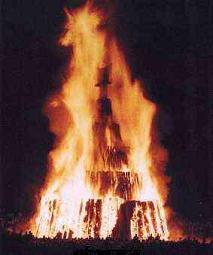
Now you may believe everything that Bible Belt preacher said until you know better, for belief is gradually perfected by knowledge unto the end of history, the fate of the individual. In fact history itself is a mistake, an elaboration of the original sin, the great mistake of necessarily imperfect, self-conscious, conditioned hence all ready doomed individual existence. In agony we may rue the day we were born. From dust to dust we go between fire and fire: The Sun gives life, but it also kills, that all vanities roasting below shall vanish in the end. How could the fire-and-brimstone evangelist go wrong when given this hell on Earth as a foretaste of what is come? But there is heaven on Earth as well, and in any case you may resent his arrogance and his insulting attitude. For all you know he is just another Elmer Gantry, a fictional conman with ulterior motives who gained his techniques from fifteen friendly Kansas City preachers who were among other queries asked by his author: ‘What would you say to get people to believe in something that did not exist?’
As far as you are concerned, your faith is nobody’s business but your own business, a private matter between you and your god, if you have faith in one, and you would rather keep your faith by minding your own business, for once you expose your personal beliefs someone will try to persuade you to put them down and take up their faithful version of the one-god – so it goes with the one-upmanship of the one-god within actually exalted by the preacher in all humility of his pulpit arrogance. You may believe that the doom-boosting evangelist who grovels before fate, and thinks that people must be crushed by his god to know God well, abuses his share of the blazing power overhead; you might even opine that he is the one most likely to be condemned to eternal hellfire if there is such a thing! And, if you are a Jew, a conservative rabbi might claim that you may with clean conscience hate the Christian evangelist as well, for there are two ways to kill a Jew: murder him or convert him.
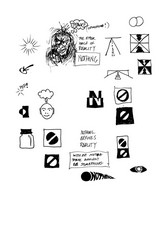
What do we really know about the Unknown? We know next to nothing if not nothing at all. In fact, when we approach the insubstantial hypostasis, our definition of Supreme Being is nearly identical to our definition of absolute space. God, to use the pagan term, is nothing at all yet somehow the alpha and omega of the all. But we would not equate our nothing with ineffable nothingness, for we dread nothingness even more than we regret ourselves in particular for the defects of the particularity we hope to overcome yet somehow oxymoronically survive in indefinite form, so we refer to nothing capitalized to allude to inchoate Nothing. The Nondenominational Gnostic knows Nothing, and he has faith in Nothing because Nothing is perfect. Knowledge of Nothing has no object, nor does it have an objective besides the realization of Nothing; and in this knowledge, which causes Socrates to feel foolish and Plato an illiterate idiot, do the wise feel absolutely ignorant. We may seem mad for saying so, but if we climb to the summit of metaphysics, we shall be made whole and see from the unity of our supreme perspective that the world is a cracked pot: All the world is mad in each and every shard; only mystics who have faith in Nothing are sane, for only Nothing is whole.
The reader might laugh at Nothing, but as Solomon said, laughter itself is proof of madness, so please suffer the foregoing foolish digression from drawing an etymological difference between faith and belief, a task to which we now return. Whosoever would fain speak etymologically in common intercourse would be misunderstood, and would therefore be perceived as a fool, or otherwise as a wise man with too much time on his hands. But who is not a fool in one way or another? Wherefore we persist in our hair-splitting endeavor, but with the caveat that we must not mistake the part for the whole, as heretics are wont to do.
To recapitulate: We have said that ‘faith’ originally stood for loyalty; people of good faith feared the lord, hoped for the best, and for that reason pledged themselves to his cause for safety’s sake. They still voluntarily loved or ‘believed’ in what they really wanted for themselves. Eventually, the terms ‘faith’ and ‘belief’ became synonymous – perhaps because the lord’s subjects, as they were emancipated, increasingly identified with the will of the lord as they became their own lords. Today we have distinguished faith from belief again, to say that faith is blind – perhaps because the lord, who is blind to persons as persons, would not emancipate subjects for their deeds, demanding their faith or loyalty in any event – while belief, although still signifying an object of affection, appertains to something that is known, hence is perfected by knowledge. A man may have faith in a woman, that she shall love him one day although she shuns him now. He will believe in her love to the extent he knows or is familiar with her; the foundation of such knowledge is biological or carnal, and the emotional love grows from a certain freedom of choice of mates; thus knowledge of moral and ethical principles were expressed as a wedding; for instance, Israel is the Lord’s bride, the Church is the bride of Christ, and so.
In fine, we say that faith appertains to fear and hope; belief to desire and love; and knowledge to the conscious correspondence of subject and object. The better we know our subject, the better we love it, or him or her. It is said that to know god is to love god. If one’s god be anthropomorphic, then to love him or her is to love one’s formal self, but no form is adequate to perfection. One would be at one with one’s perfect self, and we look without for examples; but we can only find misrepresentations in others, so to avoid melancholy we fly from one thing to the next, or away from all things into the Nothing. Of that self we all remain relatively ignorant; our modern dog psychology, pig philosophy, and technology give us small consolation, for we are neither dogs nor pigs nor machines. But as self-conscious beings we do have in our madness the consolation of faith and belief in knowledge.
|












Ron