Excerpt from the author’s book, 1908
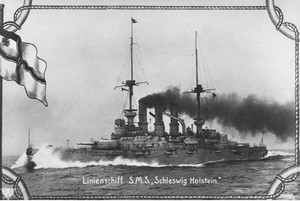
Europeans felt a great war was impending although many could not say why. For one thing, Kaiser William II was obviously "mad about ships." His enemies would soon call him "the mad dog of Europe." Notwithstanding his vacillating temperament, he held onto one thing like a dog on a bone: he insisted on building a big fleet, and did so despite all those who tried to dissuade him, as did his intimate friend, Phillip, Prince of Eulenberg, from whom he would distance himself after a scandal broke over the prince’s alleged homosexual relationships with members of the Kaiser’s inner circle.
“Is the purpose behind the building of a Battle Fleet,” wrote Eulenberg, who after the Great War would blame Germany for pushing Austria into war, claiming that he could have prevented it if only he had remained ambassador there, “the establishment of German predominance over the entire face of the earth? The destruction of British domination? If so, then the building of a Battle Fleet would indeed be necessary, but even only if there were no other means of attaining this goal”
To oppose the Kaiser’s naval aspirations was high treason as far as he was concerned. Even Phillip capitulated. William attributed his maritime obsession to his mother, Empress Frederick, Queen Victoria of England’s daughter, Royal Princess Victoria: "(My) peculiar passion for the Navy…sprang from my English blood on my mother's side."
William had several things in common with his mother besides a love for horseback riding; for instance, they painted: she painted landscapes while he, mad about ships, painted fleets and warships. She enjoyed having been lashed to a violently tossing deck of a ship during a raging storm as sea, where she gave full vent to her rapture and her dinner as well. However, she was not very welcome on her son's cruises because her serious royal demeanor tended to subdue the spirits of the other passengers.
The Kaiser’s naval plan seemed reasonable at the time to all the great powers, including England and America, influenced by Rear Admiral Alfred Thayer Mahan, United States Navy, who wrote about the influence of sea power upon history. Protection of trade from pirates and enemy states was largely responsible for the growth of sea power. Indeed, convoys would defeat the German submarine campaign in the First World War.
The Fatherland, insisted the Kaiser over and over, must have a grand marine future. On June 18, 1901, he made his famous sunny speech in that regard, 'Our Future Lies on the Water,' delivered on board the Hamburg American Line steamship Prinzessin VIctoria Luisa during a banquet following the races on the Elbe:
"... My entire task in the future will be to see to it that peace and security will make possible the growth of the seed that has been sown. Although we have not yet the fleet that we should have, we have nevertheless won for ourselves a place near the sun. It will be my duty to see to it that this place near the sun will remain ours uncontested, and that the rays of the sun will fructify our commerce abroad, and our industry and agriculture at home, and our water sports, for our future lies on the water. The more Germans there are who will go on the water, following the sport of sailing, or as voyagers across the ocean, or as naval men under the flag, the better it will be for us. If the Germans learn to embrace with their vision things that are great and far away, the petty things which still threaten to absorb their everyday thoughts will disappear...."
Furthermore, in an ill-advised interview published by the Daily Telegraph in 1908, the Kaiser speculated on far flung precincts: "Germany is a young and growing empire. She has a worldwide commerce which is rapidly expanding.... Germany must have a powerful fleet to protect that commerce and her manifold interest in even the most distant seas....Who can foresee what may take place in the Pacific in the days to come... Look at the accomplished rise of Japan; think of the possible national awakening of China. Only those Powers which have great navies will be listened to with respect...
“It may even be that England herself will be glad that Germany has a fleet when they speak together on the same side in the great debates of the future," he concluded, throwing foreign columnists for a frightening loop, with at least one exception, a suspicious journalist for the The Times of London: he observed that German naval units notoriously lacked the coal-capacity for long voyages, and that a chance for war in the distant Pacific was a curious reason for accumulating a large force in the North Sea.
The Kaiser's optimistic blustering seemed to astonish the paranoid world as if it were something new. It was traditional for Prussian leaders to make veiled threats before parliaments to get their way, but this indiscreet and audacious blustering before the whole world did more than raise eyebrows. Yet the Kaiser's statement in the Daily Telegram interview was actually an understatement compared with previous official statements made by the Imperial government; for instance, the preface of the German Naval Bill of 1900:
"For the protection of our overseas trade and our colonies, there is only one means: a strong fleet. Under the present circumstances, the only means for protecting Germany's overseas trade and colonies is: Germany must possess a fleet of such strength that a war, even with the strongest naval power, would involve such risks as to jeopardize the position of that power. For that purpose, it is not absolutely necessary that the German fleet be a strong as the fleet of the greatest naval power, for a great naval power will not generally be in a position to concentrate all its forces against Germany. But, even if the greatest naval power should succeed in meeting us with a fleet of superior fleet of superior strength, the defeat of a strong German fleet would so greatly weaken its own power, that, notwithstanding its victory, its own position on the seas would no longer be secure."
Therefore even if Germany loses she wins. Suffice it to say that there was nothing new in the Kaiser's Daily Telegram reference to his beloved fleet, a matter upon which he had always been quite consistent, as had been the reaction of the world confronted by the possibilities of its development. This was merely the continuation of business as usual, and that is why a few people familiar with their own histories of aggression were so alarmed while the naive dreamed of world peace and prosperity without a price.
England was not standing by. No, she was bolstering her navy to greet the dreaded dreadnoughts with dreadnoughts. She was geographically and culturally conditioned to stand in the way of the imperial aspiration of her German cousin.
"It was the custom in the German navy to drink a toast 'To the Day,'" wrote Professor Roland G. Usher from his seat at Washington University in St. Louis. That is, to the day when war would be declared against England. Lord Roberts had rightly said that never has England been in greater danger: ten years ago she was Queen of every sea, but now she controls only the North Sea.
"A crisis of the utmost gravity is thus facing Europe, and may at any moment result in a war," the professor continued. Prussia was once a tiny state. "Cut off from the sea on all sides, pushed hither by the oncoming Russian, dragged thither by the encroaching French, surrounded by tiny incompetent states, her rulers saw in aggression the only possible method of preserving national life.... Her only safety, Bismarck saw, lay in aggression, her only chance of victory depended on striking the first blow. By this policy, she has built up one of the most powerful states in the world... but she has reached the boundaries of Germany.... For Germany to remain static in population and in wealth... means that the date of her annihilation will be fixed by the rate of (her neighbor's) growth.... A promised land, tenanted only by native races, is not to be found. Every really available spot is held by England, France, or Russia. Germany can, therefore, obtain colonies suitable for her purposes only at the expense of these last.... (They) are by their very existence inimical to Germany's welfare... If she is to escape ruin, she must fight them."
Germany needed a highway for her fleet, and the English Channel was the only safe passage available. Therefore Germany must conquer England and France and gain control of Channel. In addition, by right of divine eminent domain, an overland route to the East must be secured, running from the North Sea to Persia, with or without the cooperation of the states along the way. Therefore, explained Professor Usher, Pan-Germanism is at once a self-defensive movement as well as an offensive movement against England for its Mediterranean and Asian possessions.
Possession, it is said, is nine-tenths of the law. And those who are already in possession will always claim, in defense of their properties, that they and they alone have the high moral ground. The truth of the matter is that their gains were probably ill-gotten in the first place, that might is right, and that right is decided by war. General Bernhardi scoffed at the notions of pacifist weaklings. Germany, he said, proved that might makes right, that robber-state crime pays. So what if property is theft?
The benefits to Germany of territorial gains, and the huge indemnity paid by France as the result of the last war waged against France, were obvious to German capitalists. Why, five times as much must be demanded of the vanquished the next time!
In any case, how can Germans in their right mind believe that the fruits of peace are greater than those of war? Is not the very existence of Imperial Germany due to war? Could it conceivably be created by anything else?
Darwinian principles are superior to the high-sounding English phrases about 'humanity.' After all is said and done, truth and ethics are relative. The Anglo-Saxon race must face the facts of life and embrace the audacious effort to direct evolution and the fate of the world. Germany, agreed most German professors, must lead the way to a Pan German Empire. The indictments brought against them for doing so were irrelevant at the time. As far as German conservatives were concerned, the English were damned, and many thousands of Germans agreed with the portraits they drew of the English and England.
# #
References:
Roland G. Usher, Pan-Germanism (1913).
Speeches, The German Classics, (1914)
J.A. Cramb, Germany and England (1914)













Ron