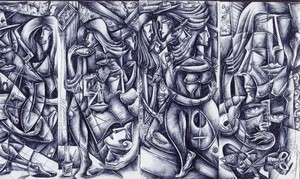
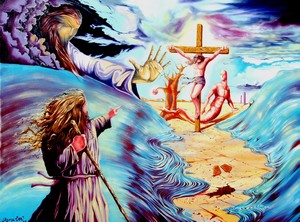
Graphic drawn by Darwin Leon.
Reducing the laws of the good life to writing and placing the words in a box or book for safekeeping, or even on school and court house walls for ready reference, will not suffice for our mutual and continuous education. Indeed, we tend to ignore reminders and positive suggestions once we write them down and place them, for instance, on the bathroom mirror or refrigerator; thus shall we ignore the law unless it is discussed on a regular basis.
Assume that once we have posted the Decalogue in our schools, students are encouraged to ask questions in order to further their education. They will want to know the origin or basis of authority for the Ten Commandments; they will want to know where they came from, and why they have suddenly appeared on the classroom wall or in the hall.
Moses, in his infinite wisdom, having had the benefits of a liberal education (according to Philo) that strives for realization of the Ideal Free Man, anticipated these kinds of questions, and he answered them eloquently according to the circumstances of his day and age. However, different words are required today now that some of the cleverest questioners have concluded that Exodus is a pious myth and Moses a composite fictional character thereof.
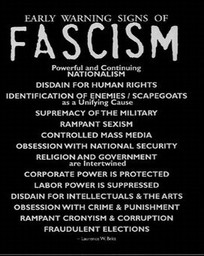
Even worse, cynical inquirers say the effort to post the Ten Commandments in public schools and courts is the handiwork of a hereditary, vast right-wing conspiracy of ultra-conservatives whose compassion is betrayed by supercilious smirks, empty poses, blatant hypocrisy and other such tell-tale characteristics as an inordinate love of property; phallic worship; the subjugation of women; love for war; gun-worship; a pro-life stance over dead bodies of women; merciless justice; and “forgiving” people so they can feel good about executing them; and so on.
Nevertheless, it can and should be demonstrated that there is something much more profound at stake than politics-as-usual. The text must be examined in its symbolic and historical context; that is to say, in its religious context, for in those days a rigid line between church and state had not been drawn. Furthermore, history is the most comprehensive subject of religion in the sense that history embraces the timely existence of man, his common humanity in relation to the Universe, and asks: "From whence, to whither, and why?"
The original Ten Words (Decalogue) of the Hebrews have been long lost and forgotten:; perhaps they were distributed amongst lost tribes. There is a great deal of scholarly contention over the authority of the Ten Commandments in their known forms, as to whether they are really from the Mosaic period at all, or are later accretions. The main bones of contention excavated are Monotheism and Idolatry, the very underpinning of the tradition itself. And there are subsidiary issues: exactly what could be or could not be coveted; whether work or trade was actually prohibited on the Sabbath; and so on.
Decalogue issues now obscure were openly discussed when the Ten Commandments were originally promulgated in the old schools. Modern students might immediately dismiss the Ten Commandments, claiming they are absurd if not irrelevant today. But that is simply not true . The Decalogue is relevant to our time, and the arguments for dismissing it as irrelevant can be refuted during the Great Conversation.
For example, addressing the argument that the Decalogue has no authority because it is part of a contrived myth, we might pronounce it a myth, observing that myths have had an enormous influence on the development of the human race. Indeed, individuals, cultures, and societies are living a myth. So let us re-examine and re-create the Decalogue myth, bringing it to life again. For only a myth could satisfy such an historical project as ours. One does not have to have blind faith in a myth, for the myth is an 'As If' founded on the truth of real experience and wisdom.
Indeed, our assignment may be the creation of a suitable myth to be read before our class without fear of being stoned to death, whipped with a strap, or getting a good tongue-lashing. A student may then bring this mythical account to class:
"The original Ark in which the Covenant was deposited contains the secret, perfectly bisexual Name that evokes the ineffable Creator. In response to the Evocation, the Name is divided into Two Meteoric Tablets: one Female, the Community or Bride; the other Male, the Executor of the Laws, or Groom. Upon the tablets are Ten Words, the Seeds of the Living Law, the Heads of all the laws flowing therefrom. The Ark was built to carry the Seeds over the Waters of Chaos, that the Living Order be planted in the Promised Land. The Ark, cleansed by the Baptismal Flood Waters, served as the Natural Womb of Mankind during the perilous voyage through Space."
The student may say that this explains the secret meaning of the Ark of the Covenant of the Lord, and why the altars in some churches are made of two parts, one male, the other female.
Another student may say that he likes the myth, but he believes that both tablets were not meteoric, that one was volcanic, symbolizing Earth. The falling meteor, or Great Falling Light, was the Great Dragon breathing fire, the dragon who impregnated Earth, turning her into a veritable voluptuous Eden or Paradise, an Ark of Life spinning and hurtling through Space or the Waters of Chaos with her consort the Sun. Here on Earth, then, we have the Dragon of Wisdom, the knowledge of good and evil, planted as an Eden also in Man. This story is, claims the student, written in the stars where we see the Celestial Virgin holding back the Dragon. And on Earth we see the dragon Python engaged by Apollo the Sun.
Another pupil asks, “Was not the dragon, or the Brazen Serpent itself placed in the Ark?”
“Yes, and that Wise and Healing Dragon is also known as the caduceus of the son of Apollo and Python, namely, Mercury, the Savior.”
“But is not the Dragon also Satan?” the pupil persists.
“No, there was no original Satan. The Falling Angel or Star is the Dragon of Wisdom, the Great Benefactor of Man who, in turn, used the gift to distinguish between good and evil. To the extent that a man curses himself, hates himself for his errors, he is the Satan of his own creation, which he wrongly projects onto the Dragon. For the Dragon is the spiritual Sun, the son of Enlightenment, or Wisdom, the anointed, the Savior, the Christos. Hence the Name spelled by the original Ten Words is the Name of the Savior.”
Despite the probable arguments against this myth, it presents many advantages to be discussed as part of the Great Conversation. The seeds incubated in the native ark must obviously be cultivated upon landing. The children drawn from the birth waters must be inspired by Life, just as the Ten Words must be taken from the artificial box, book, or plaque on the wall, and be resuscitated daily by the breath or spirit of conversation, that each person may rephrase the living law in his own words and thus make it is own. It is by virtue of that enlightening process, using the power of words, that the student journeys to truth and justice (called ma'at by the Egyptians during Moses' time).
The Decalogue bears repeating in all the schools lest we neglect the source of the Nile and rush off to soon forgotten entertainments. And, yes, no doubt we should re-examine our Original Words, whether they be Ten, Nine, or Eight (Hegelians seem to prefer Three, and Mystics like One, and Dualists are stuck with Two, and so on). Whatever the Number of our cosmic commandments, none of the terms of our pregnant conversation should be taboo. Authoritarian cover ups insult the intelligence of students and authorize perjury.
We may call our myth a myth for living a living myth, a myth coming true rather than the absolute truth itself. By all means, let us discuss that myth in full.
Such a discussion would raise certain questions about the desired degree of flexibility in a living law: if the Decalogue as posted were strictly construe d today, and enforced according to the determinate sentencing given in Deuteronomy, hardly anyone would be living today. Further questions, regarding, for example, the nature of hypocrisy would surface, and rightfully so, along with many, many other issues and definite problems of application.
Then each school would be an ark of freedom tempered by the ideal, an open society animated by the diversity of conscience that each person has willingly made his or her own by means of independent effort and mutual discussion. The aim of this education (drawing forth) would be the cultivation of the ideal person by good example and independent effort. It is not a method of forced indoctrination and inculcation by rote.
The first commandment of education is, Think! This is not something new we have added on. It is this divine and dynamic faculty that iconoclastic Hebrews raised above the idol of fear and greed, the cult emblem of ignorance, superstition, death and destruction: this is the positive aspect of their iconoclasm. Yahweh is a jealous god where the bride Israel is concerned: idolatry is adultery.
We must not end this present discussion without mentioning the importance of memory. We speak of history. Memory is history, and philosophy is its application. Untold millions of copies of the various versions of the Ten Commandments have been published, but who can recite them, let alone interpret them? Many of those who want them posted in schools believe that the injunction against murder is the First Commandment, when it is rather far down on the list! Who can say why? Many can. But that is a subject for another discussion. Suffice it to say here that the patriarchs have forewarned us that sacred scriptures have been and will be used to justify any sort of conduct good or evil: that is why they have warned us to discuss them, to question them every day.
In view of the fact that so many people have difficulty recalling the most popular versions of the Decalogue, or, for that matter, the Bill of Rights, the Seven Deadly Sins, and other important lists, it does appear that the cultivation of memory is the key to the recovery of the Lost Civilization, the Atlantis submerged so long ago by the Deluge because people had forgotten their lessons.
Who can remember even some mundane everyday thing in our money-loving age such as whose head is on a fifty-dollar bill? Well, some can, but that is beside the point. The point is that much more is involved than posting the Decalogue. Our future and the future of future generations depend on discussing it. May the conversation never end.
XYX