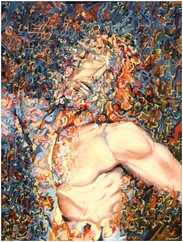
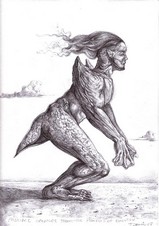
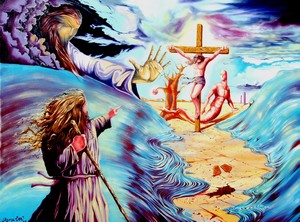
Masterpiece by Darwin Leon
GOD PLAYING SOLITAIRE
BY
DAVID ARTHUR WALTERS
The subjective self or subject strives for knowledge of its unity in opposition to itself and splits into multiple representations to that end. The objective representations, however, cannot satisfy its impossible desire to know itself as a unity, for knowledge requires a minimum of two objects perceived by a subject; the subject without an objective body cannot be one of them; the consciousness of multiple representations would be divided among multiple representations and none of them would be the unity desired.
In fine, the subject cannot exist as a unity - its mission for self-knowledge as a unity is a mission impossible. The best it can do in its multiple representations is to imagine a coherent utopian state of absolute bliss in unity; but in fact such a state is static or lifeless - bliss is death. What the self really knows is change i.e. differences.
The phenomenal unity of self is the relation of contemplative self and active object in all perspectives; the possibility of self-knowledge, then, is not the knowledge of the unity of the self-in-itself, but rather the knowledge of the phenomenal relation of subject-object: two attitudes, through all windows.
In the futile struggle for knowledge of unity-in-itself, one might say that the multiplicity of the representative fragments of being strive to recover universal being, but cannot do so because of the particularity of their efforts to know themselves. It is as if fragments were shoved from universal being into individuality, and were condemned by the original sin of their birth to never recover their origin. The original sin is, of course, that of original being striving to know itself-in-itself; all fragments projected into space-time share that original sin, therefore must perish. Self-conscious humans have made a meaningful story of it:
"Why would we be subjected to suffering in this world unless we are being punished for a crime? Do not our fathers punish us for doing wrong? Must not eyes tally with eyes and teeth with teeth to balance the blood feuds? Justice must be done to right wrongs. Our race must have done something wrong, in the very beginning, to suffer these divisions. Therefore we have inherited our propensity to do evil to one another. Our suffering here at the hands of our father above is expiation for our original sin. We are born evil. Let us be loyal then, and in hate-based group-love find and expand our unity. To that end let us submit to our fathers, families, clans, nations, states, the universal world order, in the name of the first father."
Individual human beings suffer self-conscious life; they suffer consciousness of individuality. They are caught in a double-bind: they would recover original being or 'god', but that con-fusion would kill them as individuals, and would constitute, in effect, a particular suicide contrary to the will of the original project of universal being, to know itself through multiplicity. Hence the human imagines that his will is free while universal being arbitrarily and infinitely divides in contemplation of multiplicity. The particular self is not wholly free: although it retains a portion of the universal free will, it is confronted by the multiplicity of other individuals and the rest of the world. Hence the particular self imagines a free will not actually possessed. Its "free will" is partial, is an "illusion," albeit convenient for its toleration of the determined life.
The heroic aesthete, aware that his return as such to original being is impossible, contemplates his incommutable, irreversible fate as a work of art or spectacular showing of fateful images. He recognizes and appreciates free will, unity of self, and other such notions - including even the notion of universal being contemplating itself through universally willed multiplicity - as entertaining illusions. It is not that he derives sado-masochistic pleasure from such entertainments. He genuinely appreciates the comedy of truth and tragedy of lie, as pastimes, as means by which time can be made tolerable and patience not over-taxed. He imagines supreme being playing games of solitaire.
Of course the ethical individual takes his life and his god very seriously. He is pressed all the while to decide between good and evil: Either/Or is his motto. That life is a play on the world-stage is of little comfort to the ethical individual. The spectacle does not compensate him for his anxiety and suffering: the part he plays torments him. He desperately wants the unity of supreme being and he denies the impossibility of having it.
Can we blame him? Some men would lose interest in life if they believed they were only actors (Gk. hypokrites) in scripted plays. Wherefore they imagine that they are captains of their souls and masters of their fates, that they can master and change the very form of their soul and world, if not this world, then the next. They often imagine this mastery while denying it, projecting their will onto the supreme being and imagining themselves as slaves. In their arrogance they profess humility, oblivious to their own hypocrisy. They learn to believe in their illusions as a matter of subconscious habit. They are con-fident, they are with faith, they have blind faith; otherwise the facts would cause them to despair. As for the facts confronting faith, they are vanities; the complexities perceived are illusory and ephemeral: only being or god is permanent. How being differs from nothing is unknown.
If we are to follow the reasoning at the top of this page, the ethical humans are quite right! But the heroic aesthete calls the ethical men and women unheroic fools for really believing in the ultimate vanity, the Vanity of vanities, and the illusory myths attached thereto. Maya, said the yogi, is a synonym for ignorance. The aesthete sometimes envies ignorant fools.
At least the illusion of free will behind Either/Or - behind the feeling of merit and demerit, praise and blame, innocence and guilt - reinforces the psychology of violence and disorder in human life as particular lives struggle for individual life and, at the same time, death in universal being through hate-based group-love and the like projects. Working against its unity in multiplicity, continuation of the illusory spectacle is assured no matter how brutal and cruel, so that men do not despair and do what any man would do if he really wanted the wholeness of sanity or immediate unity with the all - kill himself. But alas, that would leave all behind, so life goes on, thank god.
XYX










Ron