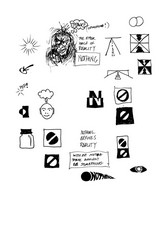
Graphic by El Ricko
SPINOZA’S GOD
BY
DAVID ARTHUR WALTERS
It is amazing how arrogant we can become in the name of an imagined god or indefinite divinity while we think we are being ever so humble. We have unwittingly hidden our pride along with our ignorance behind such names.
When our gods are criticized, we support them with our revelations or intuitions instead of the plain facts which any sane person could perceive, and we condemn the sheer stupidity of anyone who does not possess our fine wisdom—why such powerful gods need our support is a mystery.
When push comes to shove, the faithful, instead of pointing their fingers at names of gods, point their weapons at each other and prove their points; it soon becomes bloody obvious who the gods really are, and that their main interests are on Earth.
Any proposition we might faithfully refer to the arbitrary symbol, "god", no matter how ill conceived it may be, takes on the appearance of certainty; it seems to have the perfect clarity of absolute truth. It is really our own dignity that is at stake, therefore we might defend our ideas about our god to the last, convinced of the ignorance or diabolical malevolence of anyone who bothers to disagree. Hence the symbol stands not for objective truth, nor does it indicate the highest power, but rather denotes the demonstration of our blind faith in our pride and prejudicial ignorance. Those who know something adequately have no need for a name to excuse their ignorance; if they do not know something, an "I don't know" is adequate.
The Jewish philosopher Benedict Spinoza laid out his divine rules for adequate thinking in his philosophical tracts. For him, a perfectly clear idea is a true idea. A true idea is different from its objects, but corresponds to those objects just as the idea of a circle corresponds to all visible circles.
However, that correspondence is not understood or induced from observation of the objects themselves, but is rather deduced from the intrinsic nature of the idea, to the extent that idea is adequate to God, because God constitutes the essence of the human soul.
In other words, Ideas are true , clear, and distinct only when they are adequate to divinity, when they are divine. That is to say, the human mind, insofar as it possesses adequate ideas, is one with the divine mind.
In fine, true ideas are divine.
Our ideas are inadequate when they are partial or confused one with the other. But there is no doubt concerning a true idea: it carries with it, as its intrinsic nature or divine adequacy, immediate certainty. There is no absolutely doubt about it.
Spinoza made that perfectly clear: "He who has a true idea knows at the same time that he has a true idea, nor can he doubt the truth of the thing.... What can there be more clear and more certain than a true idea is the standard of truth? Even as light displays both itself and darkness, so is truth a standard both of itself and of falsity.... Our mind, in so far as it perceives things truly, is part of the infinite intellect of God; therefore, the clear and distinct ideas of the mind are as necessarily true as the ideas of God.... No one can know the nature of the highest certainty unless he possesses an adequate idea of the subjective essence of a thing; for certainty is identical with such subjective essence...."
We admire the circular thinking of our metaphysical geometrician as he approximates a perfect circle on his way to a monistic, non-dimensional point where the doubt arising from differences is entirely done away with. Yes, indeed, and may the skeptics be dismissed out of hand, for our object is not doubt but is certitude.
Spinoza's Ethics summarily disposes of skeptics: "If there yet remains some skeptic who doubts of our primary truth, and of all the deductions we make, taking such truth as our standard, he must either be arguing in bad faith, or we must confess that there are some men in complete mental blindness, either innate or due to misconceptions.... With such persons one should not speak of sciences.... If they deny, grant, or gainsay, they know not that they deny, grant, or gainsay, so they ought to be regarded as automatics utterly devoid of intelligence...."
The best argument against stupidity is a stupid argument. The best way to prove an absolute presupposition which is self-evident is simply to propose it and to call anyone who disagrees with it stupid. And perhaps they are stupid for even bothering to refute what really amounts to nothing in particular. Nothing is perfect, for how can Nothing be disproved?
Despite Spinoza's intuition of the divine clarity from which everything may be clearly deduced if the philosopher is adequate to the Subject, the proof of the existence of the Subject of subjects has not yet been demonstrated beyond a shadow of a doubt. Living philosophy does not run along geometrical tracks to concentration camps. No Final Solution has been settled upon us once and for all, and may skeptics forbid it. Over-arching generalities all too often tend to be destructive partialities—let the skeptics have at them before they leave the station. Of course, the generality proposed might be Nothing; in which case we may for very good reason joyfully praise Nothing on a regular basis and proceed with our lives.
Spinoza suffered his time and circumstances. He was a creature of his god, a reaction to the popular one-god professed by his excommunicators. His god is much more skeptical than the customary idols of religious monopolies. Spinoza's god is the Being of beings, the eternal, infinite substance of reality; everything is good is god; there is no evil; there is nothing outside of god. In a word, Spinoza was a pantheist, which made him an atheist to theists who claimed monopolies for their exclusive gods. His god is everything, hence nothing in particular; his god is the substance of the infinitely good universe of which we know only mind and matter; there are an infinite number of other attributes we do not know.
To those who need seemingly clear definitions, Spinoza's pantheism does smell to high heaven of atheism, of no god at all under the mere pagan name "god." Yet no doubt Spinoza loved the god of his salvation passionately.
As for his pontifications on the clear understanding of true ideas adequate to his god, he might as well have praised Nothing. After all, since his divine intelligence is infinite and his true ideas are infinitely related as an infinitely complex machine, his few "true " ideas, which are perfectly clear to him because they are divine, amount to nothing in comparison to his ignorance of his infinite divinity. But he thought he had ahold of something divine, something necessary; something beyond good and evil for the good reason that necessity alone is good—mysticism is essentially amoral.
Nothing, although perfect with all the dirty beings extracted from Being, was not good enough for Spinoza.
Spinoza seemed convinced that his understanding of his god had its own reward, that his understanding automatically made him virtuous. His love for his god is intellectual, unemotional. The intellectual love and obedience to ‘god,’ compliance with the absolute power and law of the universe for the benefit of humankind, is the ultimate goal of ethical scientists. However, there is no possibility of universal empirical verification from those who know Being or Nothing hence have rid themselves of essents. In the grand clarity of his true understanding, he felt he was in possession of divine wisdom, for which he wove an elaborate rational cloak.
We may find Spinoza’s unemotional mental calisthenics arid. After all, we are motivated or literally moved by emotions. Human values depend on emotions: he who has none is immoral. Still, Spinoza's geometry is rather elegant. He inspired German Romanticism, which had its arid, scientific aspect. Hard-headed Modernists like Ayn Rand were passionate about dispassionate scientific progress—see her Romantic Manifesto.
Spinoza still has his attractions. Many of his passages are beautifully expressed sublimations of the usual passions, including the desire to be God Almighty, a desire that would be expressed in another manner by existentialists to come in their worship of the transcendental ego. His true god may not be as abstract and impersonal as he might have believed.
-XYX-
David Arthur Walters
Honolulu 1999