 An etymological editorial with no offense to our predominant culture
HYPOCRISY DEFINED
BY
DAVID ARTHUR WALTERS
We do not have far to go to find a hypocrite, not if a mirror is around. Hypocrisy is the underlying crisis of humankind. But appearances are deceiving. Hypocrisy is so pervasive and obvious, and we have gotten away with it for so long, that it is not believed to be a crisis anymore.
Presidents and citizens, generals and grunts, and executives and employees lie through their teeth on a daily basis and we think nothing of it. We know elected political leaders are the phoniest people in the world; they represent our hypocrisy; they take the hypocritical oath of office, to abandon their principles and promises and do the will of the People. That much is given, therefore we are pragmatic and unprincipled. We vote for them on the basis of whether or not they are pro-this or pro-that or vice versa, and our pros contradict our pros and our cons contradict our cons because we have no principle. We hope the leaders of This Lying World of Ours will at least keep one or two promises, something to do with the usual concerns of religion and politics: life and death; say, regulate sex and make war so that our mates and other property will be secure.
In any case, when we pull up the grass roots of the pros and cons, we find clumps of hypocrites. In fact, hypocrisy is so widespread that the term itself has lost its pejorative value even at the highest level. A statement that the president is the greatest hypocrite in the world has no more value than a breath of Los Angeles air. Yet the subject of hypocrisy remains a matter of great moment to those who really believed George W. Bush when he said that Jesus was a great philosopher, rather than believing that he only said it to get the vote of the religious right, shortly after refusing to give a born-again Christian a merciful thirty-day stay of execution. A governor must obey the will of the People, he said, not the will of the Savior. The leading spokesman for the religious right said Governor Bush "would have no mercy if he kills that poor woman", then campaigned for him after she was killed.
O, my, if only we could go back to the good old days of Zoroaster when there was a void between good and evil, when right and wrong were two different things, when truth and lie were distinct one from the other, and theodicy was not needed to explain why the one-god does evil things. When the difference between good and evil fades, the value of hypocrisy diminishes, until, at last, when good and evil are thoroughly confused, there is no hypocrisy, technically speaking, for hypocrisy is more than a lie, it is a habit falsely worn, a pretense of goodness cloaking the evil will. Christians were once fond of calling fraudulent ministers who sought their fame and fortune under the cloak of religion hypocrites. Once the clear distinction between this evil world and the good one hereafter became confused, compromises were made: the organized Christian religion became one of the greatest hate-based love hypocrisies ever contrived by humankind.
The primitive Christian was engaged in a dualistic struggle. He or she was not interested in reforming this evil world. This world was damned, that much was obvious at the time. Religious life was a preparation for a different world, for the next world, a good world. So great was the difference between the twain that all attempts to bring Heaven to Earth were bound to fail. Why, the attempts themselves were hypocrisy, the proud, sinful acting out of, "I am good, better than others, they need to be reformed."
Hence the real drama of Reality is played out in the Other world, not in This Lying World of Ours that occludes it. Only faith in that good future, not present works, can save the person from eternal damnation. The question raised thereafter, when the apocalyptic Messiah did not return right away as expected and the date was put off to "only God knows when," was what to do; for if works do not work, then anything goes as long as one has faith. Hence we have the doctrine of Anything Goes. All are to have faith, but only a few will be chosen, and the choice is not in their hands but in God's hands.
We sympathize with Christians because we too are involved in the human predicament. We might say that 'hypocrisy' is universal because it appertains to the under (hypo) lying crisis (turning point) between the evil we are and the good we can become; or, if you prefer, from lesser good to greater good: but here we go again, the clear distinction is lost for we muddy the water with two goods. The root of the term 'crisis' means 'decision.' Such is the progress of human life from evil to good, or, if you will, from real to ideal, that conscious decisions must be made between good and evil. There will be many mistakes along the way; however, the important thing is the recognition, as the greatest Christian existentialist said, that there is an Either/Or, and that a decision must be made in good faith before the ship goes past the turning point and crashes into the pier, killing any number of people. Those decisions make the man. The rest go along for the ride and drift on the seas of irresponsibility.
Yet again, if we say that hypocrisy is the universal crisis of mankind, the crux of reality upon which man's aspirations are crucified, therefore everybody is a hypocrite, we lose the particular hypocrite in the abstract generality, and anything goes again, for we should not throw the first stone, we should forgive, and so on and so forth, a lax policy condemned as immoral by Jews and many other ancients, particularly the orthodox Zoroastrians. The Greek word 'hypokrisis' simply meant 'to play a part.' The hypocrite was an actor. The Greeks recognized that "the world is but a stage," and the word 'hypocrite' was not a pejorative epithet. We have the Alexandrine Jews to thank for the pejorative usage. When Jewish scholars translated the Old Testament into Greek, they used the morally neutral 'hypocrite' in place of 'hanef', a very strong word meaning “godless person.”
A hypocrite, then, is a godless person. Hypocrisy is the way a godless person acts. He hides the truth, his evil nature, with lies. He pretends to be good but he is evil. God is Truth and Satan is the Liar. Christian Jews twisted the term 'hypocrite,' unfairly applying it to Pharisees. The terms 'Pharisees' and 'hypocrites' are still synonymous as far as ignorant Christians are concerned, for they remain obsessed with distinguishing themselves from the scholarly progenitors of their cult.
Consider that if human nature is truly corrupt or less than it could be, everyone would know it, and no honest person would be moved feign goodness and righteousness. He would be what he is, and humbly confess his sins; otherwise he would be guilty of the sin of pride: hypocrisy. I am no Christian philosopher, wherefore I quote Augustine's authoritative sermon on the Sermon on the Mount:
"Therefore, He said, when thou dost an alms deed, sound not a trumpet before thee, as the hypocrites do in the synagogues and in the streets, that they may be glorified by men. Do not, He said, desire to become known, as the hypocrites do. Now, it is manifest that hypocrites do not carry in their heart what they flash before they eyes of men. Hypocrites are pretenders, like mouthpieces of other persons, as in the plays of the theatre. For one who in tragedy takes the part of Agamemmnon, for example, or of any other person involved in the story or myth being enacted, is not really the person himself, but impersonates him and is called a hypocrita. So, too, in the Church or in any phase of human life, whoever wishes to seem to be something he is not, is a hypocrite. He pretends to be a right-doing person, but is not such in practice. The whole purpose of his behavior is to win the praise of men. The mere pretenders can win, too, deceiving those to whom they seem good and by whom they are consequently praised. But from God, the Observer of hearts, they received no reward but punishment for their deceit; and from men, He says, they have received their reward; and most justly will it be said to them: Depart from me, yet workers of deceit; you bore my name, but you did not do my works. Those, therefore, have received their reward who give alms with no other intent than to received acclaim from men; not, if they received acclaim from men, but if they act with the intention of receiving acclaim, as has been set forth above. Praise of men should not be sought by a person who does the right thing, that they may benefit who can also imitate what they praise; not, that he should think they are in any way benefitting him whom they praise."
This is not the place to criticize the great Augustine, claimed by Christians as the founder of modern intellectual history. He was a former Manichean whose Zoroastrianism was tainted by Zurvanism - the doctrine that good and evil have the same father; with that and the corruption of his times in mind, we can understand his conversion to a more clear-cut distinction between good and evil, at least in intention. But we cannot see a man's intentions, and therefore we judge him by the facts of his works. Along this line we find the Deists who admit the existence of god, who believe in rewards and punishments in the next world at least, but whose worship of god consists not in professions of faith or abstruse theological incantations but in actual works.
Naturally, people with more than half a brain take issue with one-sided thinking. Pride, for instance, might be considered as a blessing and not a sin, a motive for some of the greatest and best deeds ever done in this world. Nevertheless, we do get the critical Christian point; we feel the pricks of conscience jabbing us from time to time even though we might live the lie to such an extent that we think it is the truth. Alas, hypocrisy deceives the self as well as others.
Yours truly is not a Christian, yet he cannot avoid the Judeo-Christian culture into which he was born. Nor does he have a license to practice religion or to give spiritual advice, so please consult your bona fide spiritual master for that if need be. He does believe the world is going to hell in a hand basket of hypocrisy manned and captained by a demonic crew. Wherefore he screams bloody murder from time to time, not to prophesize inevitable doom but to sound his own muffled alarm. Very few people will hear it, yet he needs to hear the echo, for his alter ego is humanity introjected.
XYX
Source Quoted:
ST. AUGUSTINE, THE LORD'S SERMON ON THE MOUNT, Translated by John. J. Jepson, Westminster: The Newman Press 1948
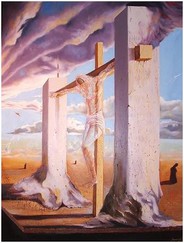
Credit: Painting by Darwin Leon
|



















I befriended a fellow engineering student, an Indian from Bombay in graduate school. Like me, he was rather areligious, but came from Zoroastrian stock and was well-versed in languages and Eastern religions. We remain friends to this day and don't discuss religion much. His wife, also Indian, is a Christian.
We were both staying in the YMCA and eating our meals together there in the dining hall in the evening. One evening, a young monk from Scandinavia sat down to eat across from us. My friend said to me, "Christians are very good people." For some reason what he said stuck with me and I still remember it.
Hypocrisy forever!
Ron