 The abandonment of principles for results
‘GET IT DONE’ FASCISM
From Notes on Fascism by Lawrence G. Lux and David Arthur Walters
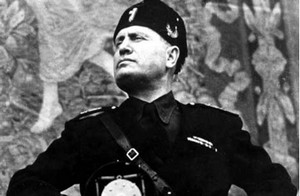
Benito Mussolini inspired the prophets of the death of liberalism. Fascism had no rational philosophy. It was in fact anti-intellectual, opposed to abstract rationale, to the reasoning liberalism inherited from the Enlightenment.
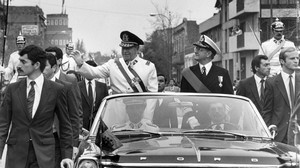
Fascism was pragmatic, concerned only with "What works," action and the "facts." That is, with consequences. Its favorite motto is “Get It Done.” For example, Augusto’s Pinochet’s motto for his neoliberal shock program in Chile was “Get It Done.”
But if "what works" is right, then anything that happens to work at the time is right. For instance, any politico-economical state imposed by force is right therefore righteous.
Naturally the "facts" are often contrived or manipulated; for instance, the facts used to support the outcome of Pinochet's economic program in Chile were carefully selected and then misinterpreted: subsequence economic analysis by impartial observers led them to conclude that his anti-liberal program was a failure.
"Know then, once and for all," declared Mussolini, "that Fascism recognizes no idols, adores no fetishes; it has already passed over the more or less decayed body of the goddess of Liberty, and is quite prepared, if necessary, to do so once more."
Italian Fascism was intent upon creating a state of economic necessity by fear and force, overlooking the "abstruse rationale of political liberalism."
Mussolini declared that liberalism was just another passing phase, and stated "Communism and Fascism have nothing to do with Liberalism." In fact, Fascism accepted not the political but the economic motivation of Liberalism, operating through privately owned, big industry. In practice, however, its revaluation of the lire forced collective control over wages, rents and prices. Nonetheless the profit motive of industry was carefully safeguarded, one major incentive being to attract foreign trade for investment.
The economic motive is not the only aspect that differentiates Fascism from Communism. Another difference is that Communism has a coherent ideology: Recall that Lenin persisted and overcame obstacles, starting with a small cadre of about 100 hard core Bolsheviks, by insisting that theory must be practiced in a certain way and that everyone must know where they are on the path to the goal.
The repudiation of abstruse generalizations in favor of "What works," in order to “Get It Done, i.e. the pragmatic approach, was actually nurtured in the United States, particularly by William James, whose pragmatism was purportedly "romantic" or "spiritual," and John Dewey, whose pragmatism was "instrumental" or "scientific."
James' pragmatism was admired in Spain, for instance by Ortega y Gasset, but not openly, for Spain was indignant over the humiliating U.S. war on Spain.
Political pragmatism is "pluralistic." Pluralism is not as diverse therefore stable as it was once assumed to be, for political hysteria, e.g. the Red Scare, can be easily induced and the factions or tribes will gather into a paranoid power bundle or fasces to persecute domestic dissidents while waging “just” wars externally in "self-defense."
Mussolini actually attributed his intellectual shaping to William James, placing him on a pedestal along with Machiavelli, Nietzsche, and Sorel the syndicalist.
Pragmatism in politics, which is currently said to be the operating force in the U.S., where party affiliation or ideology makes little actual difference in voting behavior, became popular there after the failure of President Woodrow Wilson's plan for world peace. Wilson was the personification of the world's faith in good will and human reason. He wanted to make the world safe for democracy and establish a new world order after the war to end all wars.
President Warren Harding’s general policy, on the other hand, was to do nothing on principle, to avoid entangling alliances, to ignore academic proposals, to manfully face actual realities, and not to intervene unless specific interests were threatened. The variations since then are intriguing.
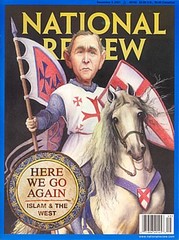
Most recently, the policy of President Bush, Sr. and its resumption by President Bush, Jr. is sure to preoccupy presidential historians for years to come. Junior appears to be one of the greatest political hypocrites ever to hold office. Almost every ideological statement he made was reversed by actual deeds, save in two areas, in domestic economics and militant foreign policy.
President appeared to be a pragmatist of the "fascist" or "right wing authoritarian" type, who gives lip-service to "democracy" with evident distaste as he does what is "good for the world" whether the world likes it or not. Despite his boring and "moronic" behavior, he built up a cult of authoritarian personality around his hawkish "cowboy" stance, one that was attractive to many Americans. His stance appears rather liberal in retrospect today, with presidential candidate Donald Trump taking advantage of fear to cultivate a fascistic reaction to terrorism, one that might well lead to a stampede.
Americans had justification for doubting the sincerity of President Bush’s apparent Wilsonian internationalism, for questioning whether he really intended to liberate the world in order to bring it under the principles of liberalism. If he was sincere, his approach was hardly pragmatic given his reversion to abstract liberal ideology. Forcing his conception of liberalism on the world could have only been accomplished through a world federation holding a monopoly of force over all regions of the world. That would necessitate the establishment of a United States of the World, such as that intended by the League of Nations.
As H.G. Wells pointed out, the problem with the viability of a League of Nations is apparent in the title: "nations." An assembly of nations with independent military forces is an assembly carrying the seeds of its eventual discord and ineffectiveness. A United States of the World is way beyond the “go it alone” capabilities of the United States of America.
Today we are witnessing the collapse of liberalism in the U.S. That is precisely what the provocateurs want, and do not mind seeing the streets run red to get it. Caution is being thrown to the wind to Get It Done as terrorism confronts terrorism.
XYX
|












You have touched on Donald Trump and this paragraph suits his rhetoric perfectly:
"Pluralism is not as diverse therefore stable as it was once assumed to be, for political hysteria, e.g. the Red Scare, can be easily induced and the factions or tribes will gather into a paranoid power bundle or fasces to persecute domestic dissidents while waging “just” wars externally in "self-defense.""
Ron
Is the word after President [Reagan or Bush?] I prefer the former over the latter.