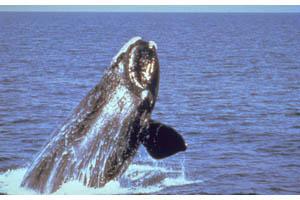
Whales breeding in Georgia during the months of December through March need lots of privacy.
Right Whales Breeding in Georgia
One of nature's most amazing and, unfortunately most endangered, creatures are whales. Among them are more than one "Gentle Giants" . One of them is the Right Whale, also known as Eubalaena glacialis, a baleen, a toothless mammal, almost extinct. It got it's name "Right Whale" from the fact that it was the right whale to hunt for it's large amounts of blubber fat, which made lamp oil and lubricants, also being used in margarines, lard and shortening.
Being a very slow animal it was easy to chase and floating on the water once it was killed and so it was easy to handle.
The right whale is black, with gray patches along the throat and belly and white patches of skin on their heads. The head is so big, it accounts for more than one quarter of the body, the upper jaw alone measures about 7 feet. The entire mammal reaches up to 60 feet, weighing up to 139,700 pounds.
At this time, during December through March they come to the southern Georgia and northern Florida coast to reproduce. They have their babies and nurse them until March, then they move on, their little ones big enough to travel.
During this time it is very important that their dens are not disturbed in order not to cause damage to mothers and their babies and so with this cause more shrinkage to an almost extinct creature. The slightest disturbance can cause severe unbalance to the calving females, causing death of mothers and calves.
Anyone who spot a den of right whales should support them by passing as slow and careful as possible and then call in to report the wherabouts of the whales, so their calving areas can be better protected.
To inform the Georgia Authorities please call 1-800-272-8363 or 1-800-2-save-me. For Florida the number is 1-800-dial-fmp or 1-800-3425-367.
By Birgit and Roger Pratcher
Authors on Author's Den
copyright December 2005
|