AuthorsDen.com  Join | Login 

 
Where Authors and Readers come together!

Authors | Books | Audiobooks | eBooks | Signed Bookstore | Stories | Articles | Poetry | Blogs | News | Events | Reviews | Videos | Success | Gold Members | Testimonials

Featured Authors:  Paul Lonardo, iDavid Arthur Walters, iBethany Peterson, iAlexander Shaumyan, iMaria Rushing, iEdie Batstone, iChristine Boyce, iOdin odin@aflx.com, iGlen Schulz, iTracey Morait, i

  Home > Nature > Articles
Popular: Books, Stories, Articles, Poetry      Authors: A B C D E F G H I J K L M N O P Q R S T U V W X Y Z     

Patricia Hilliard

 Follow Me  

· 101 titles
· 235 Reviews
· Share with Friends!
· Save to My Library
·
Member Since: Sep, 2001

   Sitemap
   My Blog
   Contact Author
   Read Reviews


Books
· Mystery of Quercus Gardens

· One Pledge Unspoken

· Making Changes

· Go To Liberty


Short Stories
· The Gun

· War Toy Boy

· The Voice of Want

· Salad Dressing

· Making America Great Somehow.

· What Words Mean to Young People

· Country Girls

· Bradley, What a guy!

· Verbatim

· That's Enough!


Articles
· Why Peterson Field Guides are Best

· War and the Earth we need to live on.

· Cures not Wars

· Are You Writing for Me?

· The Death of a Website, an author's lament.

· Verifying Ones Self

· Book Review: Pearl S. Buck: Pavilion of Women

· Taxes, taxes, taxes!

· Anti-war Protests Again: problem of war not solved.

· Plagiarism: What is it really?


Poetry
· Water is Life

· Cat and Mouse

· Voices of Need

· Life Boat

· Grasping

· Diamond Mind

· The Rebel

· A Field

· Home?

         More poetry...
News
· Eric Hoffer Honorable Mention Award

· Mystery Enters Hoffer Contest

· Mystery of Quercus Garden

· Mystery of Quercus Garden

· Helper Birds

· Go To Liberty - Finalist in Montaigne Medal Award

· Go To Liberty

Patricia Hilliard, click here to update your web pages on AuthorsDen.

Books by
Patricia Hilliard


See all Books
by Patricia Hilliard


Mystery of Dinosaurs on New Jersey Beaches
by Patricia Hilliard
Last edited: Tuesday, September 23, 2014
Posted: Thursday, April 12, 2007


Solve the Mystery of the Disappearing Horseshoe Crabs and Their Eggs.

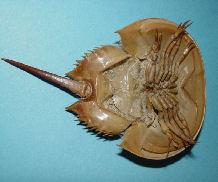
A prehistoric creature, from 500 million years ago, is expected to come to the New Jersey shore again this year. Related closely to spiders, the ancient Horseshoe Crab may soon be searching the beaches and mud flats for good places to lay their tiny green eggs.  However, when I looked at the tide chart for 2007 and the schedle of the full moon, I wondered how the Horseshoe Crab would have enough time to reach the shore, lay eggs and get back into the water before the hot summer sun came with its scalding glare.


The tide chart for 2007 for the New Jersey area indicated that the highest tides would occur early in the morning, right before the sun came up.  The moon would be setting early also, giving only a short time for the nocturnal Horseshoe Crabs to safely lay their eggs.  Does the element of time determine the nesting sites of the Horseshoe Crabs?  These prehistoric creatures that have been roaming the earth for centuries, may sense the need for better nesting sites elsewhere.  Would they be going to the Caribbean islands or the Gulf of Mexico?  It’s a mystery that needs to be solved. 


Horseshoe Crabs come up across the continental shelf from the cold ocean’s depth to the shoreline in spring and early summer. Estuarial waters and mud flats are the perfect locations for nesting.  The crabs push their way along the sand and mud then wallow round impressions into the sand where the female lays eggs and the male fertilizes them.  There are four species of Horseshoe Crabs found in the waters of Asia, North America and the Caribbean.  The Latin name for the North American species is Limulus polyphemus. It grows to a length of about 2 feet. To get to this size the crab sheds it skin as many as sixteen times in twelve years.  The abandon shells are often seen on the beaches. 


The construction of the crab is peculiar compared to most living things.  The mouth is situated in the middle of the body with the feet surrounding it.  The feet are used like hands to grab worms from the ocean floor and pull food into the mouth of the crab.  The Horseshoe Crab has four eyes that are sensitive to ultraviolet light.  The crab breaths through gills located under the body, behind the legs.


The best nesting times for the crab are during the highest tides of spring and summer.  They like to nest just a little beyond the tide line, usually after sunset or during a full moon.  But in 2007, in New Jersey, the highest tides with a full moon were in the morning just before sunrise and in the evening before sunset.  The highest tides occurred right before the sun comes up or in the evening during daylight. Would this cause a dilemma that would send the Horseshoe Crabs to some other shore? 


At Wilson’s Beach, Campobello Island, New Brunswick, Canada the relationship between tides and sunrise was different.  The schedule of tide and moon could be more favorable for Horseshoe Crab nesting.   In New Brunswick, Canada on May 2, 2007, a nearly full moon was shining at 8:12 p.m. and the sun was setting at 8:32 p.m. The high tide of 21.39 feet occurred at 12:28 a.m.  The next high tide at night on May 3, 2007 was at 1:01 a.m. rising to 21.46 feet.  This time schedule in Canada could be better for the Horseshoe Crabs.  They would not have to contend with the bright rising sun and its scalding heat which would kill them. 


Could this explain why the crab population appears to be diminishing?  The crab population could be altering its course according to the tide and moon. Maybe the bird populations, such as the Rudy Turnstone and Red Knot that feed on Horseshoe Crab eggs during migration, suffer population declines during the times when the Horseshoe Crab is farther north.  Is this a natural mystery that needs to be solved? 


Copyright 2007 Patricia Hilliard


Web Site: BayonneNatureClub


Want to review or comment on this article?


Need a FREE Reader Membership?


New Articles by Patricia Hilliard
article Image
There are so many bird and flower guides, how do you know when you have the best?
Why Peterson Field Guides are Best
article Image
If you love the Earth, <br>you should oppose war.
War and the Earth we need to live on.
article Image
Attending lectures online are mind-expanding, especially the National Academies Sciences Engineering Medicine
Cures not Wars
article Image
Why is Mother's Day so challenging?
Mother's Day Regrets
article Image
Are scientists right about male birds and ducks? Maybe not.
Myth of the Irresponsible Male
article Image
Who really is a bird expert? I call it as I see it.
The Bird Expert
article Image
Nature teaches me a lesson.
Getting Close to Nature with Kayaking
article Image
How to use your camera to improve your garden.
Camera as Gardening Tool
article Image
Memories are not always good. I remember how they used to think about the environment.
The Good Old Days
article Image
How to avoid starvation when stuck at the keyboard.
Digital Diet
article Image
If you want to avoid standing in lines in the summer heat, here is the best way to visit the Statue of Liberty. NOTE: SERVICE CHANGES due to COVID-19.
The Best Way to See the Statue of Liberty!
article Image
We are driven to write, but there are pit-falls to watch out for.
Writing is a Dangerous Business
article Image
You can get into nature writing with some experience and the new trend in nature publishing.
Nature Writing is for the Birds
article Image
How important is technology in your writing?
Dilemmas in Writing - TECHNOLOGY
article Image
How technology changes your life.
Feeling QWERTY?
article Image
What to do to get your writing out to the readers!
Writer's Dilemma!
article Image
Do you realize how beneficial writing is to your life?
Writing is the Gift that Keeps on Giving!
article Image
The spring chorus invites us to pay attention to birds.
Warblers of New Jersey and How They Sing!
article Image
Have you tried Bird Watching in Delaware? Get beyond Bombay Beach and see Prime Hook.
Birding the Prime Hook of Delaware
article Image
Snails photographed at Barnegat Light House park, New Jersey, USA in June, 2005.
Snails of New Jersey, U.S.