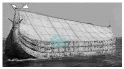
Prolog for an unfinished novella ...
a rendering of David Fasold's
vision of the ark of the great flood,
graphic by the author.
Ishtim at the Ridge - Prolog
by
JANSEN ESTRUP
Ishtim is an ancient name and his story has been told for millennia with other, newer heroes at the Ridge. You know some of their names. Those who lived in Kmpt before it was called Egypt called this hero Nu or Manu (Mother Night) and it was she (called Nammu in Sumerian myths) who rode upon the tempest and created the sun, moon and stars, and all the animals and people.
North, around Anatolia, two brothers fought a terrible war for the right to have existence created in their own image. These primal beings were named Anus and Mukarbis and after a horrific battle upon the void Anus fled skyward in retreat. But Mukarbis grabbed his ankle as he rose and climbed his brother’s legs in a deadly grip. There, suspended in nothingness, he sucked the vitality and generations from his rival and spat them copiously into the firmament, creating all the land and rivers and creatures of the glowing new Earth. Another people recorded these names as Esau and Jacob, another heal clutcher who became the progenitor of diverse tribes by destroying his brother’s offspring and legacy.
Similar stories grew up across the Dardanelles. Cronus was displaced by the only son he did not devour, Zeus (Tiws). This time Anus is called Uranus and he plays void to the old time keeper and predecessor of everything, Cronus - thus space and time. Yet another version, more modern (less than 3000 years old) has Hebrews borrowing the story of MaNu and changing her name and sex to Noah. Still another ancient yarn has it that the hero king was named Atrahasis and he, like the others, saved humanity’s remnants from a catastrophic flood.
Some believe that these stories survive from a much older event, the explosion of an Indonesian volcano scientists call Toba, some 60 to 70 thousand years ago. So great was the expelled ash that fewer than 45,000 human beings survived the long, dark winter, a time when the stars were covered and a great die-off, even in the sea, occurred. Mitochondrial DNA research has confirmed a genetic bottleneck in humanity from about that time, one of the few scientific ‘facts’ about this matter. So traumatic was this event that when volcanic dust settled the night sky reappeared and the Milky Way arched over the world it was seen as a great and colorful ‘rainbow’ a wonderful explanation had to be invented. And what of tsunamis generated by Toba? So began a surge in language which enabled storytelling to begin, evolve, then flourish. Virtually every creation story is born out of widespread destruction.
In 1989, David Fasold, a merchant mariner with many years of experience handling huge super tankers, published a book called The Ark of Noah, an exploration of the Hebrew Bible story told in a first hand way. He examined the physical evidence for such a vessel, found and photographed its remains (in the Ararat foothills, not atop Mount Ararat) and even solved the mystery of ‘gopha wood' (the material from which it is said to have been built) ... he provides plausible designs for an ark and explains how such a vessel, without engine or sail, might be propelled and maneuvered. He also speculated that such a voyage must have begun in the New World, calculates the speed and course of the ship and marks its journey across Spain and Italy before it ran aground on the conveniently inaccessible modern battlegrounds of the Iran-Iraq-Turkish wars.
The ancient Mesopotamian city of Uruk is said to have contained hundreds of reed ‘huts’, many of them more than 20 feet high and 100 feet long. Moreover, even today ‘huts’ are constructed on floating islands of reeds and house goats, fowl, sheep and cattle inside.
Some years ago archeologists announced discovery of remains of a sophisticated canal network running from Lake Okeechobee to the Gulf of Mexico, near modern Fort Myers. The lake, quite shallow, must have supported a stunning civilization in its time, yet most all traces of it have been scoured from Florida’s limestone bedrock. How?
Then there is the curious case of ‘the rushes’, a variety of reed that grows two miles high in the Andes at Lake Titicaca. It is closely related to the variety which once crowded (before the Aswan Dam) the muddy waters of the Nile and Tigris/Euphrates deltas but it is a mystery how the pithy stemmed plant came to be distributed in such far removed places and climates. The Andes location still uses this ‘wood’ to build worthy boats and Thor Hyderdahl made two successful voyages across the Atlantic in such vessels, named Ra, after the Egyptian sun god. Did these rushes once thrive on a Florida lake as well? Some years ago a German team created Abora III and attempted to cross the Atlantic west to east, as David Fasold had speculated. Abora III, built on Lake Titicaca, made it most of the way across the Atlantic before storms broke it up. It was a much smaller vessel than either Hebrew scriptures or David Fasold described, yet it made 35-40 nautical miles a day (going the ‘hard way’), slightly less than Fasold’s reckoning for a six hundred foot long behemoth. Powered by sail and steered by rows of ‘planks’ which are raised and lowered on either beam, it much resembled the system employed by Incas and their huge balsa rafts which had plied the Pacific in both directions, although the rafts also utilized a tripod mast and sail rig which Abora III did not. Fasold’s ‘ark’ was stabilized astern by a single huge drogue stone made of granite suspended by ropes and steered by a trio of smaller stones on either beam which could be winched up to permit the bows to ‘drift’ to either port or starboard as Ishtim might direct from his perch high atop the massive vessel. Fasold's experience with super tankers spoke knowingly of the long 'lead time' needed for maneuvering so large a vessel.
The secret is in construction and type of material. The largest timber vessel ever built was a 375 foot clipper ship and she would not sail because no tree has timber strong enough. It broke up being subjected to the rigors of wind and sea. But a ship built of reed bundles, the fabled ‘gopha wood’, is both flexible and buoyant.
Certainly it would take a lot of reeds to build such a massive vessel, and they would have to be harvested and dried well beforehand. Also required is a large population of skilled, cooperative workers. Lead time for such an epic undertaking might be greatly reduced by using materials already at hand. In one version, Atrahasis is warned and instructed to build a ship by the gods. In the older, Akkadian version of The Flood in the Epic of Gilgamish, it is Ennugi, the Canal Master, who instructs,
“Reed house, Reed house, Wall, Wall,
Harken, O man of Shuruppak, son of Ubarutu,
Tear down this house and build a ship ...”
Tearing down an entire city’s buildings and walls might provide enough cured, woven material for a ship the size Captain Fasold (and various scripture) envisions.
Then there is the matter of enough water to float such a behemoth. Built upon land it would have been impossible to move. So whence comes the water in enough quantity to lift this reed ship and float it around the world? Rain? It is calculated that rain covers three percent of our world at any given time, some of it in downpours heavy enough to cause mud slides and flash floods. Even rain which lasts ‘40 days’ must follow certain rules. For example, water runs downhill. If our ship had been built in the Tigris/Euphrates lowlands, where floods were routine, the first few days’ rain would have gathered and lifted us, rushed us down the natural grade into the Persian Gulf, thence into Iran and on to India. Or possibly we would have worked our way south into the Indian Ocean. Certainly we would not have been propelled backward, uphill against the flow into the mountains of extreme western Turkey.
A different problem presents itself if we suppose the vessel began its voyage in southern Florida. There is no gradient for water to gather its strength. Heavy floods do occur farther west in Mexico’s Vera Cruz region, but the cultures there built of stone and there were no large lakes or shallows for reeds to thrive. So rain alone, not even the dreaded serpent deity, Huracan, can provide the depth of water, wind or current necessary for our vessel to get going and maintain its way.
There is another theory, hinted at by Captain Fasold. He speculates that an extraterrestrial force (not necessarily divine) may have been at work, something which caused the Earth to interrupt its spin. It is a thing mentioned in lore, this ‘making the sun stand still’ or causing the day to last longer. Such a calamity might be demonstrated if one takes a shallow pan, fills it mostly with water and (holding the pan level) takes a brisk walk around and round. Pause suddenly and you will stop but the water has its own momentum. It will slosh about and even when you resume your own momentum, the water in the pan will take quite a while to calm itself.
Further imagine that instead of a pan it is a spinning ball with a molten iron core and the center wants to continue spinning, too. Not only that, the center is somewhat unbalanced and helps to wobble the Earth out of its normal rotation and out of its orbit as well. Our home, herky-jerky, takes the moon with it, perhaps yo-yoing in ever more oblong circuits and this causes the tides even more agitation. Who and whatever occupied any sort of vessel was in for a hellava ride.
So, this idea goes, a large body - say a stray asteroid - passes between the Earth and Moon, heading toward the Sun. Earth’s rotation (say we’re looking down on the North Pole and call it clockwise) staggers and slows abruptly causing the world’s oceans (which keep on turning a thousand miles an hour) to swell up out of their beds and inundate the land sweeping all before it. As with any tsunami, the seas will seek to return to their places, but now the planet’s rotation tries to regain its momentum, to catch up, causing the waters to slop around all over again. But this would have been no mere rogue tidal surge. Not even archaic words like tumult or ferment begin to prod our imaginations adequately.
Plausible. I can almost hear a modern comic ‘goddess’ rasping, "it could happen!”
But how did Ishtim and his people know to begin such an urgent project? Rather, how did his canal builder know, and how did he convince his rulers, or subjects, that he wasn’t a total whacko? Did a keen eyed astronomer priest spy this errant missile several years away and determine its near-miss trajectory? If so, by what astronomy and what mathematics?
More important, by what communications mechanism? We face a similar calamity these days with global warming but even with worldwide, 24-7 news channels, getting anything done is like watching Aphrodite being born from the froth of the Milky Way ... eternal slow motion.
So mysteries remain, speculation is rampant, conspiracy and fiction thrive in such fertile soil.
|
|


I believe the correct word is fowl, not foul.
Confused about Lake Okefenokee. Was it connected to the Gulf of Mexico by a canal system?
Ron