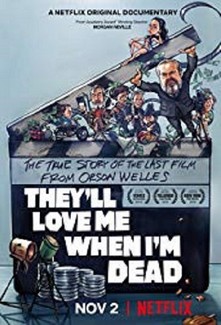
Neville’s documentary deals with the last fifteen years of Welles’ life, which were devoted to making a movie about an aging director trying to complete his last great film (art imitating life?). The always wonderful Alan Cumming serves as narrator, and clips of scenes from The Other Side of the Wind are shown as well as comments from people connected with the film who are still around, including co-writer Oja Kador and acclaimed filmmakers Peter Bogdanovich and Henry Jaglom.
Orson Welles, we won’t forget you.
This documentary seems true .
Your last film’s ups and downs we see.
Unfinished by you. A mystery.
Lots of toil as the years went by,
but funding problems might be why.
Or to keep filming was your goal
because it formed part of your soul.
Starting at top, then going down.
Hollywood is a ruthless town.
Times a-changing, perhaps too fast.
Will films of yours be ones to last?
Fortunately, Netflix is also releasing at the same time a restored version of footage from Welles’ The Other Side of the Wind, which makes a fascinating double feature for cinema buffs everywhere. John Huston looks magnificent in the lead role of Jake Hannaford, while Bogdanovich manages to hold his own as a rising young filmmaker and friend who learns about betrayal. (It’s interesting to note that comic/impressionist Rich Little was Welles’ first choice for that part.) Also, the documentary indicates that Welles thought about portraying Jake himself. What a treat that would have been!
As a confirmed movie addict, I really enjoyed this documentary. It shows filmmaker Welles with warts and all. And it reinforces my belief that he loved making movies more than anything else. Below are two of my favorite quotes by Orson Welles to prove my point.
A movie in production is the best electric train set a boy could ever have.
The cinema has no boundary; it is a ribbon of dreams.
(Released by Netflix; not rated by MPAA.)
Review also posted at ReelTalk Movie Reviews.
















Orson Welles was an original that will be hard to replace 21st-century.
Ron