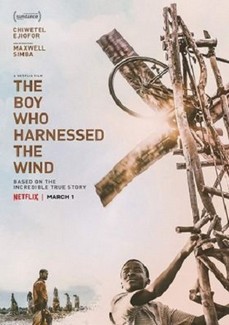
Set in Africa’s Malawi, this movie shows what happened in a farming area during a long drought. Without rain to water crops, how could the people survive? While watching certain segments, my lips actually felt parched. Film realism at its best!
Although William is expelled from his school for lack of funds, he comes up with an idea about how to draw water from the well. All he needs to start his project is a bicycle. Unfortunately, that becomes a monumental problem, one that causes a serious rift between William and his father (Chiwetel Ejiofor/12 Years a Slave).
Ejiofor directed, wrote (adapted William Kamkwamba and Bryan Mealer’s book), and stars in this remarkable offering. His brilliant performance as a concerned but sometimes rigid father should be considered during the 2019 awards season.
Soak up the atmosphere and place
as people run the famine race.
Starvation faces everyone.
What, if anything, can be done?
A young boy knows the answer here.
Old-fashioned thinking is his fear.
Will he be brave and save the day
despite his father who says nay?
The lad could be a hero now
if others help him show them how.
Suspenseful with a feel-good touch,
this movie you will love so much!
Interesting sub-plots, convincing performances by all cast members, and atmospheric cinematography by Dick Pope (Mr. Turner) help draw us into the world of William Kamkwamba. And we can’t help feeling inspired by the courage of one young boy who persisted with his inventive idea.
Congratulations to Chiwetel Ejiofor for finding this humanistic story and making sure it became a movie for everyone to see! I look forward to many more films under his direction.
To invent, you need a good imagination and a pile of junk. --- Thomas Edison
If you do what you’ve always done you’ll get what you’ve always gotten. --- Tony Robbins
(Released by Netflix; rated TV-PG.)
Review also posted on ReelTalk Movie Reviews.


























You have reminded me of when, in 1978, my host was looking for fish (there were none) near Dhaka in Bangladesh. We came upon the Ganges and I was amazed to see dozens of white sailed craft plying the waters ever so silently. It was like watching a ballet in progress that could be put to music but it was the silence that got me. No motors at all, yet commerce was in full progress.
Later, on a trip to the jungle that disappointed my host because the jungle had been cut down… Probably for firewood or dwellings, I saw farmers irrigating using a very primitive method. Two men with a leather sling between them, were dipping the sling in water in a pond and then swinging it higher up to another depression that was dug to catch the water and so forth, to irrigate the area around the pond (probably hand dug to catch water in the rainy season). I assume then crops were planted to grow in the small irrigated area around the pond. I couldn't believe someone doing that for hours on end. It was very labor-intensive and must have required a lot of calories for the men to do that. The land there was so barren (it was winter… January) that hardly even grass grew. The rainy season hadn't started yet.
Later on the trip, in Thailand along the coast, I saw ingenious windmills made from bamboo and sailcloth, pumping water up from the sea to settling ponds for drying to harvest the salt. I thought of those men in Bangladesh, doing that job by hand when windmills like those in Thailand could do it better with no effort except hand construction and repair.
Ron