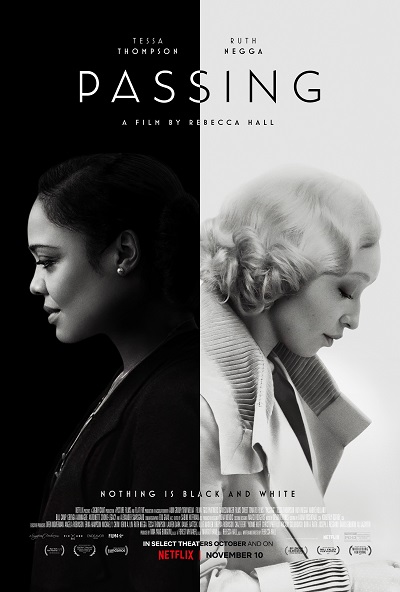
Tessa Thompson delivers a superb performance as Irene, the wife of a Harlem doctor (André Holland). She’s also active in the Civil Rights movement but doesn’t want anyone to talk about the bad things happening to Negroes in front of her children. Throughout the film, we have to guess what Irene is thinking most of the time. But Thompson is such a great actress her beautiful face reveals almost everything. And she gets excellent help with intriguing close-ups from cinematographer Edu Grau.
Matching Thompson’s performance, Ruth Negga plays glamorous Clare, a friend from the past who is now passing as the wife of a well-to-do New York racist lawyer (Alexander Skarsgard). Clare is curious, outgoing, a bit flirty, and quite fashionable. When these two old friends accidently meet again, both of their lives change completely.
PASSING, a film in black and white,
boasts two women playing roles right.
Thompson and Negga take us in
to their dual worlds. But who will win?
To pass or not to pass it seems
a question asked as if in dreams.
Two high school friends meet after years.
One is passing, the other fears.
Surprisingly, their friendship grows.
Yet between them soon tension shows.
Dangers lurk in so many ways.
Party nights and sociable days.
Love, obsession and jealousy.
A spellbinder you ought to see.
Writer/director Rachel Hall deserves high praise for her first feature film production. Her adaptation of the 1929 novel by Nella Larsen should earn an Oscar® nomination. Although I haven’t read the source, now I want to. Kudos also to Edu Grau for his unique cinematography and to Devonté Hynes for his music that increases the tension in so many scenes. Plus, costumes, hair and make-up as well as production design help us go back to the 1920s.
I want a sequel.
It’s funny about “passing.” We disapprove of it and at the same time condone it. It excites our contempt and yet we rather admire it. Why shy away from it with an odd kind of revulsion, but we protect it. --- Nella Larsen
(Released by Netflix and rated “R” by MPAA.)













I don't know who Nella Larsen was, but I never would "disapprove" or find "revulsion" in the simple act of escaping racial oppression by simply passing for white. For 30 years, I passed for being "healthy" even though my gnarled and useless hands, with my hand split when I worked, gave me away. Moving into the wheelchair, changed people's attitudes greatly. I became useless in many bystanders' eyes and in need of help offered by good Samaritans that I used to my advantage while being disgusted for being ignored7.
I recall thinking that my brother's first wife whose grandparents were farmers in northwestern Wisconsin with the name of Lee, were part of someone by that name escaping and passing back in the days after the Civil War or even before. We are now beginning to know by the use of DNA how many were successful, but I believe a great many, when they saw the opportunity, left for a better life, hard as it was in those days.
Claire being married to a racist is something I would like to see played out in the film.
Ron
Sounds excellent! Thank you Betty Jo Tucker!
Joyce Leahy