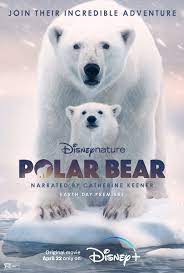
Catherine Keener (narrator) voices one member of a polar bear family as she looks back on how her mother bear took care of her cubs during difficult times. Keener may not be Morgan Freeman, but she does an excellent job here. Her voice comes across as soft and manner-of-fact, just like we would expect in this life-like situation.
While watching Polar Bear, my husband and I felt awed by the wonderful photography of these animals playing together in the snow and ice. We did not know seals were the major source of food for polar bears, so the bloodshed between these two species surprised us. And a daring climb sequence is one of the most exciting scenes in a movie so far this year. Marvelous cinematography showing unhealthy changes taking place in the polar bear land is also a highlight of this timely offering.
A hard-luck life for polar bears
as ice melts away these past years.
A female bear cub lets us know
about herself, her mom and bro.
The mother teaches her cubs well.
Swimming, hunting and where to dwell.
Finding food takes most of their time.
It’s scary when we watch one climb.
Though “Polar Bear” lacks much in plot,
awesome vistas is what it’s got.
Plus, visual lessons that we need
about the Earth’s dangers indeed!
How does Polar Bear compare to other live animal nature films? Although not as entertaining as March of the Penguins or Naledi: A Baby Elephant’s Tale, it ends up being a worthy movie for the entire family and should help viewers understand the massive challenges facing our planet.
There will be no polar ice by 2060. Somewhere along that path, the polar bear drops out.” --- Larry Schweiger, President of National Wildlife Preservation.
Our task must be to free ourselves by widening our circle of compassion to embrace all living creatures and the whole of nature and its beauty. --- Albert Einstein
(Released by Disney + and rated “PG” by MPAA.)























I remember in the 1950s in a Main Street doctor's office, a standing stuffed polar bear in the corner of the waiting room. Few could afford to hunt and stuff a trophy like that in those days. By the 1970s when I saw a half-mile loss of the Athabasca glacier in Alberta, I knew then that global warming was a real problem that needed solving. Naysayers have mocked the polar bear plight by claiming that polar bears were increasing in numbers in some areas.
I read a recent article in National Geographic showing that some polar bears have become adept at searching the shores for clams and other mollusks. Bears are opportunistic feeders and don't mind scavenging carrion. One whale carcass can sustain a number of polar bears for months. With the increase of some whale species as a result of hunting restrictions and global warming, more dead whales are washing ashore and indigenous people have taken to killing some and putting them on the shore for polar bears.
Finally, as they range from the sea where there is no ice, and they meet grizzly bears, there is some interbreeding and hybrid bears. Often even larger and more resourceful, are the result. Mother nature will adapt a species so that it can find the food it needs to survive.
We have to stop hating insects and weeds. These unwanted, nasty things underpin all life and by poisoning and eliminating them, all of the beautiful animals we admire so much will be gone, too.
Ron