 A short story about the struggle of a homeowner to maintain a lawn with a diverse blend of natural grasses and wild flowers, against a neighborhood culture of intolerance of any cover, except bluegrass. Some philosophical, environmental, and herbalistic thoughts are included about the natural beauty of dandelions, and the true Legend of El Dorado.
The Battle of the Dandelions
For the past couples of weeks, the season has been announced by the birds. Ah, Spring! After a long Winter, life returns everywhere, even to the office. We feel physically and mentally energized, we dress lightly, and people look beautiful. There is a sense of excitement, of renewal.
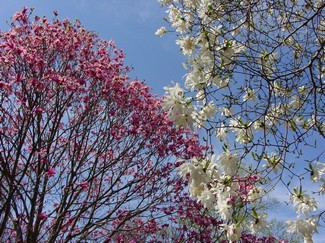
Trees bloom with a myriad of flowers and aromas. Light-green leaves begin to appear on branches and bushes. The grass in the neighborhood responds to the warm temperatures by gradually turning from brownish to green, while a potpourri of flowers mingle with the new grass blades. The most spectacular of these wild flowers is the dandelion, which comes –uninvited– to help us celebrate the new season with a party of mighty yellow vigor sprinkled everywhere like a magic carpet.
Dandelions remind me of alpine landscapes in early Spring. It is a flower I associate with my South American ancestors, the “Chibchas,” who were the protagonists of Legend of El Dorado. The true story of El Dorado occurred in the Lagoon of Guatavita located high in the Andes Mountains of central Colombia. It is a mysterious lake on the crater of a mountain. A tight “carpet” made of billions of dandelions surrounds the lake. The intense yellow of the flowers contrast with the deep green of the waters. There is no reasonable explanation to the unusual occurrence of a lake at that altitude on the top of a mountain, not even the obvious recharge from groundwater. On the shores of this lake in full moon, the great shaman of the Chibchas –“the Cacique”– covered his body with gold powder before bathing in the water, while the tribe congregated around the lake threw tiny statues made of solid gold into the lake as a sign of sacrifice. Of course, this ritual occurred before the sixteenth century when the Spanish invasion annihilated the indigenous cultures. I remember many years ago we camped on the shores of Guatavita. For hours, I contemplated the bright yellow of the dandelions, the gray mist above the lake during the evening, the deep green of the water. I felt transported to ancient times when people lived in harmony with nature.
When I moved to North America, I discovered with dismal that the venerated dandelion, along with all wild flowers, is the object of much hatred among homeowners. The appearance of dandelions and wild flowers every Spring is taken as an invasion that must be defeated. An army of heavy machines driven by “landscape professionals” disrupts the sounds, colors and beauty of the Spring. Year after year, technology provides machines with increasing efficiency, noise, and power. Today’s lawn mowers are potent circular decks capable of rotating and advancing at high speeds. They furiously attack home lawns as an enemy that must be tamed and made to conform according to a very specific set of standards of leave length and contour shape. The noise disrupts what would otherwise be the most beautiful natural sounds one can hear: the birds singing, the wind caressing the trees, the subtle trickle of water running from the springs.
However, the initial assault by the landscaping armor division is not enough. The enemy must be defeated with chemical weapons! There is no international treaty that protects dandelions against chemical weapons, no negotiation, no reason, no mercy. It does not matter that many of the pesticides and herbicides applied have been identified as potent carcinogens and that ultimately, over a long time, homeowners themselves and their pets might suffer adverse health consequences. Thus, a second division armed with a wide range of tanks, pipes and sprinkles spray solid and liquid chemicals on every corner of green in the area. A foul odor of hazardous chemicals replaces the delicious smell of flowers. On the edge of lawns, little signs warn walkers of the dangers of an area that received a new “application.” For a while, it seems like the battle has been won. The poor dandelion has been killed and the lawns of fancy subdivisions victoriously proclaim the Bluegrass Supremacy to the exclusion of any other variety, not even other types of grass. The extermination includes even the warm-weather grass varieties, called “crab grass” by the homeowners.
Every year, in the midst of this war, I silently support a healthy diversity of plants. I mow my lawn, but I never spray chemicals. I believe that dandelions and other grass varieties should be part of a natural ground cover. In the past, I have had lively discussions with some of my neighbors about what should be the definition of beauty in a lawn. I have always voiced my disagreement about this insane exclusion of other ground covers. Why bluegrass only? Why should we insist on eliminating indigenous covers, which do not require maintenance, fertilizing or watering? This madness about splash bluegrass covers does not make much sense in a world of water shortages, environmental awareness, and health consciousness.
Most neighbors see my point, some disagree with it, but in the end they understand that I have the right to plant what I want within my property. Until last week, I never thought that dandelion prejudice would reach the level of insanity for some homeowners. Is it possible that homeowners who do not support the Bluegrass Supremacy would be subject to persecution? Last Saturday evening my, wife and I returned home from a lovely day of hiking. My daughter greeted as in deep distress. She said that a neighbor knocked on our front door with such a force that she thought the door would collapse. When she opened the door, an angry man insulted her and demanded we purchased chemicals in the hardware store and fumigate our lawn. Indeed, it is the third phase of the battle: repression. It reminds me of people living under totalitarianism. The informant might be your next-door neighbor, who would turn you in for disagreeing with the government. The phase of dandelion repression now takes the form of door-to-door search for guilty homeowners, who may be subject to aggression.
Presumably, this is a neighborhood of professionals; people with education. The neighbor in question superficially seems like a reasonable person, an educated man. What kind of dandelion hatred subjects a reasonable person into temporary insanity? My first reaction was anger. My lower self –my emotional self– wanted me to confront the neighbor. No, I should not respond aggression with aggression. In the end, my middle self –my rational self– took control. I sent a written note to my neighbor appealing to his reason, explaining the environmental and health reasons I had for not poisoning my lawn, and politely reminding him that I had the right to live by my principles within my property. The battle has not ended. I hope reason will prevail. I hope that a botanic diversity and tolerance will slowly permeate suburban lawns.
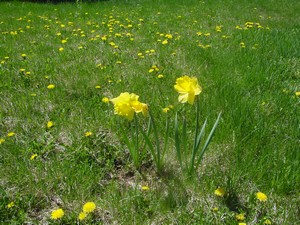
Before I mowed the lawn this week, I took a few pictures of the lovely dandelions, some mingled with late daffodils. I contemplated their joyous sunny yellow, while mentally apologizing to them for human’s folly. Why modern humans hate it? Can they not see they are part of Spring’s health celebration? Scientists named it Taraxacum Officinale. They are gradually rediscovering what shamanic cultures have known for centuries: That dandelion is delicious and nutritious in salads, but more importantly, that it has wonderful healing properties. It can heal dyspepsia, constipation, fever, insomnia, hypochondria, gallstones, jaundice, liver problems, rheumatism, gout, and stiff joints. To me, dandelion is more than a healer. It is a symbol of joy. I salute you!
|