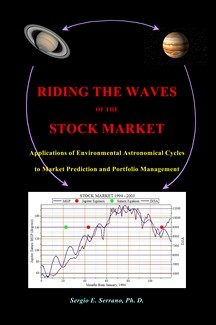
 New research reveals the existence of natural cycles in the Dow Jones Industrial Average (DJIA). A comparative analysis of market data over the last 120 years concluded there exists a significant correlation between the ups and downs in the DJIA and astronomical positions of objects in the solar system. The results offer practical applications for the individual investor, including the design of a portfolio, the periodic rebalance of assets, and the strategic buying or selling of key stocks.
This is an updated version of the article first published in December 2017, in the light of several market corrections in February and March 2020, and especially in April, May, and June 2022, which appear to confirm the market predictions of the original version. If you did not heed my advice then, it is too late. As resons for the market drops, analyst point to the global pandemic, the the disruptions in the supply chain, the rise of inflation, and effects of the wars in Ukraine and other places. Do not panic. Do not sell, or do anything. Long-term historical data shows that if you are in the market for the long haul, it will recover. More details on this and on how to deal with the normal psychological barriers below.
New research reveals the existence of natural cycles in the Dow Jones Industrial Average (DJIA). A comparative analysis of market data over the last 120 years concluded there exists a significant correlation between the ups and downs in the DJIA and astronomical positions of objects in the solar system. The results suggest that the relative astronomical position of two or more planets –especially the large outer planets in the solar system– exhibit a strong correlation with the long-term highs and lows in the DJIA.
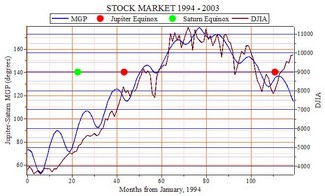
In particular, the angular distance between two of the large planets, as observed from the Earth, has an inverse relationship with the DJIA. For example, the angular distance between Jupiter and Saturn increases from zero to 180 degrees during an interrval of about 9.8 years, and then decreases back to zero degrees over an equal interval. The time lapse when the angular distance decreases was found to correlate with bull market periods. Other astronomical events found to condition the market included the occurrence of equinoxes of the large planets, the distance from the planets to the Sun, and their distance to the Earth. These events tend to have a disruptive effect, and to be associated with bear markets.
To Sell, or not to Sell, that is the Question
With the characterization of these cycles, the implications for practical applications of these patterns are crucial. The simple process of making money in the stock market consists in buying stocks at a low price, holding them for some time, and then selling them at a high price. Knowing when to buy and when to sell remains a quintessential dream of investors. The design of a portfolio, the periodic rebalance of assets, and the strategic buying or selling of key stocks depend entirely on the right timing –the timing of buying and the timing of selling. We now have a means to plan the correct time.
The natural cycles of the market tell us that there is a high season for the market, during which we should sell the expensive assets and collect profits, and there is a low market season when we should buy the inexpensive ones. Just like the climate seasons, the market cycles do not predict daily fluctuations, but they predict the conditions for a bull market and its average duration, and the conditions for a bear market.
The Stock Market Environment
What are the environmental forces that determine market cycles? We understand that the stock market reacts to the economic, political, and social environment. When we think about the environment, we evoke nature –rivers, oceans, forests, the atmosphere. However, the environmental boundaries that affect the Earth extend beyond the atmosphere. Science tells us that the seasons are caused by the axial tilt of the Earth with respect to the plane of its orbit around the Sun; that the Moon controls the tides and its massive displacement of waters; that the sunspots disrupt the Earth's magnetic field and telecommunications; that the orbits and the high rotational speeds of the giant outer planets –Jupiter and Saturn– perturb the gravitational field of other planets. Science has yet to uncover other effects of phenomena in our solar system on plants, animals, and the human psyche, which are extensively documented in many cultural and esoteric fields.
If the astronomical environment and astronomical events control many of the Earth's processes, would the human psychology of buying/selling be an exception? The new science of behavioral economics proposes that investors buy on impulse, out of illogical and emotional reactions. Then, the price of a stock is affected by individual and mass psychology. Take for example the current market conditions. The last seven years have seen one of the biggest increases in the value of the DJIA, as well as other stock market indicators. Since the last recession, the DJIA has more than tripled in value. The market is overheated, stocks are overvalued.
During the first writing of this article –December 2017– I advised readers who owned stocks to sell and collect profits, or at least rebalance their portfolios, before an imminent market drop. Yet, investors continued to pour money in the market. Then, came the market corrections of February and March 2020, and lately the dramatic decline in April, May, and June 2022. We witnessed a glimpse of fear-driven market sellout, not seen since the Great Recession of 2007-2009. As described in the above-mentioned research, this is just a small sample of the downward market conditions to come in 2022 and beyond. While the rise in the market value is slow and gradual, the drop is sudden and turbulent. Do not sell, or panic, during a sudden market drop. If you are in the market for the long haul, your assets will recover. In the book I describe strategies for planning and rebalancing, and techniques for dealing with the psychological barriers to successful investing.
While we wait for science to formulate the laws that affect the mass psychology of buying and selling, and their origins in the astrophysics of the solar system, we can take advantage of knowledge of the astronomical cycles. We can now plan and manage our portfolio with confidence, while reducing the risks of loss. I hope you will take advantage of them and reach your financial goals.
_________________________________________________________________________
Dr. Sergio E. Serrano is the author of
Translator of
AN ART OF LIVING
by Andre Maurois
|