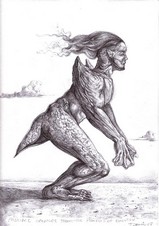
The great mistake of the German objective power-state idealists was to conceive of the State as an animal
ON THE USEFUL WORSHIP OF POWER
"We wish for no other God than Germany." Hitler
We do well to separate church and state, but they are essentially inseparable no matter how formally we separate them. The essence of god and state is one; namely, Power. We find religion in politics and politics in religion. Broadly speaking, religion organizes the worship of Power while politics distributes or regulates its exercise. We might correctly say, for example, that Communism and Republicanism are religions with the same god differently distributed. The worship of Power is universal; the form of worship changes, is expressed dogmatically and is rationalized ideologically or theologically.
Christianity is rooted in Jewish revolts against an alien empire. The methods of the original enemy were adopted during the struggle - enemies are defined by one another. Effective loyalty was eventually transferred from caesar or king and pope to sovereign State and People. By virtue of "natural law" or the law natural to humankind - reason, and by virtue of the universal craving for power inherent in the will of individuals to persevere forever without restraint, Power became more broadly distributed over the population. Power is the essence of god and state, and it is the currency funding the historical progress of liberty. Politics, the moral (mental) exercise of power, which is necessarily social, forms the distribution. We find the gist of this crude observation wherever power is the subject of discourse. For instance, we excerpt the following from Friedrich Meinecke's Machiavellism:
"Power is always and for ever part of the essence of the State, but it alone does not constitute the whole essence; for justice, morality and religion from an integral part of this essence as well.... One may say that power was certainly the most original and essential permanent factor in the essence of the State, but it is not and never will be the only one.... Treitschke repeatedly continued to announce that the essence of the State was nothing else but power, thereby limiting it an corrupting those countless people who in life's struggles hanker after simple maxims, and causing them to overestimate and revere simple power, and thus see the basic problem of the State in much cruder forms...."
"The English spirit, which had been altered by the religious movement of the seventeenth century, showed an increasing tendency to change the sword of the naked power-policy, which England always pursued, into the sword of an executor of the law - whether summoned to the task by god or by justice and morality. This was indeed, as has frequently been observed before, the most effective kind of Machiavellism, which could be brought by the national Will of power-policy to become unconscious of itself, and to appear, not only to others but also to itself, as being pure humanity, candor and religion. As a rule, this unconscious expediency in political conduct, this political instinct, is lacking in Germans. Bismarck... yielded to the German tendency to call things by their proper names, and to recognize unashamedly the State necessity of power-policy, outwardly robust, but without inner cynicism, from a deep feeling of responsibility for the State as a whole....Thus it is true to say about all his conduct, even the boldest and most ruthless of it, what Ranke said about Frederick the Great's conflict between morals and politics: The hero must be justified at least in his own eyes."
It behooves us to note that the urge to the whole is just that, an urge, a motive, a will to power. The great mistake of the German objective power-state idealists was to conceive of the State as an animal, as an individual man in its own right - the best man-state in the world of course. The whole is really not either the idolized state of being or the becoming process. The deity is the unknown Power which can only in definite effect be conceived as a multiplicity - as if the Universe conceives itself as a multiplicity because one object alone without another to compare it with is incomprehensible. The original evil or sin of the formal subject-object diremption (divorce) precludes in this world a final unity or redemption of subject-object in a return to original unity. The pessimistic perspective, that of belief in original sin, stems from the irrational (no ratio) or one-sided intuition that the whole alone is good; therefore it follows, as long as humankind consists of separate individuals, that there must be evil from the very moment of conception.
That a whole is a whole of parts is ignored. It is as if the individual, in its love of the whole, hates its own self or own power because it is limited or definite, and would, consequently, in its craving for absolute power and love of the possibility of its own extinction, sacrifice its particular representation of universal power and return its form or body to the elements. Individual freedom, then, according to the pessimistic viewpoint, is the root of all evil, for the individual will is contrary to the whole, which will ultimately absorb that individual no matter what its limited form might be. For a person to claim that he has a free will, and that he voluntarily conforms to the necessity of his extinction is a self-contradictory admission of defeat. Of course the passion for sex and violence may be rationalized or justified as necessary to the moral and physical progress of the species, the danger being that technological advances might make the premature extinction of the entire race possible.
Ethical religions and politics are in their moral aspects forms of renunciation or virtual suicide. The civilized individual altruistically sacrifices private selfishness to the greatest public good in the sacred name of the most powerful deity who dominates the world, or in the name of the highest good overlooking all, or in the name of the whole which is essentially unknown through the unreliable senses. Virtual suicide comes highly recommended by rulers regardless of their religion or lack of it. Even faithless rulers, concerned solely with power in this world rather than in the imagined next world, take advantage of spiritual religion if political religion does not suffice. Why? because it really works, because it can be employed as an effective tool for the manipulation of the faithful.
It is possible even for atheists to be saints; say, of the Compassionate Order of Saint Emmanuel the Good, Martyr, fictionally canonized by Miguel de Unamuno. Wherever Christianity might be professed, adroit references to the suffering of Jesus on the Cross can move Christians to make certain sacrifices, even their lives, in the name of god, in order to obtain the promised land in this world, and, where that is failing, in the imagined next world. Renunciation for the sake of Power is a convenient thing in cases of war, including holy wars fought by holy warriors led by holy men. Witness how and why Augustine and Luther and countless other religious authorities gave the sword of Jesus to the ruling political authority, and how they justified that gift with sophisticated arguments and casuistic stretching of scripture, and, when logic failed, by reference to "God's mysteries."
Imperial or colonial powers employed mysterious firepower and religious power to terrorize "natives," whom they presumed to be their cultural if not racial inferiors. For instance, Methodist missionaries did not try to rid Fijians of their belief in ancestral spirits, but defined the spirits as hostile "demons" instead, to be kept in check, of course, by praying to the omnipotent Almighty Terrorist, "Jehovah," whose representative on earth said, "Love thine enemies."
The term "enemies" (na meca) is ambiguous; it might mean non-Christian "people" (tamata), "kin" (veiwekani), "devils" (tevoro) and so on. The indefinite enemy is disrespectfully addressed, directly, as "you" (iko), meaning, enemy people, unnamed kin and ancestors, unspecified devils, inexplicable sickness and the like; that is, anything evil.
Malicious invisible beings frighten Fijians by putting curses on them. Prior to conversion to Christianity, evil spirits and demons could be called upon by means of formulaic sayings, then bargained with and otherwise controlled. But since the advent of alien Others and their Christian god and exploitative ways, the Fijian power over their own history in the form of ancestral spirits has declined. Constantly threatened from without and from within, they have lost Power; more specifically, power over their selves and other properties - the loss of land is their greatest fear. Their non-Christian ancestors have been demonized by the Christians. And the demons persist as demons at the behest of a Christianity whose god, to be god, needs a satan to constantly cast out. Fijians have been cast by Christians as powerless actors who must pray to the terrifying Jewish god for relief. Instead of getting rid of enemies, they must love them. It is not difficult to ascertain the underlying Christian strategy: the Fijian is to love the despicable Other, the Christians, must accept them, must love them. That sort of love is self-hate-based love. Anthropologist Matt Tomlinson concludes a research article on Ritual, Risk, and Danger: Chain Prayers in Fiji, as follows:
"The reason that the enemy was identifiable only as an ambiguous 'You' was because the enemy was not only ancestors nor sickness: The enemy was ultimately Christianity itself, in its role as a historical force which has gained authority over and against chiefs by literally demonizing the past."
Tomlinson refers to Joel Robbins' (1998) study of struggles of the Urapmin of Papua New Guinea with Christianity. The Australian Baptist Mission focused on desires rather than spiritual ancestry: desire and willfulness were formerly necessary attributes of sociability, but the Baptists deemed desire automatically sinful. "The local result," reports Tomlinson, "has been a ritual focus on naming, controlling, and occasionally extinguishing desire. In Tavuki village (in Fiji) where I lived, 'desire' is not seized on as quite so problematic, but the past's echoes of dangerous curses that haunt the powerless present create a similar unease that demands to be addressed."
One might crave omnipotence, yet power unlimited by anything at all is nothing at all. Relative freedom is always from something in particular. Power exercised has a direction; its deliberative exercise is moral (mental). Beneath the supreme power or potentate, whether that power or person be spiritual or secular, it is hardly surprising that many people find themselves anxious, in a double-bind somewhere between freedom and slavery, god and devil, saint and sinner, billionaire and pauper, and, within the class of holy men, somewhere between the obese pope in his fine cathedral and the naked sadhu who has been standing beside the Ganges for twenty-seven years with one arm in the air. The progress of civilization, again, depends on virtual suicide. It depends on the psychological implantation of a "conscience" or overseer, a virtual or introjected authority to terrify the resurgent evildoer within, that he might not rise up against the real powers without. Hence the person lives in perpetual conflict, somewhere in between good and evil. He may spiritually revolt against his masters without, but he dares not physically revolt against them. He may worship the relevant form of Power in their churches, but he may not safely revolt against the political control of that power.
Meinecke, Friedrich, Machiavellism, the Doctrine of raison d'etat and its place in modern history, transl. Douglas Scott, New Haven: Yale 1957
Tomlinson, Matt, American Anthropologist, March 2004
|












Peace and Wisdom.
"On The Useful Worship of Power" reminisces and paints a historic reality that leads the cerebration of our times on the road of social awareness.
I have enjoyed the reading of a golden Scroll by a holder of a Quill that soars wisely safe blown by winds of knowledge.
In reverent appreciation.
Under the Light of Mother Poet,
Andre Emmanuel Bendavi ben-YEHU