MY QUEST FOR THE MEANING OF EA
BY
DAVID ARTHUR WALTERS
“Ea” is a Hawaiian word in the official motto of the State of Hawaii that I believed has been politicized or misinterpreted as “sovereignty” to suit the political agendas of everyone concerned, especially the people who identify with the native Hawaiians who resent the notion that their dominion over the islands was “stolen” from them by “haoles,” a derogative term for white foreigners, with the abdication of Queen Liliuokalani in 1893.

As a matter of fact, the dominion of Hawaiians over the Sandwich Islands began to slip away with the advent of the British cartographer and navigator, Captain James Cook in 1778, whose death at the hands of natives in 1779 over his attempt to recover a stolen cutter from his ship by taking a local chief hostage is rumored to be secretly celebrated by a faction of their descendents every February 14, called ‘Kill A Haole Day” instead of Valentine’s Day. B.C. or Before Cook is Paradise, dominated by warring chiefs and nobles, and A.C. or After Cook is Hell, dominated by whites, the worst of which are the missionaries and sugarcane planters.
Most natives, however, including chiefs, priests, and especially the commoners, were quite friendly, and their naïve amiability, along with the Western military and economic technology the elite caste coveted for its power, would accelerate the inevitable undoing of their ancient Polynesian culture.
Beware, it is said, of Greeks bearing gifts. The whites helped one chief become the greatest or paramount over all the islands. Instead of the chief of a tribe, he became, like in Europe, the king of a state. Now that the islands were on the maps and more big ships were arriving, the still intact nobility, recognizing their vulnerability, went so far as to try to subordinate their dominion to a powerful foreign protector, but there were no takers from afar as of yet.
The sandalwood, whale oil, and sugar trade soon followed. The elite exploited their people for sake of luxuries. Missionaries helped formally constitute an English-style government with, of course, white advisors standing by, and then a formal parliament along Western lines in 1840.
The turning point was called the Great Mahele or division of lands whereby fee simple interests, instead of undivided communal interests, would be the rule. The natives did not have the knowhow and material means to secure their third, and wound up with less than one-percent of the whole hog. The tipping point came with the 1850 Resident Alien Act allowing foreigners, some of whom had been granted leaseholds by royalty, to own fee simple interests in real estate. They had the means, and they wound up with the most valuable lands. It was not long before they had royalty in their thrall and dominated the House of Nobles of Parliament. They constitutionally emasculated the sovereign, King Kalakaua, whose campaign for the throne had its racial plank; but in the lap of luxury and whites breathing in his ear he changed his mind. Bayonets helped him promulgate a constitution limiting royal power so the whites could formally as well as informally dominate the islands.
After Kalakaua’s death on a diplomatic voyage, his sister, Queen Liliuokalani, moved like Isis to restore the virility of the fragmented kingdom, but the white kahunas failed her, and she was swept aside in 1893 by thirteen, mostly American whites beholden to the burgeoning sugar industry. A Republic was formed with annexation in mind to free Hawaii of the sugar tariff; that was delayed until 1898; Hawaii became a Territory in 1900, and an overwhelming 93-percent of a record turnout of voters approved statehood in 1959.
The whites managed to assimilate the native Hawaiians into their culture though marriage and employment, and by virtually stamping out the Hawaiian language in the schools, whacking them on the forehead and depriving them of holidays if they spoke a word of Hawaiian. A number of them are quite successful, although far too many have been humiliated on the impoverished fringes with Jesus as their white savior. Still, fragments of the ancient culture survived, including some of the oral history, some of which was revised when written down to suit the received agenda, which can also be conveniently divined from the occult or “hidden” meaning of words.
A neo-Hawaiian Renaissance led by local musicians, artists and writers, proceeded around 1970 coincidental to the protest movement on the content. Native Hawaiians and would-be natives including University of Hawaii professors experienced Being Hawaiian. The “pagan” or “heathen” aspects of the ancient political religion were admired instead of cursed. The races are so mixed up today that almost everyone who experiences Being Hawaiian wants to be Hawaiian, and haoles can be heard cursing haoles and Americans cursing Americans in their effort to Be Hawaiian through experience. My own experience over several years in Hawaii is that the more native the blood, the kinder the people, and the closer the relationship to royalty, the more dignified they are, not inclined to killing haoles although they might want a modified kingdom restored.
The almost dead Hawaiian language was duly revived and is very much alive. Two diacritical marks, glottal stops or “okinas,” and macrons, were introduced by foreigners into spelling to indicate the manner of pronunciation and thus differentiate the meaning of words with the same spelling; that also makes for the easy reading of words with adjacent vowels, such as Mo`ili`ili, a neighborhood on Oahu defined by a lizard-shaped mountain, instead of Moiliili. Nowadays the failure to place an okina in Hawai`i, or to put an okina in front of `okina, or to use accent marks instead of okinas, proves to some Hawaiians that the speaker is illegitimate. By the way, the “w” in “Hawaii” should be pronounced as a “v” by kanaka maoli or “real men” i.e. genuine Hawaiians.
Through all forms of government Ea has survived, at least as a word in the motto:
Ua (this) mau (everlasting) ke (the) ea (spirit) o (of) ka (the) `āina (land) ka (the) pono (good).
The motto is variously translation and interpreted. The official version is, “The life of the land is perpetuated in righteousness.” Others believe Ea means “sovereignty,” so they say the sovereignty or rule over the land is preserved in righteousness, or doing whatever they might conceive to be the right thing to do if there is no supreme being to judge them. So it may be that it is only right that the United States annexed the islands and brought them into the fold of the greatest nation the earth has ever known. On the other hand, it may be that the United States did not do the right thing and are misruling the country, so the islands are somehow destined to be returned to the people who consider themselves as Being Hawaiian. Or it may be said that life on the land depends on its preservation by a harmonious people. On a personal level, a woman said Ea for her meant sovereignty over her body. And so on.

The islands existed long before human beings occupied them and they may exist long after the race perishes unless it manages not to destroy itself and to inhabit other planets before the Great Collision. Man is not the lord of land; he does not own Earth; he merely has tenancy for the time being.
It occurred to me that Ea must have a more profound definition than man’s imagined lordship over the Earth. Perhaps Ea is Earth. Perhaps each portion of Earth has its version of Ea, a sort of spirit that influences its inhabitants in particular ways as they inhale its breath.
There is a word for government and dominion in Hawaii, and it is not Ea, it is aupuni. So what did Ea mean before Cook, it was politicized after Cook? And who would know? Well, perhaps a kahuna would know.
There are all sorts of kahunas depending on their expertise. A history kahuna by the name of Samuel S. Kamakau wrote down “The History of Kahahana,” one of the last kings of Oahu, as part of his history of King Kamehameha the Great. Several language kahunas translated the Hawaiian text, copyrighted by Kamehameha Schools. In this 32d section we see “aupuni,” not “ea,” for “dominion,” and we notice the mention of two paths, one being righteousness”
32. ‘O këia mau ‘ölelo huna a Kahekili, ua waihonö i loko o Kahahana, me kona ha‘i ‘ole aku ikekahi ali‘i a me kekahi kahuna a kilo ho‘i, mekona ‘imi ‘ana i mea e make ai ‘o Ka‘öpulupulu, ikumu e lilo ai ke aupuni o O‘ahu iä Kahekili. Ahala ho‘i kekahi mau makahiki, a i ka malamaho‘i ‘o Pepeluali o ka MH 1782, ‘ölelo akula ‘oKahahana iä Ka‘öpulupulu, “Ke makemake neiau e ka‘apuni i ka ‘äina, e ho‘äla i nä hale o keakua.” ‘Ölelo aku ‘o Ka‘öpulupulu, “He mana‘omaika‘i ia o ke ali‘i, ‘o ka pouhana nö ia o keaupuni ‘o ke akua, a ‘o ke ali‘i e mälama i ke akuae like me Küali‘i, kou kupuna, ua ho‘olö‘ihi mainö ke akua i ka noho aupuni ‘ana, a me ke ola akaniko‘o, a haumaka‘iole, a ka‘i
32.< These secret words of Kahekili remained inside of Kahahana and he> did not reveal the message to any of the chiefs, priests, or soothsayers, but sought the death of Ka‘öpulupulu lest the dominion become Kahekili’s.< Several years later,> in February 1782, Kahahana said to Ka‘öpulupulu, “I wish to go around the island and restore the houses dedicated to the gods.”Ka‘öpulupulu answered, <“That is a good idea, o Chief,> for the gods are the pillars of the dominion, and the chief who serves the gods as did your ancestor Küali‘i, will rule long, grow old, bleary-eyed like a rat, bloodless, withered as a dry pandanus leaf, tottering with age, and in the end reach the world of light. The gods give such life to a religious person, and none shall rebel against his rule. If the land becomes poor or suffers from famine or is scorched by the sun or lacks fish or <servants,> the gods can be found in Hikimelemele. There are two roads for the chief to take about the island, one which will support the dominion and make it <firm> so that it shall <not waiver, and> a second which will give the dominion to others.” Now the priest may have been wrong in telling him about the right and the wrong road to take in order to keep the dominion. You, oh reader, may guess what he meant by these roads, for your grandparents may have told you.
I posed my question about the pre-Cook meaning of Ea to Mahealani Wendt, a longtime native Hawaiian rights kahuna lawyer and activist with strong connections to the land as a kalo farmer with her husband Ed in East Maui.
“Do you know a real kahuna of oral tradition who might elaborate the apolitical meaning of EA?”
“Some who were raised in Hawaiian language speaking households would know better. The Hawaiian language dictionary has quite an extensive description of the word. The immediate meaning for a Hawaiian activist like me is political, but the political meaning has its origins in concept related, but far more profound; i.e., life, air, breath, spirit.”
I asked Michael Lilly, a former attorney general of Hawaii whose great-great grandfather served in several high positions in the Kingdom of Hawaii and was a friend and advisor to Queen Liliuokalani, for a referral to a kahuna who might know the apolitical meaning of the word Ea. He put me in touch with Baron Kahoula Ching, a physician or licensed medical kahuna, a non-native Hawaiian who is recognized as a history kahuna due to his long dedication to recounting the history of the kingdom and preserving the vestiges of ancient native existence.
Dr. Ching sent me an email wherein he asked me where in particular I was coming from so he could be of service, to which I replied in my usual and frank, verbose manner:

\
“Where am I coming from with my question about the metaphysical import of Ea? Allow me ten minutes to sufficiently brief you for your response, for knowing where we are from is knowledge of who we are. I am from Hawaii, the only place I have lived that I was not unhappy with, although I kept thinking that I was missing something that could be had on the Mainland in its biggest cities. And like many others, I think of “Hawaii” as “home,” and I wish I could return, but the older I get the more difficult is it to move. I remember sitting in Stadium Park, beside myself that I was about to leave the islands, and then telling myself that nothing would stop me from coming back. And here I am in Miami Beach, and it is raining cats and dogs. By the way, I appreciate the interview you did on Thomas Square. I stopped there often to enjoy lunch when I was helping my friend Keiko Fujii from Osaka organize her eclectic dance concert utilizing local “break-dancing” kids with her professional dancers from Japan. I knew about the outcome of the Paulet Affair, but I did not realize the significance of the park. Oh, I learned a lot on the Mainland. A friend of mine in Manhattan, a psychiatrist, said he liked my company because it was “therapeutic.” It was not long before I became a “loudmouthed New York jerk,” as a friend in Honolulu said I had turned into when I returned for vacation—New Yorkers, nonetheless, are actually great people when you are one of them. I arrived in South Florida in 2004 with a hurricane and the Dalai Lama, and I became involved in writing about local politics with the consequence that I became even more “mean spirited,” although that does not happen to all in politics, which is usually about struggles over the relative distribution of the absolute power highly regarded by religion. It was the realization of how mean-spirited I had become, and recalling my recurring frustration dream of running around in an airport, ala the movie AIRPORT, trying to find the right gate for a flight back to Big Island, that prompted me to re-connect with old friends and acquaintances in Hawaii. Most have passed away. Michael was there, five months my senior, and that led to my recounting of our Supreme Court case, which I had intended to write about for some time. It was in the recounting that I sympathized with the predicament of native Hawaiians interested in the restoration of the Kingdom of Hawaii represented by its head officer. Without the land, there is no kingdom, I thought, except perhaps a kingdom of paper, which may not be worth more than the paper it is printed on. But surely there is still Ea without official sovereignty, I thought. Geography influences cultures everywhere, by virtue of the spirit of lands, and Ea is the special spirit in Hawaii, I supposed, the something that would keep us there and pull us back there when we leave. Everyone nowadays I have communicated with think Ea is inherently political, that the first definition is sovereignty for people defined by blood, while the other definitions are vaguely put. Well, that is something I want to speak to, but I do not like write from ignorance. My nickname in Hawaii was Kawika “Dumb” Haole because I figured a person must be dumb and admit it before he can learn anything. For example, I asked someone at UH what the real meaning of “Aloha” is, and he said haoles will never understand what it means because it is the property of Hawaiians. I was not offended, because there was some truth to that in regards to cultural attitude, in the fact that one must experience a culture, not only speak its language, to understand the meaning of its terms. So, being the curious person that I am, I asked Michael if he knew a kahuna who could elaborate the true meaning of EA. By that I meant the apolitical meaning, if it has one. By “kahuna” I meant someone fluent in the oral tradition thriving prior to the landing of Capt. Cook. I supposed a wise man would be the right person to ask about this metaphysical subject. Metaphysics is impractical yet superior, as the ancient sages knew, for thought is all of morality. Peace. “
Dr. Ching has not yet answered, probably due to his busy schedule, or perhaps my letter was too big to swallow in a non-political context. I followed up with a question about his relationship if any to the Chinese workers imported to work long hours as overseers whipped them from horseback in the cane fields, and I look forward to asking him if he employs any of the techniques of the ancient medical kahunas, such as rubbing coconut on a patient’s head and having him eat it, or if the plants the old kahunas used had medicinal properties. Also, I wonder if Ea is related to Chi (Qi).
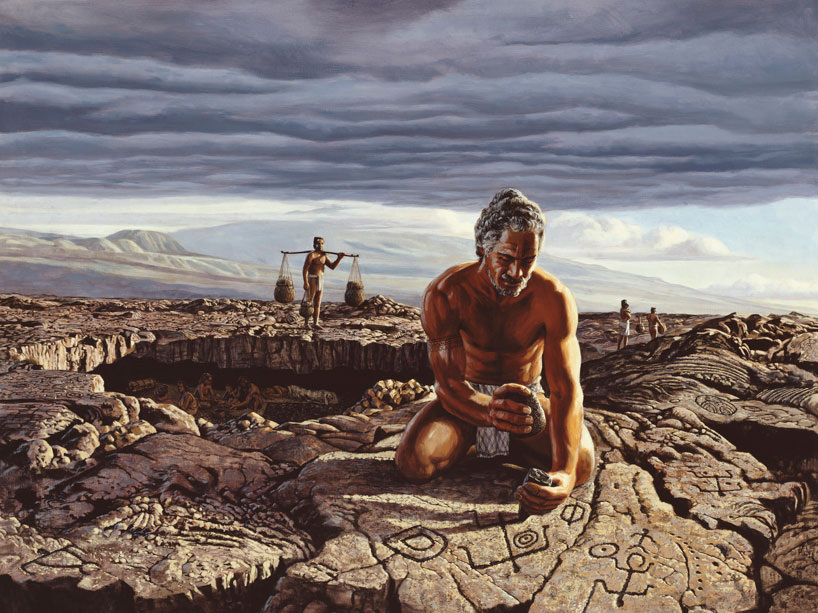
Meanwhile my quest for the essential or sacred meaning of Ea continues elsewhere. Perhaps I may find it within myself without an intermediary; that is, by mystical means. What keeps coming to mind is the volcano I liked to visit on the Big Island. The English word that keeps coming to mind is “Uprising.”













Ingeborg
Ron