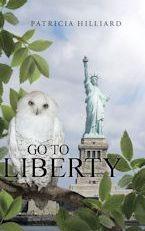
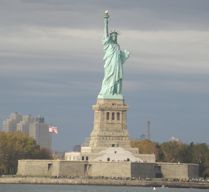
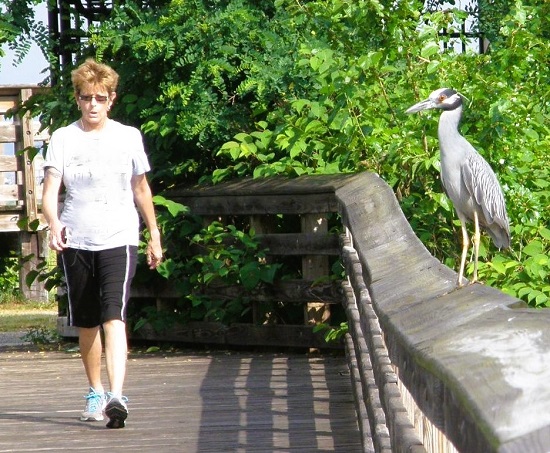
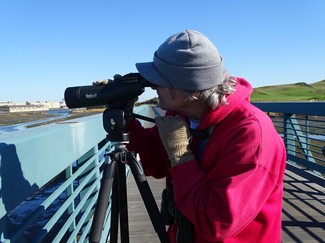
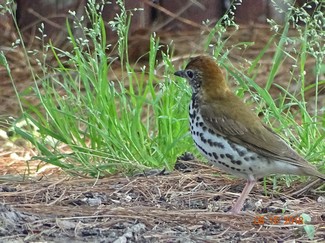
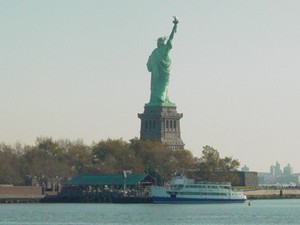
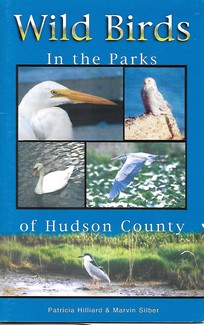
When I sat down in January 2010 to write my novel, Go To Liberty, I wanted to share my experiences in Liberty State Park, a beautiful park in New Jersey right behind the Statue of Liberty. In the early days, the park was a place to get away from the stress of working in Manhattan. My husband, Mike, and I took up the hobby of bird watching. We had lots of adventures discovering birds like the Black-crowned Night Heron and the Hudsonian Godwit that we saw in the wilder areas of the park. This is how Liberty State Park became the location for my novel.
When the local news carried a story about building a golf course in Liberty State Park, I became alarmed. My favorite bird sanctuary would be destroyed. I was at home sick with a cold and was in no mood to be further depressed. A woman by the name of Audrey Zapp was speaking out against this golf course. I contacted her and she invited us to a meeting. From this point on I experienced what the life of an environmental activist is like. I wrote letters, I rushed off to meetings. I hissed and booed politicians. This is how my novel developed into a story about a struggle for a park.
Over the years I got to know Audrey Zapp. She and I shared stories about what it’s like being a woman activist. Because, in present day society, being a woman activist is tricky. Audrey told me about the time someone tried to accuse her of having an affair with a congressman. Love letters were circulated that were said to be written by Audrey. She knew she had done no such thing, but how could she prove it? Someone was out to discredit her and stop her from supporting and protecting the park as a special place for the community. I told her about the accusations and threats I had experienced as a union organizer and tenant activist. In this way we gained a high regard for each other.
Audrey and I would laugh at how we worried about our hair and clothes and what to wear to events and rallies. Audrey would say to me, “Do you think men worry like this? I doubt it.” She was a bit of a feminist and told me how she liked to support projects that helped women and girls. We also discussed how to deal with the doubts that creep into you when you’re about to stick your neck out on an issue, even when it’s as clear and simple as defending a park for your community. We talked about why we became activists. We were both obsessed with a sense of justice, fairness and the need to bring to our community a victory to show that people still do have the power to change their world. This is how the theme was developed for my novel, Go To Liberty.
When we became closer friends, Audrey Zapp told me the story of the loss of her daughter and how she had made a commitment to do whatever she could to help young women. That’s what I admired about Audrey. She wanted to help women. She was no ragging feminist who demanded that women have careers and excel in the corporate world, she just wanted to give young women a boost so they could be better people and accomplish more good. She believed in women and the good that they could do. This is how Audrey Zapp inspired me to write Go To Liberty.
As the economy got worse, I was laid-off from my job. With job hunting on my mind, I applied for a position at Liberty State Park and was hired as a “seasonal” employee. Working in the park, part-time, I learned about the day to day functions of the park. I never realized how much work it takes to keep a park looking good. I got to know the park workers whose economic survival came from their jobs at the park. Parks are a great place to create jobs and get people back to work.
As a customer service person in the park office, I met many of the park’s patrons and answered their questions. I learned how important parks are to people. I listened to their stories. Some old men came and told me how they left from this park as soldiers—back when it used to be a train yard—and went to fight in World War II. Women would come in and compliment us on the park’s many gardens. Children would gaze with wonder at the Statue of Liberty and ask if lightening had ever struck the torch. One day, a battered woman came to the park office to escape from her vicious boyfriend. Another time, I met a man who came to the park to contemplate the meaning of life because he was dying of cancer. People came to the park for so many reasons: to jog, to sit and think, to dream, to have a family picnic reunion and meet the elders one last time, to learn how to fly a kite, to learn how to catch fish, to learn how to ride a bike. This is how people discover the meaning and value of their lives in parks.
So from the people I met in the struggle to save the park and of those who worked and visited the park, I created my characters Amanda and Coleen, Eva, her sister Judi and then Sally, the secret park hero. In the novel, their park is threatened by development. A fictitious foundation wants to put a hotel, a sports complex and a botanical garden in the park. This development would take over the natural areas of the park—similar to the golf course struggle that Audrey and I and others were in at Liberty State Park. In my novel, Amanda is the older experienced woman activist. She is a bit of Audrey, a bit of myself, both facing the changes that come with getting older.
When I worked selling tickets and guiding tourists onto the boat to see the Statue of Liberty, I chatted with my young women co-workers about their lives and their goals. The teen and young adult years of life are so exciting because they are a time when so many important decisions are made, and if not done right, can take years to correct. I compared their comments with my own feelings at that age. From this I developed the characters of Judi, Sally and especially Eva, a young woman who feels drawn to take a different path and reach different goals, to go beyond what the other women in her family have done. She wants to do good things with her life. She wants to do something that would build her community. The park is the perfect place for this. This is how the characters were developed in my novel, Go To Liberty.
One day when I was dilly dallying in front of the computer unable to write the next chapter, I thought of reaching out to a long-lost friend, Bernadette Cozart, who used to work at Central Park. I thought maybe she’d have a story to share or put a new idea in my head for the novel. I typed her name into all the social media that existed at the time and found her name listed in a 1993 New York Times link. I quickly clicked through to the article and yes, it was my friend. But the article was an obituary. I read it through to the end where she was quoted as saying, “Instead of taking children on field trips to see farms and gardens, why not bring nature into the community? I don't think it's fair that they should have to go outside the community to have that experience of seeing things grow." It was a concept my old friend and I had talked about when we were both living in Cleveland, Ohio. So I took this message from her and gave it to my character Amanda Walters. This is why I wrote the book: Just so a good idea like that could keep going.
I learned a lot from the real Liberty State Park. But I also learned that there is a fictional park that every tourist refers to as Liberty Park. It is made up of New Jersey’s Liberty State Park and includes the National Parks of Ellis Island and the Statue of Liberty. It’s in the minds of the people who know of this wondrous place beyond maps and state boundaries. You need to go to Liberty Park to experience it. From the joy of seeing your first Snowy Owl to a sense of Freedom at the sight of a torch being held by a statue, Liberty Park is where humanity goes to dream of a better world. In writing my book, I hope to inspire people to defend nature and the parks we love. This is the story of Go To Liberty.










You have an interesting way to promote your book by outlining your experience with Liberty Park and the people that frequented it.
Ron