PEARL HARBOR CALLS FOR MORE WAR TO MAKE PEACE
BY
DAVID ARTHUR WALTERS
More war is needed for more peace
“This is a war to end all wars,” spoken by President Woodrow Wilson, a saying coined to justify waging the Great War, was a quotation taken from articles by H.G. Wells compiled into the book The War That Will End War. Wilson only used the term once, in the context of his belief that WWI would “make the world safe for democracy.”
After listening to the fine speeches of United States President Barrack Obama and Japan Prime Minister Shinzo Abe at Pearl Harbor on December 27, 2016, about the prosperous reconciliation between their countries as a result of World War II, not to mention the prosperous reconciliation with Germany, it dawned on me that what we need is not an end to war altogether, but an even greater world war to effect an even more prosperous reconciliation between enemies.
Indeed, given the fact that men by natural law love to make war for the sake of democracy, which can never be perfectly realized except in the Hereafter, waging war to make the world ever safer for democracy is inevitable.
John Adams, in his December 21, 1884, Darwinian letter to Francis Parkman must have known that when he wrote, “Democracy is the only subject for history. I am satisfied that the purely mechanical development of the human mind in society must appear in a great democracy so clearly, for want of disturbing elements, that in another generation psychology physiology, and history will join in proving man to have as fixed and necessary development as that of a tree; and almost as unconscious.
Walter Lippmann must have realized it too when he remarked in 1967 that “the delusion is that whatever war we are fighting is the war to end war,” and, President Richard Nixon, as well, when he said, “I do not tell you that the war in Vietnam is the war to end wars.”
Mssrs. Abe and Obama made it clear that the rewards of the latest world war greatly exceeded the costs, so it follows that, since reconciliation follows enmity, another war and reconciliation would have at least as many and probably more benefits since there is no end to progress short of extinction of the race.
It appeared that majority of people were unconvinced that the Great War had improved the world, and therefore they did not want to enter into another one because they were unaware a continuation of the war was needed to realize an appropriate reconciliation and its benefits. So leaders must take the lead until the horrors of war are forgotten.
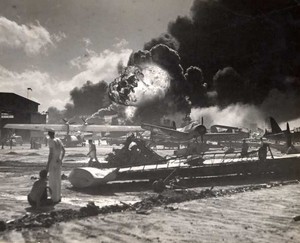
Franklin Delano Roosevelt should not be blamed, then, if what Robert B. Stinnett claimed in Day of Deceit: The Truth about FDR and Pearl Harbor (2000) is true , that Hawaii was surprised on Dec. 7, 1941, but President Roosevelt knew it was forthcoming, and research since then indicates that Washington withheld its knowledge of a forthcoming attack from Hawaii hoping that the “surprise” attack would provoke the U.S. into entering WW II. It is often remarked that, in 1944, no less than Oliver Lyttleton, Great Britain’s Minister of Production, stated that “Japan was provoked into attacking America at Pearl Harbor. It is a travesty of history to say that America was forced into the war.”
“More that 2,400 patriots” lost their lives at Pearl Harbor on the Day of Infamy, or so it was now said at the first celebration there attended by a Japanese prime minister, who respectfully kowtowed to the greatest nation on earth. The number varies with different reports inasmuch as all heads were apparently not accounted for.
The attack was infamous because people don uniforms and man battleships for peaceful reconciliations after wars. They certainly do not arm themselves for war to become sitting ducks for attacks. Gentlemen who have points of honor to resolve agree in advance as to the time and place of duels, and nations should do likewise.
As a matter of fact, Americans seized the Sandwich Islands from the Kingdom of Hawaii, which was largely administered by whites interested in profits, with the advantages of the economic benefits of war in mind.
Representative Draper of Massachusetts remarked in the House of Representatives on the strategic value the Hawaiian islands (Congressional Record on Feb. 4, 1894):
“I believe that the true policy of this Government is to negotiate a suitable treaty with the de facto Government in Hawaii, and annex the islands… on no account ought we to neglect this opportunity of securing this naval and coaling station, so important to us, both from the point of view of commerce and of coast defense. No naval force can operate on a hostile coast without a friendly base within easy distance. In the Pacific we now have the opportunity to secure our Western coast by accepting possession of Hawaii as our most rational form of coast defense. With adequate fortifications on these islands, and a suitable naval force in the Pacific, our coast would be far more secure in time of war than it could be made by any expenditure for harbor defenses on the mainland alone. The concession in 1887 of Pearl River, in Hawaii, to the United States for use as naval station, with exclusive privilege of establishing a dry dock, storehouses, and repair shops, is a valuable one, but has never been utilized. The situation is admirable, and the estimated cost of necessary fortifications and harbor works is moderate in view of the great advantage to our nation. “
What about the indigenous people of Hawaii? They had welcomed the Anglo-American-Saxon gods and had treated them well, although they were eating them out of house and home, and the whites helped them establish an English-style monarchy.
Well, a few whites in Hawaii were as Hawaiian as Hawaiians. Yet the U.S. Congress in Washington was rife with racists at the time. Charles Darwin’s theory was in vogue, and Darwin, in Descent of Man, first published in 1871, had implied that the Anglo-Saxon race was superior:
“There is apparently much truth in the belief that the wonderful progress of the United States, as well as the character of the people, are the results of natural selection; the more energetic, restless, and courageous men from all parts of Europe having emigrated during the last ten or twelve generations to that great country, and having there succeeded best. Looking to the distant future, I do not think that the Rev. Mr. Zincke takes an exaggerated view when he says, ‘All other series of events—as that which resulted in the culture of mind in Greece, and that which resulted in the empire of Holy Inquisition in having lowered, through selection, the general standard of intelligence in Europe, only appear to have purpose, and value when viewed in connection with, or rather as subsidiary to the great stream of Anglo-Saxon emigration to the west.’”
The Spanish American War, waged in 1898 and involving Guam, the Philippines, Puerto Rico, and Cuba, made Hawaii’s strategic value especially evident to the superior Anglo-Saxon race. “Hispanic,” derived from a Roman word for the tribes encountered in Iberia, denotes a culture rather than a race, but racists are inclined to disagree with that definition. Cubans, for instance, were referred to in Congress as “monkeys.” The native Hawaiians were in a different class of “heathen” as “savages” on the mainland, yet racists did not think they were much better than apes unless Christianized and deprived of their language.
We know that Queen Liliuokalani threatened to promulgate a constitution returning control of the kingdom to native Hawaiians, a control her brother had relinquished with a new constitution at bayonet point. That put a terrible fright into the planters.
Charles L. Mac Arthur articulated to Congress the circumstances that led to the overthrow of the Kingdom of Hawaii under threat of military occupation and the establishment of a provisional government run by whites in 1893 pending annexation in 1898. Venereal disease introduced by whites had nearly killed off the Aloha race, but he does not give that as a cause.
"It seems absurd that an American statesman should be willing to commit the future destinies of Hawaii to the rule of the monarchy of a race rapidly dying out, rather than to the vigorous and progressive auspices of the American Republic. The native population of Hawaii fell off from 1866 from 57,125 to 31,446 in 1890 -- a loss of 22,679 in twenty-five years. At that rate of loss the whole native population of Hawaii will be wiped out completely early in the second quarter of the next century, so that the child may now be born who will live to see the entire extinction of the Hawaiian race. This is a startling fact. Yet it seems to be true that in a little more than a century since the discovery of the Hawaiian group by Capt. Cook the population has dwindled from 400,000 to less than one-eleventh of that number. I have not space to give the reasons for this decay of the race, one of the principal of which seems to lie in the fact that the native women generally lack the motherly instinct for the proper care of their children.”
He claimed that Queen Liliuokalani and her deceased brother King David Kalakaua were not of royal blood, but of the high chief class, and with a disreputable background. Both crown and legislature were corrupted, for example, by drugs and gambling. That would be licenses to produce opium, and a lottery to raise revenue for the kingdom, whose treasury was strapped by the ambitious king’s profligacy.
During the Congressional hearings reported in the “Morgan Report,” Chairman John Tyler Morgan asked Representative Spalding if his zeal as an annexationist was based on the naval and commercial value of the islands to the United States. He answered that, “if it is not desirable for the United States to hold Pearl River, if it is not desirable for the United States to have that country as an outpost, it is not worthwhile for them to have anything to do with the country, because as an agricultural country, mineral country, and mercantile and manufacturing country it is of small value.’
Well, King Kalakaua had engineered a reciprocal treaty with the United States that exempted Hawaiian sugar from tariffs and gave the U.S. exclusive use of Pearl Harbor, around which a great deal of real estate development was already taking place. Hence the sugar boom that doomed his kingdom. His sister Liliuokalani was proud that David worked the deal, but she noted that her people foresaw the writing on the wall:
“Some foresaw that this treaty with the United States might become the entering wedge for the loss of our independence. What would be the consequences should the Islands acquire too great a commercial attraction, too large a foreign population and interests? Would not these interests demand the protection of a flag backed by a great military or naval power?”
King Kalakaua was a politician. He had an anti-American agenda to begin with, and by an ironic twist of fate was saved from a riot by American troops, and owed his crown to American intervention.
After thirteen white traitors to the kingdom forced his sister to relinquish control in 1893, President Grover Cleveland had James Henderson Blount conduct an investigation in the islands. One W.D. Alexander told Blount that, "many of the evils of Kalakaua’s reign may be traced to the reign of Kamehameha V. The reactionary policy of that monarch is well known. Under him the 'recrudescence' of heathenism commenced, as evinced by the Pagan orgies at the funeral of his sister, Victoria Kamamalu, in June, 1866, and by his encouragement of the lascivious hula dances and of the pernicious class of kahunas or sorcerers. Closely connected with this reaction was a growing jealousy and hatred of foreigners. During Lunalilo’s brief reign, 1873-’74, this feeling was fanned into a flame by several causes, viz, the execution of the law for the segregation of lepers, the agitation caused by the proposal to cede the use of Pearl Harbor to the United States, and the famous mutiny at the barracks. This disaffection was made the most of by Kalakaua, who was smarting under his defeat in the election of January 8, 1873. Indeed, his manifesto previous to that election appealed to this race prejudice. Thus he promised, if elected, “to repeal the poll tax,” “to put native Hawaiians into the Government offices,” to “amend the constitution of 1864,” etc. “Beware,” he said, “of the constitution of 1852, and the false teaching of the foreigners, who are now seeking to obtain direction of the government.”
It is suspected that an errant kahuna may have put a curse on Pearl Harbor, subjecting it to the 1941 attack, in compensation for the loss of sovereignty of native Hawaiians over their homeland, but that remains uncorroborated. If that were the case, Hawaiians howsoever defined should be amply rewarded given the pleasures resulting from the painful war.
Behold Hawaii today, the pearl in the imperial crown of the greatest nation on Earth, the prosperous pacific capital of the Pacific, bristling with military arms and commerce! True, it is overrun by haoles (foreigners, especially whites), but a trust was established for people who have some indigenous blood. All things being equal, every resident may want to be a beneficiary.
Yes, there is some resentment, some “quiet racism,” some activism for a return of the stolen sovereignty, but the Aloha spirit has virtually reconciled everyone into the racial melting pot. Let us face the truth, we are all mongrels, so let us be tolerant pending the next violent outburst followed by an even better reconciliation. Perhaps Hawaii will return to a paradisiacal state with a mutually destructive nuclear war between East and West.
Prime Minister Abe rejoiced at Pearl Harbor that Americans have tolerated his people. “On behalf of the Japanese people,” he said, “I hereby wish to express once again my heartfelt gratitude to the United States and to the world for the tolerance extended to Japan.”
“What has bonded us together is the power of reconciliation, made possible through the spirit of tolerance. What I want to appeal to the people of the world, here at Pearl Harbor, together with President Obama, is this power of reconciliation.”
Japan was utterly humbled by the war, and its people will no longer be “patriots” if attacked. “We must never repeat the horrors of war again,” Mr. Abe disarmingly pronounced. “This is the solemn vow we, the people of Japan, have taken. And since the war, we have created a free and democratic country that values the rule of law and has resolutely upheld our vow never again to wage war. We, the people of Japan, will continue to uphold this unwavering principle, while harboring quiet pride in the path we have walked as a peace-loving nation over these 70 years since the war ended….
“Showing respect even to an enemy they fought against; trying to understand even an enemy that they hated — therein lies the spirit of tolerance embraced by the American people. When the war ended and Japan was a nation in burnt-out ruins as far as the eye could see, suffering under abject poverty, it was the United States, and its good people, that unstintingly sent us food to eat and clothes to wear….
“The Japanese people managed to survive and make their way toward the future thanks to the sweaters and milk sent by the American people. And it was the United States that opened up the path for Japan to return to the international community once more after the war. Under the leadership of the United States, Japan, as a member of the free world, was able to enjoy peace and prosperity….”
Indeed, look at Japan now. And take a look at Germany. And witness the United States and Great Britain. War pays big dividends for the surviving generations, or so it seems, especially if they embrace the democratic Anglo-Saxon culture.
“Even today, the horrors of war have not been eradicated from the surface of the world. There is no end to the spiral where hatred creates hatred. The world needs the spirit of tolerance and the power of reconciliation now — and especially now. Japan and the United States, which have eradicated hatred and cultivated friendship and trust on the basis of common values, are now, and especially now, taking responsibility for appealing to the world about the importance of tolerance and the power of reconciliation. That is precisely why the Japan-U.S. alliance is an alliance of hope.”
Indeed, the world is on the brink of war again. Nuclear weapons may be tested on another country. Millions of civilians may be murdered before the military forces clash, instead of afterwards. Great swaths of the world will have to be rebuilt by a greatly reduced population, so there will be plenty of jobs. The technological innovations developed for more efficient mass murder will be put to peaceful use after the reconciliation, so maybe we can go where no man has gone before, to some other planet, to tolerate aliens and make it safe for democracy.
“Here at Pearl Harbor,” President Obama eloquently declared, “America’s first battle of the Second World War roused a nation. Here, in so many ways, America came of age. A generation of Americans — including my grandparents — the Greatest Generation — they did not seek war, but they refused to shrink from it. And they all did their part on fronts and in factories.”
Thankfully for the sake of spiraling progress, with some backsliding along the helix, leaders seek wars for one reason or the other; but do not blame them entirely, for they only represent the mood of followers who would assassinate them if they did not desire war to break the boredom of prosperity or alleviate depression.
“After one of the most horrific chapters in human history — one that took not tens of thousands, but tens of millions of lives — with ferocious fighting across this ocean — the United States and Japan chose friendship and peace. Over the decades, our alliance has made both of our nations more successful. It has helped underwrite an international order that has prevented another World War and that has lifted more than a billion people out of extreme poverty. And today, the alliance between the United States and Japan — bound not only by shared interests, but also rooted in common values — stands as the cornerstone of peace and stability in the Asia Pacific and a force for progress around the globe.” Thus sayeth Professor Obama, a citizen of the cosmos and Polynesian at heart.
No, nations must not balk at the painful loss of lives if they would progress morally to the peaceful interludes between wars. Kant taught us that good intentions alone make us good and it is imperative to do our duty no matter what. Nothing exists in history to assure us that the great moral dilemmas can be resolved without pain.
Why, no less than eminent historian and presidential adviser, Arthur Schlesinger, Jr., in his essay 'The Causes of the Civil War, a Note on Historical Sentimentalism' (Partisan Review, October 1949) favored the trending evolutionist argument in favor of the necessity of pain for the moral gain of mankind, contrary to the notion of “sentimental” revisionists historians who believed the pain could have been avoided, and argued that millions had died in wars for nothing; wherefore war has no end but destruction, hence war is for naught.
Perhaps taking his cue from President Roosevelt, he suggested in a memo to President Kennedy, when he was informed of the plans for the Bay of Pigs invasion, "Would it not be possible to induce Castro to take offensive action first?...If only Castro could be induced to commit an offensive act, then the moral issue would be butted, and the anti-US campaign would be hobbled from the start."
Schlesinger would have people progress against evil by doing their duty, progress for him is not the "keynote" of human history, but is rather "anxiety and frustration," hence he did not believe such progress would ever eliminate the necessity of doing that duty via social paroxysms of mass murder and mayhem. Violence therefore seems inevitable. His progress is rather like a tragic, vicious cycle of a revolving-door justice system, instead of rehabilitation and the end of the criminal record. “We delude ourselves when we think that history teaches us that evil will be 'outmoded' by progress and that politics consequently does not impose on us the necessity for decision and for struggle.... Sometimes there is no escape from the implacability of moral decision. When social conflicts embody great moral issues, these conflicts cannot be assigned for solution to the invincible march of moral progress...."
Well, President Obama does not buy that pessimistic outlook. He still believes in progress: “I hope that together, we send a message to the world that there is more to be won in peace than in war; that reconciliation carries more rewards than retribution. Here in this quiet harbor, we honor those we lost, and we give thanks for all that our two nations have won — together, as friends.”
Message received. War is obviously waged for the benefits of peace, so the more war the better. At least that is one side of the coin.
# #















thought provoking read
Never Stop Writing!!
m
Ron