As fast as there was metal, there were knives and swords of bronze, iron, steel. As with guns, one idea proliferates into hundreds of designs, each needing a name.
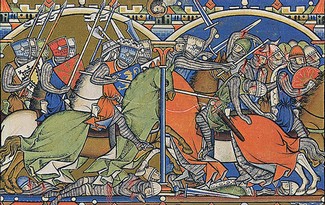
These weapons may seem quaint now, like suits of armor, but there was no quaintness at the time. Soldiers had to be athletes and butchers. They hoped to hack into soft spots unshielded by armor. War, before long bow and rifle, was intimate. Even if you won, you got bloody.
One imagines that alcohol, plenty of alcohol, helped a lot. Drums, bugles, and bagpipes make us braver. (John Keegan, in The Face of Battle, is famous for putting the reader in the fight, if you can stand terror and vomit.)
War was ever a catalyst for new technology, new language. Bec de corbin sounds aristocratic but means merely crow’s beak. It was a long pole ax, designed to punch through armor. The most poetic name is Morning star, a simple, nasty club with one or more spikes on it.
All early armies had innumerable variations of blunt or cleaving weapons. Blunts include: the mace or flanged mace; the bludgeon, truncheon, or maul; the quarterstaff (basically a thick stick).
Most weapons have simple, descriptive names: club; flail; broadsword; pike (a long thrusting spear); war hammer (like an alpine hammer on steroids); horseman’s pick; and battle axe. This last has a long literary history: “A fierce, unpleasant older woman with strong opinions,” according to Wikipedia.
We’re still using many of these weapon-words; we see others in historical novels; then there are names encountered mainly in crossword puzzles: fauchard, guisarme, glaive or voulge (pole cleavers); halberd and sparth (ax on a pole); baselard and poniard (types of dagger).
Swords and knives open up an endless can of terms: cinquedea, a short sword; Grosses Messer (big knife, which evolved into the saber). mercygiver, for the coup de grace; scramasax (large Saxon knife, charmingly pronounced scram-a-sax; sgian (knife worn with kilt).
Don’t be fooled by the mild-mannered Swedes and Danes. They’re a/k/a Vikings; a thousand years ago they steered their long boats up the Seine to terrify Paris, and southward through Russia to Kiev and Constantinople. Everyone hated them. No self-respecting Viking packed less than three weapons. They lived for war. Great warriors were buried with their swords. Imagine hundreds of guys like Clay Mathews wailing away. They called it going berserk.
For centuries, the Zweihander (two-handed sword) was the boss weapon. The Vietnam War saw the introduction of a mine called Claymore. Where could that possibly come from? It turns out that a big sword, the kind that Braveheart swung, was called a Claymore.
We are still familiar with the word dagger, even as most people have not held one. Daggers which are rounded had a special name: rondel, which English majors know as roundel, a kind of poetry that goes around. There was the ear dagger for close-in work. Perhaps the most famous dagger was called stiletto, because it was long and thin like the Roman stylus. It survives in fashion wars.
A personal dagger you might carry inside your cloak was called a dirk, especially designed for hand-to-hand combat during the Age of Sail. A tough name for actor Dirk Bogarde, whose given name was Derek.
---------
Bruce Deitrick Price is a novelist and poet. Love of language and knowledge led to his disgust with the dumbing-down in our public schools, a subject he analyzes in "Saving K-12.”




Interesting aticle!
Never stop writing!
m
This was not prompted by writing historical fiction. Rather as a poet I love odd words. As a technologist, I am fascinated by the endless variations of what we now consider very primitive weapons. At every year in history, there was always an arms race.
As you see in the art (soon to be posted), the combatants are almost elbow to elbow. That's the part that fascinates me.
Ron