“Are you a bird watcher?” the man asked.
“Who me? Oh no, I’m no expert.”
“I asked you if you were a bird watcher. I’m no expert myself.”
“I look at birds sometimes, but I don’t know their names.”
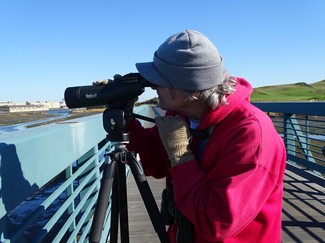
“Well, come have a look at these. They are Canvasback ducks. They come down in the wintertime right here to Newark Bay. Look.” He pointed to his scope that was lined-up with a flock of ducks on the bay.
The woman leaned forward, timidly at first, then leaning in closer, she peeked through the scope.
“That’s amazing, are they all the same?”
“Yes, Canvasback ducks, males and females,” my husband explained.
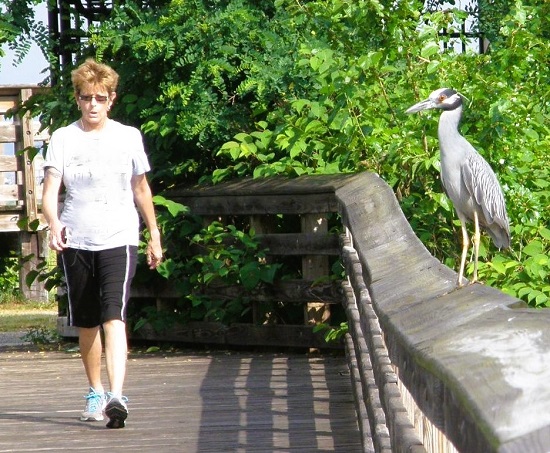
I stood in the background and listened to the dialogue. No, my husband was not an expert. I had worked with him for years to get the names right, along with the correct identification. It started out Buffalo head and finally to Bufflehead, the little black and white ducks that played in the cold waters in New York harbor and Newark bay. Blues were easy to remember, but they had to be called Great Blue Herons. He stumbled frequently on Yellow-crowned Night Herons and Black-crowned Night Herons calling them yellow-crowns and black-crowns, but I insisted on the true name: Night Herons. There are over 300 birds in the eastern U.S. If that isn’t challenging enough, you could learn the nicknames that make everyone laugh. “Butter Butt” for Yellow-rumped Warblers. In these days of sexual scandal, the name Woodcock would make people do a double-take. But this bird is nicknamed “timberdoodle” which always makes the children laugh. Coops and Sharpies are spoken of often by birders, but as bird guides we had to remember that our new bird watchers needed the real names, Cooper’s Hawks and Sharp-shinned Hawks.
The wonder of nature would sometimes get lost in the name game. I’d try to throw in some of the wondrous facts about the bird we were viewing. This bird has flown here all the way from Peru. That duck can fly and dive but it cannot walk. This bird nearly became extinct because people thought it was a shorebird and didn’t realize it needed trees to build a nest. I dredged this information up from years of reading bird books since my days as a Girl Scout.
Bird watching or “birding” is intimidating. Some people think you have to pay to learn about it, have an expert at the ready, on the chance you might make a mistake. The scope and binoculars baffle many people. The cost can be staggering too. They just give up. But others are intrepid, reporting that they saw a Black-crowned Night Heron when in fact it was a Great Blue Heron. Now that more people are getting into birding, more miscalls are popping up in the listserv and digital bird reports. It’s driving the bird experts crazy. But it’s a good sign that more people are experiencing nature and therefore, caring about it. Nature is not a plane ride away, it’s in your backyard. An old-time birder once said to me, “All my life I chased birds, and flew across the country to see a special bird. Did I really see them or did I make a mistake sometimes? I never thought to take pictures. Chances are the bird would fly before I got the picture. I don’t know, did I really see those birds?”
“But you had fun looking for them, right?” I asked him, “And you traveled, met new people, and learned a lot about nature and planet earth, right?” To my mind, that’s what the bird watching is really all about. It’s the seasons, the weather, the bird and the people you meet. It’s all about having fun playing a guessing game with nature.


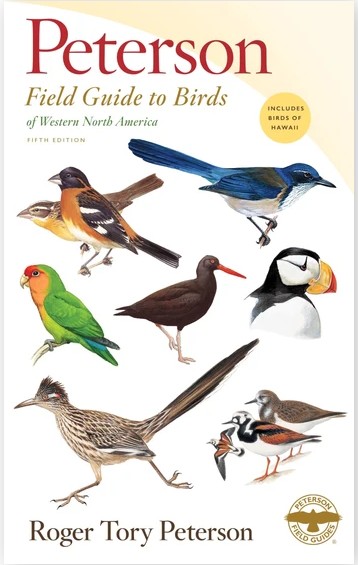









I have been accused of being a birder for my attempts at identifying birds that frequent my very small backyard in suburban Houston. I have always been concerned about wildlife and identifying what I was seeing in a correct way. Fortunately, I have had a few migrating birds come by my window that I was able to identify by using the What Bird website. It makes me recall that book on birds that my grandmother had that we wore thin looking up birds that we saw on the farm. That book I recall only contained a small fraction of the most common birds in the American landscape with colored illustrations.
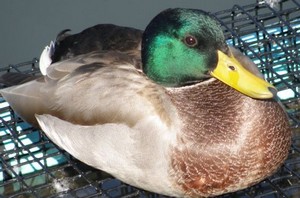
My searches are much harder. While at the local State Park I saw wood boxes for wood ducks, I thought. And then, one year, when we had a three or four year rookery of non-native Indian cattle egrets occupying a wooded vacant lot nearby (they cut down the trees to get rid of them), we suddenly had very strange ducks in the neighborhood… Black Bottomed Whistling Ducks. There must've been a nesting box nearby because twice that summer, the parents proudly paraded their young through my backyard through a hole in our cedar fence to the overgrown power right-of-way behind our house. What a delight!
One night the ducklings even came to both our front and back decks and one got in the house when we opened the sliding door to the back deck.
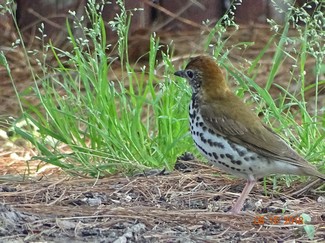
I have had a devil of a time identifying sparrows. They all look alike and the pictures in What Bird? seem to show such variations of color and pattern that I find it quite impossible.
Recently, I saw a Peregrine falcon eating a sparrow? In my backyard. quite a rare sight I think.
Here is a video of the egrets… http://ronhullauthor.com/streams/cattleegretsbroadband.mov
Black Bottomed Whistling Ducks at Brazos Bend State Park, nearby.… http://ronhullauthor.com/streams/Brazos-Bend-5-26-03.m4v