What’s in a Name?
By
John DeDakis
DeDakis. Tricky name. It’s Greek. And most people screw it up regularly.
My dad, N. George DeDakis, emigrated from Greece in 1913 when he was six years old. The N stood for Nicholas. All my cousins called him “Uncle Nick,” but somewhere along the way, he started to prefer George, his father’s first name.
An incident in college might have had something to do with the name alteration because perhaps “Nick” seemed too “ethnic.”
Dad told me that he tried to join a fraternity but was blackballed because he was Greek. Oh, the irony. Blackballed from the Greek system because he was Greek. Proof that bigotry is illogical.
When Dad arrived in America, our last name was spelled Ntentakis, but it was Ellis Islanded into Dedakis. The family settled in Illinois where a typo in the Chicago phone book rendered the name DeDakis. Papou thought capitalizing the second D looked distinguished, so that’s what it’s been for more than a hundred years.
But how the hell do you pronounce it?
The Greeks would say, deh-DOCK-ees.
But the Anglicized version is deh-DAY-kiss. Long A.
There’s been no end to the way the name has been butchered over the years, even before I made my debut in 1950.
Sometimes my dad would use one of the mispronunciations to tease my mom: “Hello, Mrs. deh-KY-iss,” he’d say.
When Michael Dukakis ran for president in 1988, it led to additional name amusement.
My wife Cindy and I lived in Atlanta at the time. As she was going through the check-out line at the grocery store, the cashier saw our name on the check and remarked, “Oh, Dukakis! Are you related?”
Cindy politely pointed out, “No. His last name begins d-u-k. Ours is d-e-d.”
The clerk, still looking quizzically at the check: “Ohhhh.” Pause. “Are you related?”
Um. No.
But also, yes. That’s because names ending in k-i-s originated on the Greek island of Crete, or so I’m told.
I’m used to people being baffled by the name.
When I was in the Army, one of my sergeants called me “DOO-duh-keye.”
“It’s deh-DAY-kiss,” I corrected.
“That’s what I said: DOO-duh-keye.”
Sigh.
A passive-aggressive photographer I used to work with regularly called me deh-DINK-iss, but he was just being a jerk.
Names of cities can also be tricky. When I was an editor at CNN, we discovered quickly that it was important to find out how the locals pronounce the name of their town because what the name looks like in print is often not the way it’s actually pronounced.
Example: New Berlin, Wisconsin. You’d think Berlin is pronounced ber-LINN. Nope. The locals say BURR-linn. I’m convinced it’s so they can tell who the outsiders are.
Fast forward. Now I’m a novelist, a writing coach, and a manuscript editor. I suppose I could’ve made my life less complicated by adopting a pseudonym. Some of the biggest names in American culture are pseudonyms:
Marion Robert Morrison. Ever heard of him? Sure you have—John Wayne.
Norma Jeane Mortenson. Who the hell is she? Marilyn Monroe.
Many writers are introverted. One shy writer told me that when she writes using her fake name it’s like becoming a different person, a more confident version of herself.
As for me, I choose to continue to bravely endure the various permutations of DeDakis. I always hold my breath whenever I’m introduced. Even when I provide my host with a prono, the most common pronunciations are deh-KAY-kiss, deh-COCK-iss, and deh-DOCK-iss.
Bottom line: I’m okay with however you choose to say my name. That’s because it doesn’t matter. I know who I am. And that’s all that counts.
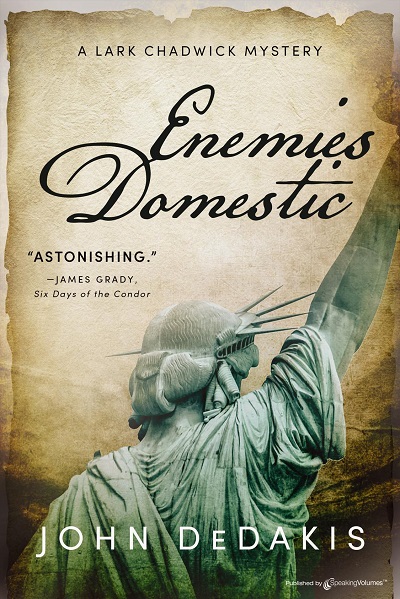
Award-winning novelist John DeDakis is a former editor on CNN's "The Situation Room with Wolf Blitzer." DeDakis is the author of five novels in the Lark Chadwick mystery-suspense-thriller series. Book 6, Enemies Domestic, a political thriller, will be released in the summer of 2024. DeDakis, a former White House correspondent, is also a writing coach, manuscript editor, and host of the podcast “One-to-One.”
Website: www.johndedakis.com
,