DYSTHMIA
No, he did not know, perhaps
had never known.
Books could not tell him, or stars,
or ivory-soft hands.
A blinding eye, the cosmos,
if cataracted with floaters.
How at home he was with
shadows, phantoms, ghouls,
thinking himself a hologram:
or maybe everything else:
here, there, neither.
Folding from the pane's
cold coast rain into a
scotch and cigar,
he was nigh mothered.
The breast of recollection
suckled him, and the floor
rose to baptize him
like a huge parquet cat,
impotent.
He pondered the house, houses:
one room, walls an artifice,
exteriors too, comforting
in a scotch-like way.
For minutes.
Sleep was an issue.
He dreamed walls at forty-five
degree angles, menacing every
step, prohibiting advancement,
entrapment in an alternate physics.
When young he had longed for
just one (not overly) debilitating
infirmity, an anchoring perspective,
to wrest from from physiology's
festering test a persistent,
monstrous beauty all his own.
But alas, he was hopelessly firm.
Was that the ocean he heard,
five hundred miles west?
Why not?
He heard whispers
a million minutes past.
Digraphs, trigraphs, he thought,
consonants stuttering
the rounded waves.
Spinach in teeth.
Splinter in throat.
A candle flame undulated,
tiny belly dancer, perfect,
burning for only him.
Things were not so bad?
What was that the girl with the pearl flesh
said, the dark-rimmed-glasses-waif with
thrift-store flip-flopped feet?
The breath of a vowel lounging
on the side of a cliff.
Strange place to lounge, he thought,
not so strange the vowel.
Fluidly, he accepted normalcy
in abnormal places.
Things could always dissociate,
like over-boiled chicken from bone
or love from sex.
Chronically lusting over life's
ligaments, in truth
he craved entropy more.
Unlike his articifice closets, only memory
held skeletons, like the one fashioned
in grade school, where he cheated:
on first trying, femur dangling hand;
metacarpals as brains.
Had self-knowledge meant to include
a skeleton's lipless grin?
Undressing women with his eyes
became ever scarier around the mouth -
pouting, puckered, horrified,
inwardly grinning.
His heart was all adhesions,
cut, re-sutured, obdurate.
Mercifully, ambient noises
on the street below
gifted him the security of the
intractably displaced.
Dirty dishes spoke the language
of the dead, easily digested,
a familiar reek.
Realizing a decade ago
how much he hated yellow,
he hid his teeth, except when alone,
dayreaming things like
flesh on flesh, worn templates.
The day was a bland soup.
Things needed immediate doing
which could always wait.
Clouds cleared.
It was the vile time: three o'clock,
Wednesday: exactly midweek.
Lifting an encrusted tome,
he peered from the smeared window,
staring into the sun,
deeply, darkly.
Copyright Julianza Shavin 2009


 Share
Share Print
Print Save
Save Follow



Thank you so much for your time in reviewing "Dipthong," which I thank Ms. Caligaris for pointing out I misspelled!
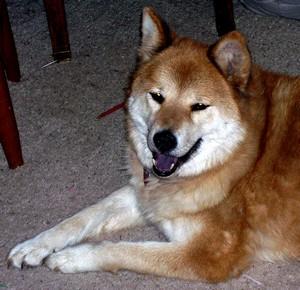
Gene: Yes, the poem is based only loosely on you. A visual image, combined with the nightmare of insomnia (paradox, huh?) --- I have never met you, of course, see only your picture. The scotch and cigar ref. is from knowing you. But you will never, I hope, be the man in the poem. You are not now. You are far too vital, productive, emotional, motivated, unjaded.
To Ms. Caligaris: Thank you immensely for correcting my spelling, but more -- for pointing out that I misused the word -- which no, I did not kidnap from the poem, but really WANTED for the title. I take titles very seriously. The correct word, of course, is digraph (which could also be trigraph, but either will do), because I really don't like the sound of consonant cluster. That was out from the beginning. Digraph, or a cluster of consonants (no matter how many)works for me, in that this fictional man is in a state of stasis, inertia, I might even say life-us interruptus. His life is not free-flowing (which seems to me more vowel-like), but in a way, stopped. I realize that later this stopping (stuttering the waves) implies movement, but it is not HIS movement. Yes, the title is DEFINITELY metaphor for the whole poem (the corrected title!). The man is stuck, period. He does not change from beginning to end; only in certain memories (flesh on flesh,e.g.) is he even vaguely "alive," but is in an unfortunate (not even) cycle of nowhereland, despair,or even beyond. I do mean it as a sort of arcanum, in the sense of mystery or secret, in that he is (in a hapless sort of way, as am I), seeking the answer to what is the meaning of life? of his life? why go on? -- also in the sense that really, he is already pretty much a ghost. It intends to border on surrealism, because he is living quite inside his own head. As far as a the cerebration, yes, that too -- I was hoping to offer some literary merit (proclivities) with this one, but also was modeling not only on an earlier poem, but, in theme, on persons I have known (usually but not always older than I) -- and you are correct, as are Gene and Mr. Cederberg, that I, even not at a very advanced age, am speaking somewhat autobiographically. When I meet, or read work a person who seems like the fictional "he," I identify. I am quite the nihilist, or as Gene once pointed out, probably an absurdist. Even with quite a full life, motivation is difficult, and I tend to live in the past, and am haunted, stuck. To counteract this, I overcompensate, rarely pausing from writing, composing or painting. The "he" here is beyond that relief/release. I know this inertia, or, say, anhedonia, quite well. For me, it is an endogenous curse I fight each day.
Mr. Cederberg: Yes, sir, the poem is rather the dream-state, because the man has been reduced to such. I did not feel the need to elaborate as to why. I like that the imagery is enigmatic, because it feeds into that dream state. It is not meant to be totally logical (to the reader). It is not even logical, or analyzed by the "he" of the poem. In a way, he is watching himself in his own movie. There is nothing new, only memory. (He may also be entering a sort of dementia or psychosis, but I didn't mean to imply that.) He is sort of like a person in long-term solitary confinement. It plays havoc with the mind.
Please let me know what angers you. That interests me very much. The fact that the poem "flies heavily," or with difficulty, that its wings are not vital, is a great compliment which I treasure. I do love when the form mirrors content. Now, you probably did not mean it this way, but rather as a negative quality. I DO understand that; nonetheless, I am content that the poem is lugubrious. And -- oh my gosh -- Steppenwolf, about which I had not been thinking, but had read many MANY years ago, is one of my favorite books of all time. I am mad about that book! In the past, I have recommended S. to many friends. I wonder if you have read any John Barth -- The Floating Opera, Lost in the Funhouse, etc. He is one of my favorite authors. I am flattered that you used up a lunch break thinking about this poem.
To all of you, and to the other reviewers, thank you so much for your feedback. It is invaluable. I am now off to correct the title and the text.
Thank you again, dear readers. julianza
addressed the shadows, phantoms, and ghouls that sometimes haunt my sleepless nights in an unposted (and less accomplished) poem I call The Outsider. All that aside, I find (in my non-professional appraisal) this to be one of your most successful works to date; unquestionably a deeply disturbing work of art. In the end, I have to agree with Richard's observation that this mood piece is perhaps a reflection of your own life. A remarkable performance, Julie. Damn, but you are a helluva writer! af-gene.
I just now stumbled on this.
My impressions and comments are only as a reader, not as an author, poet, or digital artist. My thoughts are not intended to be definitive, exhaustive, complimentary, or demeaning.
Now ...
There is a quality in this that lends itself to literary vignettes.
A sense modality of fleeting impressions, whether in a dream state or in a waking state. It also appears to me as snapshots of enigmatic imagery threaded together with an arcane logic that taunts the reader to make sense of it.
I am sure that this took some time and stretched
things out a bit in the area of your synaptic activity.
The piece angers me, and it delights me.
I am vexed, but am also imparted a kind of emotional strength.
I do feel intoxicated because of the phantasmagorical qualities of the poem primarily because it has given me access into the land of another artists observations. Still the wings of the poem have a kind of heaviness to them. In other words, it does not fly easily because of the content.
On third reading (this took my whole lunch break to cogitate)I was reminded of one of my favorite authors - Herman Hesse; in particular a section of his wildly successful novel 'Steppenwolf'.
In particular the 'Magic Theatre' where Harry Haller was able to live out the possibilities and fantasies of his mind and life. Your poem reminds of that long corridor he entered into - one side covered with endless mirrors, and the other countless doors. You either get a reflection of your own life in this, or you walk through one of the doors and let the myriad interpretive possibilities of your insights take you to another place where you think you understand.
fee