Scarecrow Beatific
Beauty often enters twisted,
not as a clean line but a bent nail,
a wrist turned like a question mark,
a shoulders hunched as a wind-burdened hill.
In the body’s wrong angles, light pauses,
as it does on metal wreckage,
a door sheared sideways,
ribs of iron exposed,
holding the sun the way scars remember heat.
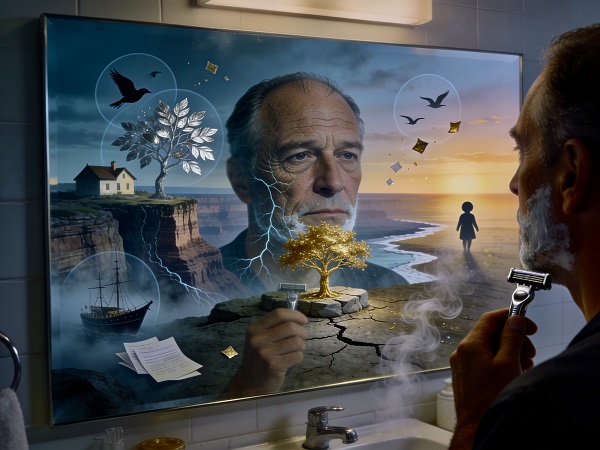
The old man’s spine is a crooked fence,
years wired to it by weather and grief;
his face a tide chart of losses,
creases folding like sea-worn cliffs.
Pain sharpens him into clarity,
the way salt filigrees bone,
beauty leaking through distortion,
learning to breathe through damage.
Below ocean surfaces, kelp knots itself into dark prayers,
thick cords strangling light,
eelgrass trembling like arthritic fingers.
Fish drift past with borrowed faces—
the lumpjaw, all suction and pout,
the anglerfish hauling its false star,
bodies stitched wrong by pressure and depth.
Such might be unbeautiful only to the straight-minded eye,
their forms precise answers to brutal questions.
Wyeth’s scarecrow,
a rickety geometry of wood and rags,
built to repel wings from grain,
leans so hard into motion it becomes an act of faith.
Its arms fling wide like a survivor signaling shore,
crooked, emptied, radiant with intent.
It tells us this: even the most contorted shapes,
human, ocean-born, or field-bound,
are practicing astonishment so that we might smile
our gratitude as we embrace the unexpected beauty.


 Share
Share Print
Print Save
Save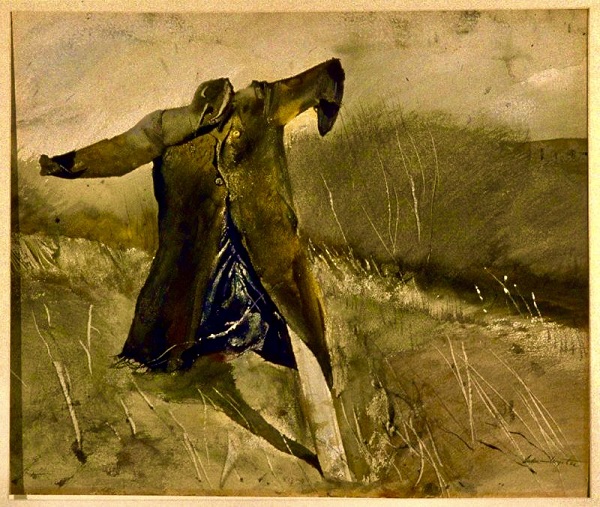










Often the neglected becomes new again when discovered. Thanks for the memory of watching an old piece of farm equipment left out in the field where it last worked.
Ron