We met our guide Swan after breakfast the next morning. Oh yes, a word (or two) should be written about our delightful buffet breakfasts that both Peter and I had come to look forward to. We had established a routine of a solid breakfast, followed by a full day of activity and touring the countryside, but no lunch or snacks of any kind, until evening time, when we took pains to find a nice place for dinner. By now, Peter was well over his stomach trouble, the sticky rice acting effectively as a sealant that put him to rights. We knew he was feeling much better at breakfast time. We would arise early, to get the jump on the waves of Chinese tourists that seemed to appear, especially in the breakfast room to lay waste to the buffet table like hungry locusts.
I usually went to the egg station as soon as possible to get my order in. “Two eggs,” I whispered timidly, “Over easy,” I said, showing with an upside down wave of the hand what I wanted, and then sliced down dramatically, “and cut the yoke.” The last thing I wanted were runny, undercooked eggs. The eggs were made in buttered splendor – they actually tasted like real eggs – and not the tasteless fair that we usually get in most modern metropolises. I skipped over with my plate of eggs to another table to pick up my freshly made toasted brown bread awash in melted cheese and butter. “That should take care of me for the day,” I thought happily, when suddenly I heard a booming voice from the egg station. “Six eggs, please,” Peter cried, holding up a handful of fingers, plus one, to make sure the cook knew how many he meant. He returned to our table with a stack of untoasted bread to wash down the eggs in great gulps. Not to be outdone, I tiptoed back to the cooking station and asked for a crepe. I had seen the cook making a feather-light and thin pancake served up with Burmese honey and fresh cream that was cooked to perfection ; but Peter had the final word with his stack of six pancakes dripping in honey and assorted jellies.
After breakfast, we met up with our beloved guide Swan again in the hotel lobby. “Not another pagoda,” I cried out in mock dismay, but Swan was now attuned to my humor and took up the slack by affirming that indeed we would be visiting another remarkable pagoda surrounded by 845 small stupas as though in deferent tribute to the richly decorated central pagoda. Work began on the pagoda in 1939 at the start of the Second World War and was finally completed in March of 1952. There are many buddha images in row upon row in niches along the walls, all cast in the color gold, a truly sublime sight filled with religious nostalgia. The entrance is protected, not by the traditional mythical lions, but by the statues of the magnificent white elephants that are sacred and auspicious in Buddhist symbolism. Thereafter, we took a short walk through the nearby banyan tree grove Boddhitataung, where a thousand Buddha images lie at rest among the sprouting banyan trees. Ah, walking through the aged banyan trees is like walking through an ancient grove associated with the mythic gods of Greece. One half expects a centaur or unicorn to come trolling through the corridors of trees in this mystical setting. The banyan trees is considered sacred in places like India and Burma and is well known for the mercy of its abundant shade. In fact, in India, the leaf of the banyan is said to be the resting place of the Lord Krishna.
But even the shade of the banyan tree fades into darkness and it was time for us to move on, even if we did feel most welcome in the shade of the banyan tree’s embrace. We were scheduled to go down to the river and bid goodbye to our guide Swan, as we would be making our way by riverboat down to a town further south called Bagan. We were to meet the new guide on the boat who would escort us there. It was a little sad to bid goodbye to Swan. He was such a charming little fellow, a student soon finishing up his university studies. He worked on the side as a guide and had done this for the last few years. It doesn’t take long under these circumstances to get to know and like the guide, so it was with a heavy heart that both Peter and I bid him farewell.
However, Swan was to help me through one last challenge. After bidding me goodbye, he helped me down the side of the dusty hill to a steep embankment at the edge of which lay the river boat that would take us south to Bagan. When I saw the wooden plank that I had to walk across to get onto the boat, I stopped dead in my tracks. I can’t do this, I immediately said to myself. At my age, I now know what I can and cannot do, and crossing that narrow, wooden plank sagging perilously in the middle and crossing a no-man’s-land muddy cliffs and water about 50 meters seemed an impossible task. Swan took me by the hand and coaxed me on, not wishing perhaps to have his charge stranded along the way without any option of moving forward. Peter, of course, was already up ahead on the plank himself with his usual bravado, but he as well almost slipped and was standing on one leg before balancing himself once again, preventing himself from fall down in the gulf of the waters below. I took a deep breath and mounted the plank. Mercifully, two people stood nearby, a women on the river bank’s edge and her husband perhaps on the boat itself holding a lengthy bamboo poll that I was able to hold onto as a kind of makeshift handrail as I perilously cross the narrow wooden plank like an infant learning how to walk in his new toddler shoes. Once on the boat and tucked into the lounge chair, I breathed a sigh of relief that I hadn’t made a fool of myself.
Our new guide, Lyme, took up the slack where Swan had left off. The boat drifted away from the shore out into the open waters as Peter and I settled in for a two-hour ride downriver, heading south to the next city on our itinerary called Batan. The guide Lyme struggled to talk to us over the loud noise of the boat’s engine; but eventually gave up when he realized that he was actually losing his voice. There would be time enough to get to know each other over the next few days of travel. So, I settled in to enjoy the afternoon’s leisurely ride downriver, with the countryside of Burma spread out on either side of the river with its exotic landscape of trees and stupas and golden tipped pagodas that specked the countryside as far as the eye could see. A more peaceful setting one could never hope for.
The next morning, having slept contentedly in the Sincere Smile Hotel, a comfortable, unpretentious three-star hotel that was perfectly adequate to our needs, Lyme met us punctually in the hotel lobby after another sumptuous buffet breakfast. “Pagoda hopping for today,” Lyme joked, a handsome young man who spoke fluent English with an air of an impish, street-taking cavalier. Where and how he was able to pick up such fluency, like a New York street urchin, I will never know. “But not to worry, you will be taken through the grounds of a temple at the end of day in a horse-drawn cart. That should loosen up your bones,” he said to me affectionately at me as he took my arm.
First stop along the way was the Shwezigon Pagoda, a prototype of Burmese stupas, that consisted of a gold-leafed circular stupa surrounded by smaller temples and shrines, gleaming the sheer essence of gold in the sunlight. Built amazingly enough at the end of the 11th century, this pagoda has especial religious significance because it is said to enshrine a bone and tooth of Gautama Buddha. From there, Lyme took us to the Manuha Temple, also built in the late 11th century by the captive Mon King Manuha and one of the oldest temples outside of Bagan. The king had colossal Buddha images built at Myinpagan while he was held in captivity. Stricken with remorse, according to the Glass Palace Chronicle, he built a colossal Buddha with legs crossed, and also a dying Buddha, saying: “Whithersoever I migrate in samsara, may I never be conquered by another.” As I visited these pagodas and temples and heard the stories about these kings from our dutiful guide Lyme, I couldn’t help but wonder and marvel at the rich and enduring history that took place in these former times and the legacy that this peoples of ancient times left behind for us twenty-first century travelers, nearly a millennia into their future, to wander about and gaze upon.
The short, horse drawn cart ride that we were promised turned out to be an ordeal as we were taken through a pot-marked and rutted pathway through the landscape of these gleaming golden temples. Peter mounted the cart up front with the driver, but the guide Lyme and I were tucked into the narrow confines of the open carriage on the back seat. As the horse, trotted along, I was tossed and turned in every direction, holding on for dear life so as not to slip down out of the back of the carriage. It made for a charming picture, but was a most uncomfortable experience, bone-rattling indeed. We also saw the Myingaba Gu Byaukgyi temple, known for its spectacular mural paintings on the walls and ceilings, a true marvel to behold considering the ancient time when they were created. Another spectacular day ended on a cliff at the end of the carriage ride overlooking the grand Ayeyarwaddy, Myanmar’s longest river that now in the dry season as half the size of itself with elaborate sandbars, but still a magnificent sight as its waters cut through the exotic landscape speckled with gleaming pagodas in the twilight.
The next morning, expectant of another day of adventure, I told Lyme, our faithful guide and newly found brother, that we needed to change money. Peter and I exchanged turns changing money to share, changing $50 first one of us that we would spend for a few days, and then another $50 from the other. An odd situation did arise when it came to the bills. Peter was very proud of his dollars (in Germany where he lives, he usually deals in euros), but when it came to changing the money into Burmese kyat, they wouldn’t accept his bills. “Why not,” Peter shouted in outrage as he clutched his precious dollars. Remember, Peter must have been a formidable sight to these diminutive and demur peoples as he towered over them with his close-cropped hair and colossal bulk. We came to learn that the Burmese wanted (and would exchange) only crisp new bills and held firm on this point as they smiled at us sweetly. Having lived abroad for many years and travelled extensively to such places, I quickly understood that they would not budge on this point and that we would have to scramble to find suitable bills among our stash. Similarly, many of Peter’s bills either had the wrong serial number of them. The Burmese were wary of certain serial numbers – and also the head of the President on the bill had to be “big” – AND rejected the bills if any had any kind of stamp or markings on them. Fortunately, I was able to find a few suitable bills that managed to service our needs for the rest of the trip down to Yangon, the former capital known until recently as Rangoon.
The stately and knowledgeable Swan was now a distant memory as the impish and talkative Lyme saw to our every need. We had grown accustomed to his presence with us as we travelled along, like a new found brother we didn’t know existed. There is no doubt that travelling brings people closer together than would otherwise be experienced. On that particular morning, Peter and I were sitting in the back seat of the car, while Lyme sat up front as we waited for the driver to take care of some business. Like all people these days, he fiddled a while with his phone, searching, surfing, and more searching, for what I know not. Then he put the phone down. Lyme began chit chatting about himself, telling us a little about his experiences as a guide. Upon questioning, it wasn’t long before he opened up and confessed that he had a travel company that he was managing with a partner. They had gotten involved in some kind of student exchange program, he told us dreamily; they had contracts with some high schools in European countries and Lyme’s company facilitated their entry into Burma where he served as they guide. “It was a thriving business,” he told us, “until my partner cheated on me and ran away with $10,000. I couldn’t pay the bills,” he lamented, “and couldn’t cover the costs of the hotels and other things.” How many times have I heard that story from friends of mine and others who were cheated somehow by their friends.
I sat there in the back seat feeling moody; but continued to listen to Lyme as he told us about his family. He came from a big family and he was the last in line of many children. All of his siblings were married with children of their own. He was the only single son left to take care of his father when he suddenly came down with a serious illness. “My father was my responsibility, that’s our tradition here in Myanmar, as the only son still left at home.” He went on to explain that he father was getting weaker and weaker. Lyme was out on a tour with some high school kids away from home and while he was gone one of those nights, his father had passed away.
As he told us the story, he began to quietly sob. Peter and I sat there stunned as we sat listening to Lyme’s sad tale. He blamed himself apparently for his father death and said that if he had been with him, and had taken better care of him, he would still be alive. “I can never forgive myself,” he told us from the front seat of the car. He continued to sob now, his story ended and I made a few sympathetic remarks hoping to console him. “You don’t have to forgive yourself, Lyme,” I told him. “I am sure your father looks down upon you now as the faithful son that you always were.” About a minute of silence passed that morning in the car as we waited for the driver to return. Lyme shook himself like a bird refreshing his feathers as the driver approached the car. “Let’s go,” he said, as if wishing to snap out of it. “We have a full day ahead of us.” Indeed, I thought to myself. We never know the sorrows that other people carry around with them, nor do we know the courage that they bring to bear in meeting life’s moments with the dignity they deserve. I was moved in the way Lyme shared his story with us and his willingness to show the extent of his emotions as well, as an extension, a gift in fact, of a special trust among strangers.
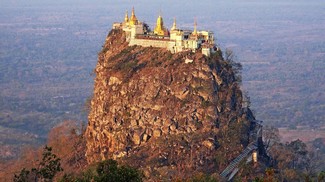
As it happened, I had my own mountain to climb later that day. We headed further south on our way to Mt Popa, an extinct volcano located in Central Myanmar southeast of Bagan. Down through history, it was known as a pilgrimage site with numerous Nat temples and relic sites atop the mountain. Southwest of Mount Popa lies Taung Kalat or pedestal hill that rises 660 meters into the sky. A monastery lies atop of the mountain pedestal that can be reach only by climbing the nearly 800 steps. “Are you up to the task,” Lyme asked and Peter answered the question for me, “Of course he is, John is like the Duracell battery,” he quipped. I recalled the over 200 steps I had to climb with Peter to reach the Heidelberg Castle several summers earlier, so the thought of nearly 800 steps or nearly 4 times the climb seemed daunting indeed.
The passageway lead through the base of the cliff where an elaborate marketplace sold their wares to the locals and the tourists alike. Many of the tourists were locals from other parts of Myanmar. The crowds on pilgrimage were vast and the steps making their sinuous way up the mountainside were narrow and deep; but fortunately there were railings to cling to along the side of the passageway that aided in my ascent. We were an unlikely threesome, Pater, the guide and myself taking up the rear. The ever-present monkeys along the mountainside tried to intrude themselves into our midst looking for food. We had been warned not to let down our guard with these rude, insinuating creatures who like to steal things and make their great escape. Smart phones were their specialty. “Is that red powder or paint smeared upon their asses,” Peter asked naively. “No, Peter,” I chided him. “That is completely natural.” “It can’t be,” he insisted. “Oh, but it is,” I confirmed. Upon reaching the top, where the monastery lay amid the rocky crags, we were treated to yet another fabulous view of the surrounding countryside awash in the clarity of the harsh winter light, clear to the horizon.