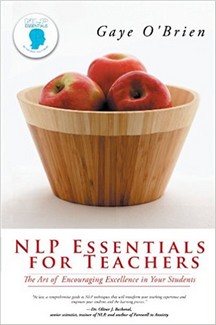
My book discusses beliefs about learning and NLP techniques that are useful for teachers and trainers to have, to be able to assist students achieve better outcomes.
"NLP Essentials for Teachers: The Art of Encouraging Excellence in Your Students" is designed to assist teachers, trainers, parents and anyone else, to enhance their communication skills.
The book firstly encourages the reader to examine their beliefs to ensure that their belief system is congruent with empowering the learners they teach.
Secondly the NLP model is discussed which points out that what and how well we learn is determined by how we feel at the time and what effect the language that we hear, has on us.
Language either verbal or non-verbal causes us to make a picture in our mind. Positive language helps us to create useful images and negative language has the opposite effect.
So the techniques taught explicitly include the use of proactive language, developing rapport, reframing behavior and catering for different learning styles using specific ideas for the different modalities.
Excerpt
Beliefs That Support Learning
The following presuppositions of NLP provide guidelines for both excellent teaching and learning. They also encourage positive behaviour in the classroom.
Rapport is created when respecting how others see the world.
Taking note of this presupposition will greatly assist you in working more successfully with all individuals, as you will become more accepting of all students.
Behaviour occurs in a context.
If you change the context, you can expect or observe a different behaviour. As a teacher, you would notice the changes in students when they do different activities, take different subjects, or go on various excursions.
All behaviour is motivated by positive intent.
All behaviour is done for a reason, even challenging behaviour. Every student wants to be recognised and acknowledged for his or her achievements.
Resistance in a person indicates lack of rapport.
There is no resistance, only lack of rapport. Build rapport with students, and there will be no resistance.
People are not their behaviours.
Accept the person and change the behaviour.
Behaviour can change from moment to moment, or in different contexts. Change the undesirable behaviour by catering to the student’s needs.
Everyone does the best he or she can with the resources available.
If students have limited personal or material resources available to them, then they will tend to achieve a more limited result.
There is no such thing as failure. There is only feedback.
People are all learning machines, and they learn by failing and getting feedback. That is how learning happens with everyone. No one does things perfectly the first time. Both teachers and students have to learn to accept and implement feedback. See chapter 11 for suggestions on giving effective feedback to students.
Teach information in small steps to ensure success.
Using a process called chunking, teach students to do tasks step-by-step. Give them instructions in this way. This is a great life skill to have, and it reduces the likelihood of being overwhelmed by situations.
Students are in charge of their minds and their results.
This concept is a difficult one for many students to grasp. It is often easier for them to blame someone else for their lack of progress or success at school. Encourage students to accept responsibility for their own actions.
The map is not the territory.
Explain to the students that this may also mean the itinerary is not the holiday, or the recipe is not the cake. Alfred Korzybski, mentioned previously, believed that what the brain interprets as happening all around us is not actually everything that is going on in the world. It is rather an interpretation of the world. His idea was that the brain only stores bits of the whole picture and may have not tested this information with sensory input.
How well you have communicated is indicated by the response you receive.
This is a very powerful presupposition! If you have communicated well, you will get a good response, no matter how difficult the message is that you are conveying.
We all can be resourceful if we are in charge of our emotional state.
As you know, it is often challenging to do something well if you are distracted or feeling stressed or upset.
Flexible communicators find a way to establish rapport.
These communicators will vary their direction or strategy if their current approach is not working.
Calibrate on behaviour.
Calibration requires noticing subtle changes in a person’s body language from one situation to another. Notice the differences when a student has responded to your comment or assistance.
Present behaviour is the best choice available.
This may be a difficult idea to accept, particularly if the student is misbehaving. Remember, though, there is always a reason for the behaviour—even if the student is not aware of why he is doing it. Challenge the behaviour and change it.
You cannot, NOT communicate.
You are always communicating—even if it is by being silent, as during that time you will be exhibiting body language.
People have all the resources they need to succeed.
This is a very empowering presupposition. Some of your students will not believe that they have the resources to succeed. The challenge is to show them how to access the internal and external resources available to them.
The person with the most flexibility of behaviour will control the system.
The more adaptable students are to changing circumstances, the better they will perform. Inflexible students tend to perform poorly—for instance, when there is a change of teacher in the classroom.
Imagine how successful the learning would be in a classroom where these assumptions are modelled and taught consistently! Take up the challenge and notice the change in your classroom dynamics.
Professional Reviews
NLP Essentials for Teachers: The Art of Encouraging Excellence in Your Students
“At last, a comprehensive guide on NLP techniques specially dedicated to teachers to empower their students and the learning process. In “NLP Essentials for Teachers”, Gaye O'Brien shares with you powerful and effective techniques that will transform your teaching experience. You and your students will both be richly rewarded.”-Dr Olivier J. Becherel, Senior Scientist, Trainer of NLP, Speaker and Author of “Farewell to Anxiety” and “The Missing Guide for Students”.
NLP Essentials for Teachers: The Art of Encouraging Excellence in Your Students
“This book has the potential to change your life! It will assist you to become a better teacher. Gaye’s book delivers on practical knowledge and skills to promote success in the classroom for pre-service and experienced teachers.” Bill Blayney, Senior Lecturer, Teacher Education.
NLP Essentials for Teachers: The Art of Encouraging Excellence in Your Students
“Great work. What a good resource.” Gina Mollicone-Long, Best selling Author and Creator of GreatnessU.
The Harlem Renaissance remains exciting, inspiring, and irresistible in the first half of the 21st Century for the same reason that the many people who lived it found it exciting, inspiring, and irresistible in the first half of the 20th Century. De
This valuable educational tool for students and teachers not only entertains with engaging stories on the lives and events which comprised the Harlem Renaissance of the 1920s. It also provides important case studies of diversity, multiculturalism, an
Suicide Awareness for First Responders helps you to better understand suicidal people, how to help them, what to do at a scene of suicide threats or completion. Suicide threats and completion among first responders is also covered.