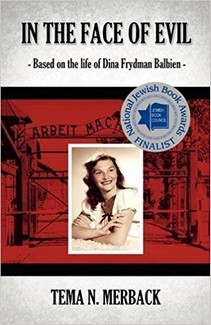
In the Face of Evil is the extraordinary true story of a young girl’s coming of age during the decimation of the Holocaust.
A Jewish teen survives the German invasion, the devastation of her family, and Nazi concentration camps to be reunited miraculously with her young lover.
Ten-year-old Dina Frydman lives a comfortable middle class life with her family in Radom, Poland in summer 1939, just weeks before the Nazi invasion. The love of family and friends offer no protection against the menace of the Nazi regime that begins to siphon off the worldly and spiritual goods of Radom’s Jews. We witness the struggle of Dina as she comes of age during an apocalypse and fights to survive. When her family is deported and murdered at Treblinka she finds safety at a forced labor facility where she experiences her first taste of love when she at thirteen meets Natek Korman, a passionate sixteen year old who rekindles her will to live. Forced by the Nazis to separate, the young lovers vow to find each other after the war. From work camps to death camps, Dina survives the war alone. The aftermath of six years of death and destruction presents a new obstacle, how to live? In 1945, she is reunited with Natek only to face the most important decision of her life. She chooses to follow her dream.
Excerpt
Chapter 4
Germany Attacks
One week later, during Shabbat, on Friday, September 1st at 4:30 AM, the bombing begins. I awaken to an explosive rumbling that bathes the room in a flash of white light. It is impossible to ascertain whether the shattered peace is raining from the heavens or emanating from the bowels of the earth. At first, I think it is a violent thunderstorm hurling down upon us and sucking the air from the atmosphere. This is like nothing I have ever experienced. As our building shakes to its foundations, I am terrified it will collapse, killing us all. Above the wailing sirens, I hear glass shattering, my mother screaming, my brother crying, and my father in the next room trying to calm them both. My poor grandmother shrieks with each detonation and then regains her senses in the momentary lull. Then she lapses into a mournful combination of moaning and praying in Yiddish to God and my grandfather to intercede and still the firestorm threatening to consume us. Another explosion shakes the building, drowning out the pleas of the inhabitants in my home. I grab my sister. “Nadja, what is happening?”
“I don’t know!” Her arms fly around me and we shudder against each other in fear. With her hand clutching mine, we jump from the warmth of our bed and run to the window to see what is happening. Beneath the canopy of stars, we hear the drone of planes overhead. The sky has turned a blistering red from the glow of the fires burning throughout the city.
Gripping the window sill, I look at the scene below. Horses run up and down the street in terror, wailing in fear. They must have escaped their stalls when the bombing began. Adding to the confusion, people are running up and down the street, their arms flailing, trying to avoid being trampled by the disoriented beasts. Every minute, another deafening explosion shakes our home and we hear terrified shrieks from the other apartments. My father runs into our room shouting, “Girls get away from the window! It isn’t safe!”
Nadja and I flee from the window to our father’s arms. “Tata, what is happening?”
“Come, come with me into the other room. The war has begun. Germany is attacking!”
Staring at my father in disbelief, I begin to cry. Nothing has prepared me for this moment. I feel helpless and exposed as another blast rocks the timbers of the building, sending rivulets of dust-like grainy particles that shroud us in a grayish mist. We run with my father to the safety of our parents’ bedroom, where my mother, brother, and grandmother are cowering under the bed. My brother’s arms are locked around my mother’s neck as he whimpers, “Tata, Tata, make them stop.”
My grandmother cries repeatedly, “Please God, help us!” Another explosion shakes the building and the room is filled with a pellucid white light that turns night to day. My sister and I dive under the bed. My mother holds us tight, protecting us with her arms as if they are armor and she can shield us from any harm.
My father does his best to hide his own fear and calm us. “Don’t cry children, don’t worry it will stop. We are safe; the building is strong. Be brave my darlings.”
He is trying to convince himself as much as he is his family. Under the bed, we cling to each other, frozen with terror as the attack continues for what seems like hours.
I feel certain we will not survive the night. Perhaps this is the end. In a terrible final collapse of wood, iron, and glass we will be buried beneath the rubble of our building, forgotten to the world.
Several times during the night, the bombing stops, only to resume an hour later.
We remain prisoners in our home for the next five days while bombs intermittently strike our city. My father ventures out to hear the news. When he returns, we run to him, happy that he has safely returned.
“Tata, Tata, you’re back!”
My mother rushes to him, interrupting our questions, “Joel, what have you heard? Is there any hope?”
Looking at our pleading faces, he responds, “Yes, yes, there is good news. On September 3rd, England and France declared war on Germany!”
“Thank God!” my mother exclaims. “What else? Tell us more!” My father weighs his words, “Unfortunately, the Nazis are moving rapidly. The Polish army is fighting valiantly, but they are heavily out-armed and undermanned. Germany is pounding the cities and transportation lines. Thousands of people are being killed. I must be honest with you, I can’t imagine any other outcome than the Nazis conquering our country.”
“How long?”
“How long what?”
“How long before the British and the French come to our rescue?” my mother asks impatiently.
“I’m afraid… it’s likely we will have to endure a German occupation. It will take time for the allies to prepare for war.”
My mother’s face conveys what we all feel, as her eyes flood with tears.
Protectively putting his arm around her shoulders, he says, “Come dear, let us make some tea and listen to the radio.”
We listen to our radio; the steady flow of news is disheartening. The radio waves are filled with the aggressive repetitive voice of Hitler screaming, “We will take Lodz today and tomorrow Kielce, and on and on until we take Warszawa!”
My father turns the dial in search of something other than the hysterical boasting of Hitler, as we sit in misery. Finally, we hear the voice of a Polish reporter crying out his dismal news, “Countrymen, the sovereign nation of Poland is being bombarded. The Germans have thrown an immense force against Poland. We estimate nearly 2,400 tanks organized into six panzer divisions have rolled across our borders, striking with rapid precision through our defensive lines. The Germans are surrounding and destroying our troops with foot soldiers and mechanized infantry. The tanks are scorching the earth and leaving a path of death and destruction in their wake. The only way to describe what is happening is to call it a blitzkrieg, or lightning strike. The blitzkrieg is an organized attack of such surprise, speed, and strength, it is impossible to defend against. Pray for our brave soldiers who are fighting for their lives and yours!”
In horror, we hear guns firing and explosives detonating in the background. The announcer’s voice fades in and out with the crackle of radio static and interference, until there is only the hiss of a severed transmission.
I sit at the window in my bedroom during a momentary lull, staring down at the street. I had begged my mother to let me go down to Fela’s apartment to see her. Her answer was an unequivocal “No!”
My mother, who never raises her voice to scold any of us, now is on the verge of hysteria; her worries overwhelm her usual calm demeanor. The streets are nearly deserted except for an occasional human who darts from doorway to doorway, furtively making his way to some unknown destination.
I stare to see if I recognize anyone that passes, a near impossibility as each one clings to anonymity in the shadows and hides as best he can. The radio in the next room drones its endless blitz of bad news.
We are all suffering various forms of shock and fatigue as we wander from room to room, looking for respite. We hear that the roads are clogged with refugees heading east in a desperate attempt to outrun the Germans who are conquering the towns and cities in their path. I listen at the window and it occurs to me that even the birds have been forced to flee. They vanished when the bombs appeared, flying east to what they hoped were peaceful skies.
How I wish my family and I could take wing and follow them in their flight to safety.
I imagine a procession of overloaded carts filled with the few possessions piled precariously without toppling—accumulations of a lifetime salvaged and grabbed in a few moments of panic, as the fleeing refugees hastily departed. How did they decide what to take and what to leave behind? The carts, pulled by over-burdened horses and oxen, move in a slow exodus, mothers, fathers, and children trying to escape chaos. All the while, thousands of birds fly above, screeching, their wings tearing at the wind in a desperate flight to escape.
My sister comes to sit beside me at the window, hugging me in her arms, offering a bit of solicitude and affection, “So, what do you see, Dinale?”
“I see the end of our world and it breaks my heart,” I answer, as tears well in my eyes.
“You mustn’t lose hope! There are good people in the world; they will come to our rescue. We will have to be strong and resilient; it is our fate.” Her words sound strong, but her face belies her words.
“You don’t sound as if you are convinced. And since when do you believe in fate and not free will?” I grumble.
“I’m afraid that freedom for all Poles disappeared when the Nazis crossed our border. I don’t know what the future will bring, but I do know we are in for difficult times and Mama and Tata are going to need us in ways that I can’t even imagine.” She squeezes my shoulders to emphasize her words. “Right now they could use your sunshine smile and maybe you could comfort Abek and play a game with him. He is so frightened and could use a little distraction from his fears. I’ve tried, but he won’t respond to me.”
I nod and turn from the window. My brother Abek is playing quietly on the floor with his jacks. I smile at him and tousle his blond curls, asking if I can play jacks with him. He looks at me, his eyes wide with confusion, not sure what to expect from those around him. My once jolly brother, now subdued, hands me the ball. Taking it I whisper, “Are you afraid? It’s okay if you are. I know I am.”
My question is met with silence as Abek stares down at the jacks on the floor, refusing to look at me.
“Abek, please talk to me. I know sometimes I am not the best sister in the world. I’m sorry; I really am. You know I love you and would never hurt you, not really. Please talk to me and tell me what you feel!”
He leans in to me, his blue eyes glistening with tears. Overnight, my high-spirited brother has been silenced and replaced by this pensive, withdrawn child. My heart is breaking as I grab his hands in mine to reassure him. “Abek, it’s okay to cry,” I say as I lean into him, our foreheads touching.
No longer able to hide the emotions overwhelming him, he covers his face and begins to sob. My arms envelop him as I try to assuage his pain. Clinging to one another in pent-up sorrow and fear, we tremble as a torrent of tears sweeps our bodies, leaving nothing but barrenness in its wake. With childlike perception, Abek and I sense some inexplicable line has been crossed. No matter how much my parents try to assure us, our world of Radom, and a thousand other cities and villages like it, has vanished. Not for a month, or a year, but forever. We cry without knowing our childhood already has deserted us. Clinging to each other, we hope for an epiphany, an angel from heaven to save us from the fearful uncertainty shrouding the future. We weep in each other’s arms for what seems forever. Finally, our tears are spent and I release him.
“Your eyes are all swollen and your nose is all red,” he giggles through his sniffles.
“And, what do you think yours looks like?”
Laughing in mutual misery and burrowing his head in my shoulder in a gesture of love, he whispers, “I’m glad you’re my sister.”
“Me too, I’m glad you’re my brother.” I hug him so tightly, he is forced to inhale deeply and I feel his ribs expand in my arms.
I think about Nadja’s words—being strong and surviving. Each of us will have to be vigilant not to let despair crush us. At that moment, I promise myself that no matter what the future, I will find a way to bear it. I release Abek, pick up the jacks, and throw them across the floor. “Come on Abek, let’s play.”
Chapter 5
“The New Order”
The morning of September 8th dawns without the usual sounds of military conquest. The streets are empty of pedestrians and the skies hold no sign of aircraft. The barrage of artillery and bombs has ceased. The city seems to be slumbering under a spell, blanketed in an intense quiet, the kind of stillness that precedes or follows a major storm.
Still in my pajamas, I rest my hands on the window sill and stare at the abandoned street. All the while, my sister sleeps. At first, I barely register the tremor beneath my fingertips, but within a few minutes, a visible pulsation increases with frequency and speed. The ground is shaking and I hear a distant rumble, not unlike thunder. Looking up, I see there isn’t a cloud in the sky. Within minutes, I distinguish the source of the now deafening disturbance. The first vehicles bearing the flags of red background and black swastikas make their way down our street.
“Dinale, what’s happening? What is all that noise?” My sister awakens.
“It’s them.”
“Who?” Suddenly the sleepiness is gone from her speech and
Nadja jumps from bed and joins me at the window.
It’s the Germans. Look!” I point to the parade of steel and armor.
“Tata, Mamashy, come quick!” Nadja runs to the door as my parents rush into the room.
We stand in silence, watching the Germans march into Radom. It is a spectacle of unmitigated military might, clearly meant to quash the hearts and minds of the conquered citizenry who hide like ghosts behind curtains. We watch as hundreds of motorcycles, tanks, trucks, and armored vehicles pour through the abandoned streets. A deafening clamor fills the air, dust rising from the ground like a desert sandstorm.
My father’s face is as pale as the moon in the sky, a sorrowful look in his eyes as if he were attending a funeral. Unable to bear his unhappiness, I wrap my arms around him and offer up a smile, “Don’t worry, Tata. We will find a way to live through this. Please don’t look so sad.”
He presses me close to his body, forcing his lips to form a smile. “I know, maidele. It just breaks my heart that you, Abek, and Nadja will have to endure this evil.”
The Germans quickly occupy the government buildings, sheltering their soldiers and setting up their command posts. A few days later, the SS units and police arrive amid triumphant fanfare. This time, curiosity gets the better of Radom’s population and the streets are crowded with onlookers.
My sister and I join the throngs to watch the arrival of the elite officers of Hitler. Many in the crowd are visibly disturbed, tears flowing freely from their eyes, as the conquerors march through the streets laying claim to our city. I look around in shock to see that some of the Poles are actually greeting these monsters like heroes, welcoming them with their hats and handkerchiefs high above their heads waving in salute. I look from the smiling Poles to the scowling faces of the SS, dressed in well-tailored uniforms, black spit polished boots, and cocky hats with the skull and cross bones death insignia. I shiver and whisper to Nadja, “Do the Poles hate us?”
“The Poles have never been our friends. They will gladly feed us to these murderers without a moment’s remorse. Look at how they are greeting these monsters. It’s as if they are being liberated—not being occupied.”
Her words freeze the blood in my veins. I feel the bile rise in my throat as I watch the arrival of Hitler’s ambassadors from hell.
In the following days, Nadja’s words play out. The Poles adapt to their new masters, groveling with solicitousness in their passion to please. The Nazis regard the Poles with contempt, but at least they are considered human. Not so the Jews. My father can no longer leave the apartment, as the Nazis constantly grab Jewish men off the streets and take them to work details where they are beaten without mercy. The Germans need labor to rebuild the armaments factory razed during the bombings and to repair roads and bridges damaged during the bombings. The expendable Jews are put to work as slaves. Forced to clean the streets and haul coal, the Jews feel the force of blows if they do not work fast enough.
For their entertainment, the Nazis prey upon the recognizable religious Jewish men and rabbis. With their peius, long curled side-locks, black long tunic coats, and felt hats, they are easy prey. They bear the initial brunt of the worst cruelties. The Nazis take pleasure in humiliating and denigrating these poor souls. Ripping their beards from their faces, they beat them with clubs and kick them until they are nothing more than a bloodied mass of pulp, unrecognizable as the human beings, grandfathers, fathers, brothers, or sons they once were.
I run with my mother through the streets on a desperate errand for food and supplies. Her hand tightly grips mine as we pass such a scene. I stare in horror as three Nazis shouting obscenities beat an old man as he pleads for mercy. I feel faint as blood gushes from the old man’s nose and he crawls in the street, groveling for his life. I look at my mother, her face a mask of fear. I want to protest but she hushes me and pulls me away.
When we are safely away, I ask, “Mamashy, why are they beating such an old defenseless man? What possible pleasure can they get from it?”
She looks at me, her face flushed with compassion. “We are helpless, Dinale. I am sorry, but there is nothing we can do. These people have no decency or conscience. They are filled with the power of their hatred. I need you to be brave, care for our family, and help others when you can.” She smiles at me through her tears and hugs me close. “Come, we must get some potatoes for dinner and hurry back home to your father. The streets are so dangerous; he will worry if we take too long.”
Jews no longer walk the thoroughfares of the city. Our vibrant neighborhood is a place of fear and mourning for a world now vanished. Many of the businesses remain open and my mama begins opening our store, stocking it as best she can.
My father remains at home with us, listening to the radio for any news of hope. Hitler proclaims he will conquer Warszaw in a week, but has underestimated the valor of the Poles. The fighting is fierce as the German war machine surrounds and squeezes Warszaw in its grip. Yet Warszaw remains free and the Polish army fights on, even destroying the Reinhardt tank division, a pride and joy of Hitler’s army. Warszaw is determined to withstand the onslaught of the German blitzkrieg. Against all odds, the remaining patriots fight on, knowing the fall of Warszaw is inevitable.
It is September 13th, the holiest day of Rosh Hashanah. The year 5700 on the Jewish calendar dawns and the “Days of Awe” begin in Radom. I lie awake listening to my parents arguing in the next room, something I have never experienced before from these two respectful people.
“Temcia, I will not allow these interlopers to cower us from keeping faith with God!” My father’s voice rises in a crescendo of indignation. “Abek and I must go to synagogue!”
“Joel, I am telling you that you will not go! There is no reason to put Abek or yourself in harm’s way when we can all remain here and pray as a family. I have a terrible feeling that the Nazis will wreak havoc on the Jews during our holiest of days.”
“Temcia, allow me my dignity. Please don’t fight me on this.”
Nadja lies next to me listening to my parents arguing. “Is Mamashy right?” I whisper.
“Yes, definitely. Tatashy is being unreasonable. God will hear him just as well in our home as in the shul. Believe me, God has never heard more prayers than will be coming to him tonight and every day and night so long as Hitler is on the march. Mamashy is right and she will prevail and get her way no matter how firmly Tatashy protests.”
Finally, my mother uses the ultimate weapon that women throughout history have wielded when all arguments fail; she begins to sob. My father in an instant is powerless as the tears gush from my mother’s eyes. My father and brother remain at home and at sundown, we hold hands, greeting the Jewish New Year. We are united in our prayers of peace for all mankind.
My mother is proven correct in her premonition. While we are safely at home, the SS wreak havoc, entering the synagogues destroying the interiors, desecrating the sacred texts and scrolls, and plundering the sacred articles. They patrol the streets, randomly entering Jewish homes and arresting anyone found celebrating the holiday. They drag them from their prayers and force them into work details where cruel humiliations are perpetrated against them. The tales are horrifying. Some Jews are forced to scrub the sidewalks with their prayer shawls, while the Nazis set fire to the beards of others. Meaningless tasks are devised as punishments against the devout. The president of the Jewish Community, Yona Zylberberg, is dragged into the streets and made to walk for hours with his arms raised above his head, carrying a heavy stone, while the Nazi oppressors taunt and beat him with clubs and whips. At least he is alive.
One of the saddest losses is that of a beloved Hebrew teacher, Chaim Shlomo Waks, who is arrested and taken to SS headquarters. There, the Nazis torment him by trying to force him to eat pork. This deeply religious man refuses, so they beat him without mercy as he cries an endless chant of “Shema Israel, Shema Israel!” Finding no other way to silence him, they shoot him in the head, silencing his voice forever. The “new order,” as the Nazis call themselves, leaves a path of death and destruction on that holy day throughout the city of Radom. Deep into the night the cries of the afflicted can be heard.
Still, the Jewish community as a whole remains strong in the face of persecution, just as they have time and again throughout our history. In an effort to protect the community, our leaders do their best to answer to the continuing demands of the Nazis. The council is required to provide a list of all of the Jews in the city and their occupations. As the Nazi demands increase, the Jewish community tries to manage some semblance of normalcy. People return to work, slipping quietly through the streets to open stores and factories. Jewish charity increases in an effort to care for those already suffering immense losses.
It’s a rainy morning in September when we children are allowed to return to school. I am delighted to see Fela waiting for me as usual in our courtyard. She holds her umbrella as a gray drizzle falls from the heavens.
“Fela!” I cry, running to her, our arms enfolding each other as we warmly embrace. Our umbrellas entangle in a mesh of wire and cloth. “I am so happy to see you! Mamashy has been so protective, she hasn’t let us out of the house.”
“I know,” Fela replies. “My parents have been impossible, never letting us out of their sight. Our home feels more like a cage than a home.”
I take her arm and we begin to walk our familiar route to school. I am alert for danger, my eyes cautiously glancing around for any signs of trouble.
“I am so afraid all of the time,” I whisper. “Bubysy continually cries and prays and everyone else is so jumpy that the slightest noise or complaint sends them into a tizzy.”
“It’s the same in my house. My mother is constantly on edge and my poor father has nowhere to go to escape her,” she giggles. “I hate the Germans,” I exclaim. “I hope God destroys them all.”
Fela nods, looking around to make sure I have not been overheard. “Everyone is saying that if we just keep a low profile and do our best to meet their demands, we should be able to endure the occupation and survive.”
“I don’t believe it. Every day it gets worse. Every day they make new demands and are never satisfied. Their hatred and cruelty seems to grow with each brutal act. I saw them beat an old defenseless man!”
Like a wizened older sister, Fela tries to calm my fears and acts the sensible one in our friendship. “Dynka, we will manage, you’ll see. We must manage, we have no choice.”
“I wish we could escape to your grandparents’ cherry orchard right now,” I sigh. “I can taste the sweet black cherry juice; you know how much I love cherries? Remember, when we were there this past summer and we played in the orchard? Remember how big the cherries were and how I looped them over my ears like long beautiful dangling earrings and you said they looked like rubies? It seems like a million years ago. Life was so beautiful. I don’t think I can bear this thing called war.”
Fela’s eyes mist and she wipes away a tear that has made its escape down her nose. “It will be alright. Someday we will return to my grandparents’ cherry orchard, and you can eat all the cherries your heart desires. Then we will grow up and go to Palestyne and marry farmers.”
I smile at her, my bravery returning as I remember the promise we made beneath the branches of the neighborhood apple orchard. I squeeze her hand. “I know you are right. This will pass.”
It is September 17th when Poland’s old enemy, Mother Russia, under the iron rule of Stalin’s dictatorship and emboldened by Poland’s vulnerability, seals its bargain with the devil Germans and invade our eastern border. Poland is like a lamb surrounded by a pack of hungry wolves. Then, on the 27th of September, Warszaw surrenders to the Nazis and the nation of Poland ceases to exist. Within two days, the Nazis and Russians divide Poland with the intention of exploiting her resources and enslaving her people.
With the sealing of this bargain, more than 2 million Jews fall into the hands of the Nazis and another 1.3 million Jews into the clutches of the Russians. The cold and rain have come unseasonably early this year, echoing the misery that envelopes us.
As the days advance, my parents and sister discuss with ever increasing bitterness the continuous commands of the Judenrat.
They are trying to mitigate the Nazi cruelties on the Jews while carrying out the oppressive orders demanded on a daily basis.
One of the first of the confiscations is the surrender of all radios. My father reluctantly turns over his precious radio to the authorities, knowing it is a move to isolate us from news on the progress of the war. Newspapers are my father’s sole link to the world and he obtains every printed publication available in Polish and German, legally or on the black market. The illustrious Yiddish newspapers are silenced.
I am reading in the kitchen as my father storms in, cursing under his breath, and stuffs his newspaper into the garbage can.
“Tata, what is it? You look so angry.”
Quickly composing his anger, my father says, “Nothing darling, it is nothing, just some silliness in the newspaper. Please continue your reading. I didn’t realize you were in the kitchen.” My father returns to the other room, leaving me perplexed as to what would cause such a reaction. My curiosity gets the better of me. I retrieve the paper from the trashcan and search the front page, looking for any clue to my father’s behavior. The newspaper is the German publication Der Sturmer. It takes several minutes for me to make sense of the words and figure out which article is the culprit. I carefully read until I am stunned to discover the source of his anger. “The Jewish people ought to be exterminated root and branch. Then the plague of pests would have disappeared in Poland at one stroke.” Over and over, I re-read the sentence to make sure I am not mistaken as to the vile meaning. The word “exterminated” sticks in my throat. Holding the newspaper as if it is infected with the plague, I run to my father, pointing at the threatening sentences, “What does this mean, Tata?”
My father is in the dining room surrounded by newspapers, his glasses perched on his nose. He looks up and I can see he is loath to discuss the offensive words with me. Patting his knee, he motions. “Come sit, Dinale.”
Arranging myself on his lap, I lean back resting my head on his shoulder snuggling into the safety of his arms. My tears fall like rain. “Are the Nazis going to kill us all, Tatashy?”
“Hush, hush, maidele. Don’t be silly. They can’t kill millions of people; it’s not possible,” he says, wiping the tears from my eyes. “But Tata, if they say it, they must mean it. But how? Are there that many bullets in the world, millions of bullets?”
“No, no, no, they would be foolish to destroy such an army of workers. Better to use us for cheap labor. The world is not going to sit by and let this Nazi menace take control of Europe. The Germans tried this once in World War I and they were stopped and brought to their knees by the world’s free democracies. They will come to the rescue of Europe again, you’ll see. We must stay strong and our resolve to live must be firm. The Jewish People have survived time and again and lived to tell the tale of every tyrant who has tried to destroy us. Remember your Jewish history? Remember Haman ? Now, dry your tears and go back to reading your book.”
“But, Father, you yourself said that it will take time for the other countries to come and rescue us. How will we live if they wish to wipe us from the face of the earth?”
“These are harsh and hurtful words, but the Nazis will realize what a resource we are. I don’t want to hear any more about this and please don’t tell your brother. We love you, your sister, and brother so much. We will do everything to protect you, don’t worry. Throw the newspaper away. It’s simply one man’s insane words.”
Although my father does his best to calm my growing fears, the newspaper article arouses a mounting sense of foreboding in me. My sleep is plagued by an endless nightmare. I am running from uniformed monsters, lost in a world of darkening terror, screaming, “Stop! Stop! Stop! Leave them alone, please don’t hurt them!” My body is soaking with sweat; my heart pounding against my chest.
Nadja shakes me awake gently. “Dinale, Dinale, it is okay,” she reassures, rocking me in her arms. “Nothing is going to hurt you. You are safe in your own bed. It’s me, sweetheart, Nadja, your sister! Don’t cry, you are safe, it’s only a bad dream.”
Gasping for air, I tell her what I can remember of the nightmare. “It was horrible! I saw them dragging you and Mamashy and Abek away. They were pulling you in one direction and me in another. I couldn’t stop them. I tried, but I couldn’t. It was so unbearable.”
She shudders against me and holds me closer to her. “I know how scared you are. We all are scared. It is only natural for you to be traumatized by this nightmare we are living. It’s impossible for any of us to understand how anyone could hate us this much. To hate children, the infirmed, and the aged is beyond comprehension. But, we are safe and doing our best. Cry all you want darling, but don’t give up hope. Remember I’m here for you always.”
I cling to my sister whimpering, “I’m sorry but I can’t stop the dreams, they are so frightening and they always end the same! You are taken from me and I am taken from you.”
October already shows signs of being a harbinger of an unusually cold and damp winter. The Radom Jews struggle to feed their families and maintain a semblance of dignity throughout the Nazis’ onslaught of daily humiliations. Each day brings new orders, called befehl, many disseminated with the sole intent of humiliating and reducing community resolve. The new German Mayor Schwizgabel demands that the Jewish community raise a sum of money for the privilege of being allowed to live and work in occupied Poland. They try to blackmail two million zlotys from a population that has already been stripped of its assets. When the community cannot raise that kind of cash, they agree to a lesser extortion of one thousand sets of bedding needed for soldiers and officials. The tailors and seamstresses of Radom, my Uncle Chiel being one of those tailors, sew around the clock to finish the bedding before the deadline. Nothing can satiate the Nazis and soon it is a running joke that “If it belongs to a Jew, it must be good, and we want it!”
At the end of October, a new decree is delivered. All Jews over ten years of age are required to wear a white armband with a yellow Star of David sewn to it. Whenever we leave the house, we are required to wear the badge and if caught without it, we will be arrested and deported to German labor camps. We sit at the kitchen table sewing the armbands symbolic of the punishment for the crime of being Jewish. My brother is on the floor playing with his jacks.
I slip my armband over my sleeve and look in the mirror, admiring my handiwork, “I am not going to allow them to make me feel bad about being a Jew. I’m proud of the Jewish people. I’m proud of our history.”
“Silly girl, some pride,” says my sister with a hostile grunt. “The Nazi beasts are isolating us from the Polish population. They are dehumanizing us and removing our dignity. Each step is intended to fulfill a larger plan. That’s what these armbands are for, to visibly mark us.”
“I will not allow them to make me feel bad about being a Jew,” I defend.
“Mamashy, I want to wear the star too,” Abek chimes.
Cruelly I turned on my brother, “Well you can’t, Abek, because you are just a baby, you aren’t old enough to be counted as a Jew.” No sooner are the words out of my mouth than I regret saying them. Abek looks from me to our mother, his eyes filling with tears. “Mamashy, I am a Jew. Tell her that I am a Jew.”
My mother’s face hardens into anger as she reprimands me, “Dina, there is no reason for you to say such cruel words. Abek bears our covenant with God upon his person. He is a circumcised male. He can never be anything other than a Jew. You will apologize to him this instant!”
“I’m sorry, Abek, I shouldn’t have said that to you,” I say feeling downcast and ashamed.
My grandmother sighs, “I don’t know what has gotten into all of us. Can someone please tell me where decency and respect has gone?”
In frustration, my sister answers, “Bubysy, the Nazis have made the words decency, respect, and kindness meaningless.”
Every day brings a new edict with a new loss of rights. Jews no longer are allowed to walk on sidewalks or take public transportation unless we obtain a special pass from the Judenrat. Many boulevards and squares are illegal for us to use, a sure sign of our degraded status. We are forced to abide a curfew limiting our ability to gather. All the kosher butchers are forced out of business as they no longer are allowed to slaughter animals according to the laws of the Torah. My parents bemoan the end of their much-loved butcher business. Soon every Jewish business in Radom and throughout Poland is expropriated by the Third Reich and German administrators are appointed to run them. In some cases, ex-owners of businesses are still allowed to run the businesses and work for the new German managers. Many of these German managers have no idea how to run the businesses and have to bring in Jews to help them. My Uncle Tuvye becomes a co-supervisor with another friend, a Mr. Berman, at a shoe factory. All Jewish bank accounts are frozen and the few Jewish banks that existed are forced to close, their monies absorbed into the ever-growing bank accounts of the Nazis. Jews are legally only allowed to possess 150 zlotys in cash, which is nothing considering the rising cost of food. Jewish doctors, lawyers, and musicians are not permitted to practice their professions or perform their services for non-Jews. This is quite a problem for the Polish population since they rely heavily on Jews in all of these fields, particularly medicine. They close all of the Jewish schools, but it doesn’t really matter. My sister and I are needed to stand in endless lines that wrap around blocks to procure some bread or other necessity for our family. We are forbidden to walk on Lubelska Street, the main artery of the city, and we are not allowed on Rynek Square where the city hall is situated. Finally, they confiscate all property owned by Jews. We no longer enjoy any rents or income from any of our properties. We have no avenue of complaint as we are denied rights or status as citizens. There is no protection from the courts and, like criminals we are under the jurisdiction of the police.
The practice and celebration of Judaism is expressly forbidden in any public venue or even in the privacy of one’s home. With a heavy heart, my father decides to dismantle our beautiful Sukkoth and supply our family with an ample supply of wood for the winter.
I watch with sorrow as he begins to dismantle our Sukkoth, a beautiful outdoor room used during the festival of Sukkoth. It still holds the decorations of fruit and vegetables we hung from the slated open canopy. Inside our Sukkoth is a large wooden table where my mother draped a beautiful linen table cloth and placed an earthy set of wooden dishes, symbolic of the primitive tools of our ancient ancestors.
Sukkoth, a celebration of the harvest, is called The Feast of Tabernacles. Sukkoth literally means “hut” and is symbolic of the temporary homes used by the ancient Jews after the Exodus from Egypt. The holiday is a time to thank God for his benevolence in providing for the needs of his people as they wandered the barren desert for forty years. Besides the religious connotations, Sukkoth is a holiday of excitement for children. Our courtyard was filled with at least eight Sukkoths belonging to each of the families in our building.
Each family took pride in hanging the harvested fruit and vegetables from brightly colored ribbons that swayed in the breeze. Together, the many Sukkoths looked like a carnival of colorful pavilions. They provided us with endless entertainment as we played hide-and-seek among the structures. We laughed with unabashed joy as we hid from each other under tables and chairs and behind the posts and drapes of the Sukkoths. Nothing was more fun than the celebration of Sukkoth. It bonded our family and our friends in a love of life and the continuation of the ancient traditions of our people.
I close my eyes and remember how my father took the Lulav in his right hand and lightly shook it. The Lulav was created with a date palm frond entwined with the Hadass, a bough of a myrtle tree and Aravah, a willow branch. In his left hand, he shook the Etrog, a fragrant citrus fruit perfuming the air with a zest of lemon flavor. Then he brought the two ritual objects together to touch, pointing and shaking them turning in a circle toward the north, east, south, and west while reciting the prayer asking God for his blessings for adequate rainfall for the vegetation of the earth.
In that joyous week, we celebrated God’s bounty with outdoor dinners at the wooden table laden with delicacies of fruit and vegetables and traditional foods like tsimmes (fruit compote) and cakes laden with apples and cherries, representing the sweetness of life. The holiday meals were followed by singing, dancing, and recounting stories of Sukkoths past and praising God who had blessed us and brought us to this special season.
Professional Reviews
Horrific and beautiful
I have avoided holocaust books, probably due to the overwhelming material that's available and broadcast in all kinds of media. But a friend suggested Tema's book and I'm so happy he did. Horror and depravity is not fun, not entertaining, yet somehow she has written a page turner with beautiful prose and graphical descriptions that brought me into the action and often on the edge of my chair. Just to think that this ten year old living in hell from 1939 to 1945 emerges as a forward looking 16 year old survivor on her way to the United States is a miracle. This book is a graphic reminder that we must not forget this evil.
A Must Read
This is a beautiful dedication and poignant retelling of a time in world history that is hard to fathom.
Ms. Merback's book reads like a novel and her prose is eloquent. This book should appeal to young and
old alike.
Should Be Required Reading
Well....Let me say this...if some of the 'whiners' on facebook would just take a moment, read this book. All their complaining about their job, their weight, burning their dinner, blah blah blah...Would seem so damn petty. This beautifully written book puts life's little blips into perspective. What this little girl, and thousands of others endured is un-thinkable. I am encouraging pretty much everyone I know to read it. It will make you more thankful for the life you have.
The Harvest of Souls Crossover is a story that is exciting, vigorous, and full of suspense about the fight of good and evil in two realms, the light and dark world. The Howdy Family is determined to defeat the world of darkness, led by the seemingly