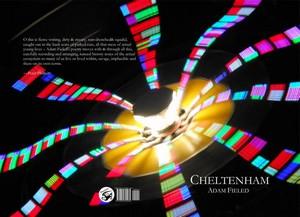
Cheltenham was published in print by Blazevox in 2012.
Cheltenham and the Cheltenham Elegies were written about the Philadelphia suburb where I was raised. The numbered form of the poems isn't that different from the form employed in Apparition Poems; but, thematically, these poems lean on a narrator registering and assimilating a past seen with twenty years hindsight. The poems appeared in Otoliths, Tears in the Fence, Boog City, Decanto, Blazevox, and Quarter After. Here are the Cheltenham Elegies on Pennsound.
Excerpt
#414
And out of this nexus, O sacred
scribe, came absolutely no one.
I don’t know what you expected
to find here. This warm, safe,
comforting suburb has a smother
button by which souls are unraveled.
Who would know better than you?
Even if you’re only in the back of
your mind asphyxiating. He looked
out the window— cars dashed by
on Limekiln Pike. What is it, he said,
are you dead or do you think you’re Shakespeare?
Professional Reviews
from Phenomenology : Cheltenham Elegies
The process of critical comparison in literature reveals and adumbrates, over a long expanse of time, that in the interstices between works of literary art, of perhaps equal value, a system of compensations binds and fastens comparison and chiasmus. When positing the Cheltenham Elegies in relation to Keats’ Odal Cycle, and bearing in mind the preponderant strength and subtlety of Keats’ prosody, I would like to suggest this compensatory chiasmus for the Elegies— just as Keats’ prosody not only vivifies the Odes but justifies the entire Odal endeavor, the Cheltenham Elegies are vivified and justified by the exquisite tensions and dramatic intimacies between the specific characters who populate them. Keats’ Odes, it must be iterated, are populated by no specific person other than the Odal protagonist— the intimacy between this protagonist and Art and Nature must suffice. The intimacies thus explored are Platonic intimacies. As human drama must compensate for metrical sublimity in the Elegies, what should be sublime in them are the intricate complexities (scaffolding again) between the characters, and the sense of crescendo/decrescendo inhering in the miniaturized dramas which unfold and coalesce from line to line, and from (as certain characters are carried over) from Elegy to Elegy. The precise substitution is humanism for formalism— and heightened psychological acuity for heightened diction. Poets and critics are free to decide, in their own systems of compensation, which counts for more, within the context of poetry, rather than in drama, philosophy, or literary criticism itself.
On Cheltenham Elegy 261
In Elegy 261, there is a preponderant weight affixed to outside the mind realities (initially), and the imposition of outside the mind realities on the interior terrain of innocent kids:
Never one to cut corners about cutting
corners, you spun the Subaru into a rough
U-turn right in the middle of Old York Road
at midnight, scaring the shit out of this self-
declared “artist.” The issue, as ever, was
nothing particular to celebrate. We could
only connect nothing with nothing in our
private suburban waste land. Here’s where
the fun starts— I got out, motherfucker.
I made it. I say “I,” and it works. But Old
York Road at midnight is still what it is.
I still have to live there the same way you do.
In an American suburb like Cheltenham, the landscape is mostly occupied by nothingness places— homogenized, generic strip malls and thoroughfares, along with neighborhood after neighborhood of undistinguished, unattractive homes, parks, and schools. It is an outside the mind reality of entrenched nothing and nothingness— places which not only mean nothing to anyone, but which were specifically designed and manufactured to mean nothing to anyone— hostile places for kids with brains and imagination. Old York Road is the archetypal suburban pivot point— supporting commerce, facilitating different forms of traffic, but generic enough to guarantee that cognitive-affective attachment to Old York Road is extremely unlikely for those who use it. Connecting nothing with nothing, in 261, manifests the process by which the human mind, surrounded by nothing and nothingness outside the mind realities (soulless realities), internalizes nothingness also as an interior reality; having, under the weight of perpetual imposition, no choice but to do so. Once the nothingness of the suburban landscape is internalized, the mind’s affective and imaginative capacities grow numb, and subsist in a state of dormant torpor. When the hero/anti-hero of 261 pulls his rough u-turn in Old York Road, it is both to demonstrate rebellion against internalized nothingness and to (by risking death) express complicity with it. It is an ambiguous gesture, which also encompasses expression of an internal landscape incompletely homogenized with Cheltenham’s outside the mind tactility.
This is why, ultimately, 261 is a poem about, and Elegy for, brotherhood— neither character is so absorbed and assimilated into nothingness (Cheltenham) that a sense of humanity is lost, and the drama of the poem inheres of watching the Elegiac Protagonist connect (as an inversion) the “something” of bold-if-foolhardy rebellion against nothingness with the something of his own artistic triumph. Whether the hero/anti-hero has established an “I” which “works” we cannot determine. What we see, by the end of the twelfth line, is both triumphant and tragic— it is inferred that nothingness, when internalized at a young age, is impossible to completely eradicate in human consciousness— thus, the Elegiac Protagonist still lives, on an internal cognitive-affective level, in a space vulnerable to nothingness. Over the course of the Elegy, we watch as Old York Road begins outside the mind and makes a phenomenological transition inside, moves from physical to metaphysical textual subsistence— and signifies identical nothingness realities in both realms. Likewise, between the two friends, the drama is initiated in physical reality and dissolves into a metaphysical or phenomenological drama between two interiors— who has managed to expel, and thus transcend, the most nothingness, and who has manifested more presence in the world. The Fancy-equivalent in this Elegy (to lasso in Keats’ terminology) is this phenomenological dissolution from outside the mind into the mind’s interior (a confrontation, rather than a break-in as in 414), from the physical into the metaphysical (especially as regards Old York Road, what it is), and the felt truthfulness of this dissolution, even if (as in 414), we complete the Elegy surrounded by unresolved tensions and ambiguities (never learning the current “location,” inside or outside, of the hero/anti-hero), and the omnipresence of the banal.