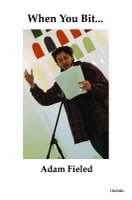
When You Bit... came out in print from Otoliths in 2008.
When You Bit... is a three part sonnet sequence set in Wicker Park, Chicago in the late Aughts, and Philadelphia. The three sections (Sister Lovers, Dancing With Myself, Two of Us) enact, first a menage, then a condition of solitude, ending in a conventional two person relationship and its vicissitudes.
Excerpt
Big Black Car
Your middle: tongue
(hers), man (me), riding
together, I bitch (middle’s
middle). I tongue man
you, her, spacious, it, of
you, all of us, can’t feel
a nothing, I can’t. Not
of this, of you, of her,
of all of this riding, in
what looks big, black,
has tongue-room. I
can’t feel a thing. I feel
nothing of bigness, black
fur interior her you. Ride.
Professional Reviews
Jeffrey Side on When You Bit... from Jacket Magazine 37
When You Bit, Adam Fieled’s new collection of poems published by Otolith, was inspired by an incident Fieled experienced after a book reading in Chicago when a female poet (for some reason) bit his arm. This suggested to him the overriding theme of the book, that of “vampirism”, as he explains: ‘The “vampire” theme has to do with the way in which lovers devour parts of their mates; the process of eating can be emotional, physical, psychological, or spiritual. So it’s vampirism on many levels’.
^
The book is made up of three sections named ‘Sister Lovers’ (concerning a ménage Fieled was involved in), ‘Dancing with Myself’ (concerning Fieled in isolation) and ‘Two of Us’ (concerning Fieled and one other person). The first two sections contain 20 poems each, the last, 21 poems. Each of the poems in all the sections apart from ‘Splat (p.38) and ‘Severance’ (p.64) are 14 lines in length, in what is perhaps an homage to the sonnet tradition, indeed this could be inferred from a line in ‘Severance’ (‘Oh you are elegant, for / you know each sonnet / backwards that was ever / spat … ’). All of the poems comprise a single verse paragraph apart from ‘When You Bit’ (p.32), ‘Cake Walk’ (p.55) and ‘Hooded Eyes’ (p.70), which form three stanzas and a couplet; ‘Hips’ (p.54), ‘Mouth Around’ (p.59), ‘Salmon’ (p.60) and ‘Love Poem’ (p.65), forming 2 verse paragraphs; and ‘Straw Rut’ (p.63) forms one verse paragraph and a couplet.
^
As with Fieled’s other published works the poems in this volume are welcomingly elliptical and multi-resonant, such that trying to force a particular critical exegesis for each poem would be unhelpful to those readers who prefer poetry to “speak” to them rather than for it to tell them things. Such readers are often stifled by such a critical methodology rather than one that enables an interactive approach, whereby reader and text can find equilibrium between personal significance and authorial “intent”. Therefore, I will only endeavor in this review to look at those parts of the poems that achieve this ideal for me personally. To speak of the appreciation of poetry in other than personal terms is to stifle the poetic impulse of both reader and poet.
^
The poems’ semantic and lexical formulations offer the reader a wealth of interpretative strategies to enable an “opening out” of the texts in order to appreciate their multiplicity of meaning/s. This can be seen in the poem ‘Tuesday’ (p. 24) where this multiplicity is played out in terms of time, geo-physical space and memory, as the poem’s “speaker” ponders on the certainties/and or uncertainties of an unnamed “other’s” absence:
^
Yesterday don’t matter:
it’s gone. Now: cut. I’m
aghast. You’re there, or,
you’re here with me.
^
The collocation of ‘Now:’ immediately subsequent to ‘it’s gone’ creates a tension between past and present in terms of the speaker’s emotional engagement with their memories. The use of ‘cut’ following the colon of ‘Now:’ appears to be a decisive element that settles this tension, as it functions as arbiter in deciding the relevance of ‘it’s gone’ and ‘Now:’ as utterances that can be relied upon. Yet, this definitiveness cannot produce absolute certitude as the speaker is still ‘aghast’, which signifies an air of bewilderment brought about by the uncertainty regarding the relative proximity between “the past” and “the present”. This doubt is extended into musings on whether whoever the speaker is addressing is in reality present or not—either they are somewhere else or ‘here with me’. The speaker cannot seem to resolve this.
^
Indeed, we cannot know for certain if the speaker and absent other are not in actuality one and the same, as is inferable from:
^
[… ] Look at the
big blue water: it’s us, &
us alone, together, here, now [… ]
^
Here we are introduced to the possibility that the water (or whatever it symbolises) and ‘us’ are either one, or else so closely entwined “symbiotically” that distinctions of subject and object become irrelevant. Yet, again, we cannot be certain of this as the “us” is qualified by ‘ [… ] alone, together, here [… ]’, which by the inclusion of “together” reintroduces the notion of a subject/object divide, whereby the separate “other” is able to potentially give ‘Micro hand-holds’ and ‘Micro lip-twists’.
^
Incidentally, the use of the word “twists”, here, begins an extended allusion to two songs from Bob Dylan’s Blood on the Tracks: ‘A Simple Twist of Fate’ and ‘You’re a Big Girl Now’—songs that both deal with aspects of time, memory and a lover’s “absence”. In the poem, the appearance of the word “twists” immediately proceeding the word “Simple”, which in turn immediately proceeds ‘I’m learning it these days’ (a direct quote from ‘You’re a Big Girl Now’), connects both ‘A Simple Twist of Fate’ and ‘You’re a Big Girl Now’ to the poem’s concerns regarding memory and doubt. Similarly, the poem’s expression of doubt is a quality redolent of some aspects of the better love poetry of Thomas Hardy, which also deals with aspects of memory, doubt, certitude, a lover’s absence and their perceived “presence”.
^
In ‘Apartment Pizza Guy’ (p. 11), we see an inspired use of elliptical phrasing to represent the totality of solipsist experience:
^
Apartment: I’m lost.
Here a bed, there a
bed; no everywhere.
^
Here we have a language that partly takes on the appearance of descriptive observation, yet functions wholly as non-descriptive. The descriptive elements (‘Here a bed, there a / bed’) could be termed “neo-descriptive utterances” which are formally similar to empiricist modes of discourse but like all good poetry empty of empirical significance. The overall tenor of the lines quoted exudes an atmosphere of existential confusion. The “bed” could be two beds, or just one bed that becomes two alternately in the speaker’s mind as this confusion is experienced. He has already acknowledged that he is lost, and is likely to be in something of a dissociative mind-state, as reflected in: ‘no everywhere’, a word combination that simultaneously expresses “that which is” and “that which is not”—a perception not normally accessible to everyday consciousness.
^
Although the poem doesn’t expressly convey it, one senses the presence in the room of another person, possibly female. This inference is derived from:
^
Couch: seat between
two, silk-skirted, red.
^
‘Silk-skirted, red’ suggests this to me, as does ‘seat between / two’, which has erotic overtones connotative of heavy petting on a couch. It is important to stress that it matters not if this rendition of this imagery is correct or not. The strength of such lines is that they allow for such interpretations.
^
In ‘Grudge-Fucks’ (p.19), we see one of the hallmarks of Fieled’s poetic style. It is a style that draws you into a chaotic linguistic fandango:
^
[… ]I
hang on the end of clothes —
lines: I’m ten sheets, each
dripped w grease, blood,
butter, milk, a catalogue of
epic grudge-fucks.
^
This kaleidoscopic tumult of surrealistic imagery, with its litany of body fluids and food stains serves to intensify the frustration the speaker feels in his persistent quest for emotional serenity through sexual acts:
^
This, crazy, water-leakage:
I slip-slide away into you,
out of you, into her, out of
her, we’re oil-slicked birds
squawking out minor-key laments for lost closure.
^
The culmination of which is the ‘catalogue of epic grudge-fucks’ mentioned in the lines quoted earlier.
^
In ‘Dark Lady’ (p.31), we have a possible allusion to the “Dark Lady” of the Shakespearean sonnets, transposed onto the speaker’s current romantic involvement. As with some theories regarding the gender of Shakespeare’s Dark Lady, the poem similarly has aspects that suggest ambivalent gender. This is played out in the poem’s puns, which allude to anal penetration:
^
You’re more of everything, actually, & you’re also a pain in the ass.
^
And in the concluding lines we have: ‘but you’ll never know there’s a man in you’, playing on notions of male-on-male penetration and ambiguous gender orientation. The poem is skilful in its use of sexual imagery and the line: ‘I’ll wind up in my own / hands again tonight’ aptly exemplify Fieled’s loyalty to plural meanings.
^
The collection is further enriched by novel turns of phrase, interesting word combinations, varied imagery and linguistic inventiveness such as the following:
^
‘Where mouth’s leak rose’ (‘Hooded Eyes’, p.70)
‘I’m ready not for bed, but for being sheeted’ (‘Sheet Covered’, p.69)
‘I sharpen my teeth on pictures of you’ (‘I’m Down’, p.66)
‘Don’t do anything, but open yourself as a door’ (‘Love Poem’, p.65)
‘Window-pane lizards’ (‘A Web, A World Wide’, p.8)
‘I show off rope-length for your amusement’ (‘A Web, A World Wide’, p.8)
^
I highly recommend this collection to the poetry reading public and also to those who don’t read poetry, as to read this will show them what poetry can be.