Category: Poetry Publisher: Blue & Yellow Dog Press
ISBN-10: 0982953534
Pages: 66
Copyright: Feb 1, 2011
ISBN-13: 9780982953534
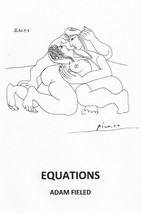
Equations was first released in print by Ray Farr's Blue & Yellow Dog Press in 2011.
Equations explores sex, romance, and relationships in a first person narrative context.
Excerpt
#9
Anyone who is a mentor is also a friend. Jean is sharing her knowledge with me out of pure friendliness. She is bemused by my naïve limitations. She shows me how to do doggy-style; how to sixty-nine; how different kinds of “kink” can liven things up. When she decides to ride me in nothing but cowboy boots, I notice that there are ways to make sex memorable if you have a flair for drama. She insists that we have sex when she is menstruating, and asks me to save the condom as a memento. But in all this friendliness, there are serious undercurrents. I’m not going to be the father of her child; she has other affairs going at the same time; she is fitting me in. Jean is a drifter with a vagabond’s restlessness; one day, I leave her at a subway station on Market Street, and am left with a sharp intuitive sense that I may never see her again. One of her equations is, if I can move quickly enough, I can never be bound. Sure enough, she’s gone from my life. I have gained in wisdom and experience; she, perhaps, has gained nothing. But when I look at the memories she’s left me with, I am struck that they are mostly happy. Vagabond equations leave no room for angst; there is no sense of things withheld. They give you everything they are, and you may keep what you wish.
Professional Reviews
from Exile and Exegesis
Translation is another key issue my body of work needs to face. The truth is simple: prose tends to translate better than poetry. That is why, on a world level, Flaubert is read more than Baudelaire; musical language, melopoeia, etc, which animates poetry, infuses it with vital life, tends to be at least partially lost in translation, while prose remains intact. So, if you cannot read The Flowers of Evil in French, there would seem to be no reason to read it; while reading Madame Bovary in translation may be as edifying as reading it in its original dialect. One advantage Equations has in my canon is this (and it is shared by Letters To Dead Masters); another is that Equations, through ending on an affirmative note, may be more companionable than Apparition Poems and Cheltenham, with their philosophical musings, conundrums, and elegiac remembrances. Equations affirms, in its precise dialectic, that human relationships are worth investing time and energy in, that love is real and a powerful force for good among the human race, and that sex need not be the only issue on the table for men and women (or men and men, or women and women). Oddly, the protagonist of Equations ends the narrative in a state of solitude:
When you get in a train, you transcend an entire life you leave
behind. Yet every human life has to balance stasis and movement. It’s
something Trish never learned— how to move and not move
simultaneously. Trish demands absolutes— absolute movements, absolute stillness. I have learned that the only absolute in the universe is existence itself— something will always exist. I don’t pretend to know how, or what, or why. I’ve left all the shot-glasses out; Jade forgot her cigarettes, American Spirits. I fish one out of her pack and light it.
With the memory of Jade still strong in his mind, he is free to affirm, rather than negate, all the sensory data he sees before him, and his responses are free to be warm and lively. Opera Bufa and When You Bit also end on comparative, affirmative high notes; all are steeped in dynamic energy around human growth and progress towards different forms of enlightenment— about love, sex, the body, art, and textuality itself. Equations has the advantage over the other two of being heavily prose-based; thus, a text which can translate into other cultures and do other dances in other (or Other) contexts. Against the triumphant solitude of the Equations protagonist by the end of the book is this Cheltenham Elegy, and the tragic interaction it recollects in visionary tranquility:
Huddled in the back of a red
Jetta, I thought we were in a
Springsteen song. But there are
no backstreets in Cheltenham.
It’s only the strip-mall to house
and back circuit. Anyone could’ve
seen us. It wasn’t a full consummation—
for want of a graceful phrase, we
were too smart to fuck. There was
no playing hero for me. Nor did I
force you to confess. What could you say?
Cheltenham was soft, and all too infested.
Whether the deeper truth is latent in the Equations or in the Cheltenham Elegies brings to the surface what the ultimate nature of humanity as a whole is. Equations artfully affirms, and the Cheltenham Elegies artfully deny. As the composer of both, I predict that the numbers will always lean towards Equations, both for its being (mostly) prose and for its being affirmative; even as I know that the more profound and terrible truths hidden in the Elegies will draw in those brave enough to face the darkness and the emptiness of raw humanity at its very worst.
Selected poems from previous & forthcoming collections together with Q&R apps on each page to enable audio rendition simultaneously with the written text