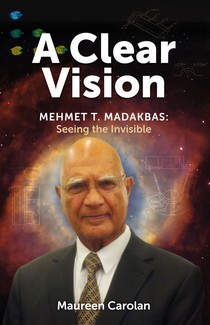
An account of scientist and entrepreneur Mehmet T Madakbas who offers an insight to success in science, business, philosophies and joy in life
This book of recollections is both informative, engaging, has a clear vision of understanding technical scientific physics, business experiences and the balance of work/home life harmony. There is a degree of mentoring for students and young entrepreneurs.
Excerpt
Education: Before graduating from high school, I was living with my parents in Ankara, and at that time there were a limited number of universities to which I could apply. The most popular was Istanbul’s Technical University, so naturally I wanted to go there. I sat the entrance examination and did not receive enough points for Istanbul. Eventually I was accepted into Ankara University’s Science Faculty — I felt this was an inferior appointment to begin the academic life of becoming a physics engineer, physics being my primary subject. I’d also wanted to do engineering, which was complementary to physics. My first year at Ankara University comprised an education in basic physics and mathematics. I had hoped that at the end of the course, which was four or five years, I would complete the course and achieve a certificate. But fate had a way of intervening and my best-laid education plans took an unexpected turn. I went to Germany for three months with IAESTE (International Association for the Exchange of Students for Technical Experience) to study and work in Braunschweig Physikalisch Technische Bundesanstalt (PTB). I was there for three months and in that time I built my first nuclear radiation counter. How wonderful it was to study and live in Braunschweig and truly appreciate both the high level of learning and the associated support given to create and educate. I decided that Turkey was not the place for my educational development, but instead I’d study abroad and enjoy the education and society of a Western lifestyle. Returning from my time in Braunschweig, I continued my first year at Ankara University. I knew this experience at PTB had changed my perception of studying in Turkey. Shortly after returning, I saw a public notice about a Swedish professor of advanced physics, specialising in solid-state physics, who had been appointed to lecture the fourth year students. This professor did not speak Turkish, but he was a brilliant man who could express his knowledge of physics through graphical presentations and expressions. The Dean of the university thought it prudent, though, to enhance the professor’s incredible acumen by having someone translate his lectures from English to Turkish. After seeing the advertised position, I immediately applied. I was amazed when I was appointed as the professor’s interpreter. It meant I was working on fourth year advanced physics, which turned out later to be my primary subject. Solid-state physics and semiconductor device technology resulted in some innovations and advanced publications, which I completed at Uppsala University in Sweden. I continued to translate technical advanced physics while I was finishing my first year in physics. But as it was a paying position, I didn’t let the challenge get to me. The interpreting helped advance my knowledge of physics; it also taught me how to learn, to increase my understanding of physics far beyond my actual first year. I was incredibly lucky that the professor helped me in such a clear and concise way. He invested a lot of his time to help me understand his fourth year physics by way of graphs, pictures and words. I found it highly satisfactory knowing that I was successfully educating the Turkish students. It proved to be an intense learning year that also enabled me to earn some valuable finances. It was a very unusual first year of university, to say the least. I received my certificate in differential and integral calculus, thus giving me superior mathematics knowledge as well as basic physics knowledge. I still continued to apply for transfers to other universities such as Istanbul Technical University — which, once again, I failed to get in. I also applied outside of Turkey, like the Arizona and Cornell Universities in the US. I was accepted in the US universities, but scholarships were not available by them; I would have to pay my way. It was then I saw an advertisement from the Swedish government, offering scholarships for advanced physics graduates. I was not advanced, as I had only just completed my first year, but the year of interpreting fourth year physics from a Swedish professor proved to be an incredible asset. I applied, even though I had no degrees, nor was I an advanced science graduate. I only had the two necessary certificates (one in mathematics and the other in physics) to prove I had finished my first year in the very basic subjects. Surprisingly, I was accepted. I felt like I was flying through the air! I said yes to the Swedish scholarship and prepared to leave Ankara University and Turkey.
Professional Reviews
A Clear Vision
“We are used to reading of outstanding sporting success. The scientific world of Mehmet Madakbas may be unfamiliar to the general reader, yet his is a story as remarkable as any record of human achievement. This well-written and easy to read book reveals his clear, courageous and passionate vision of adapting an entrepreneurial approach to scientific application and stands out as an inspiration to all who want to have a go, and in particular, to young scientists keen
to pursue the commercial development of their discoveries.”
Noel Braun, author of
Books by Noel Braun
A Clear Vision
Just a progress report re A Clear Vision........... I want to say a big thank you to you for requesting me to review this book, I think I have said 'wow ! ' on every page....this man was a genius , amazing personality and commitment, and I am finding this fascinating.
What a giant of a man !! Yet he comes across as truly humble.
I should think you will be very proud of the fact that Sid Harta is publishing this book.
Best Regards, from a very grey and wet Canberra,
Alison Lewis Canberra Australia
A Clear Vision
Review
The story of Turkish born Mehmet Tokyay Madakbas who moved to Sweden to be university educated before returning to Turkey to lecture, and then advancing his career by working in other world countries is truly amazing.
What a man … what a life!
It does not matter that the reader may not be a physicist, nor indeed a scientist in any discipline, not even a person who has been involved in business. To read in length Mehmet Madakbas’s life of invention and corporate acumen is an experience not to be missed.
Congratulation to Maureen Carolan for successfully completing the story of his work.
Valerie J. Griffiths
Want to review or comment on this book?
Need a FREE Reader Membership?
Reviews for "'A Clear Vision' Seeing The Invisible by Maureen Carolan"
Thank you for writing this biography of a man that few people know, including me. The excerpt describes a man who excelled in physics but had some difficulty, but a lot of luck, when it came to getting a higher education and solid-state physics. Physics was my best subject, but I chose another path, probably because I could not master advanced calculus and differential equations. I gather that Madakbas may have made major contributions to science, particularly in imaging and light science. Otherwise, he just joins millions of others who have made it in business through their personality and business acumen. Their stories are inspirational, but few can follow without the kind of luck involved that many successful people have as well as ability. I've known many scientists and engineers who couldn't write an article about their work without help. Perhaps that's why he is not writing his autobiography, but having you write what he lectures.
I would agree with one of the reviewers that there should be more biographies like this rather than those of sports stars and other entertainers. The contributions of innovators to society are far greater. There are stars like Elon Musk, but also many others who failed to be detected by famous radar.
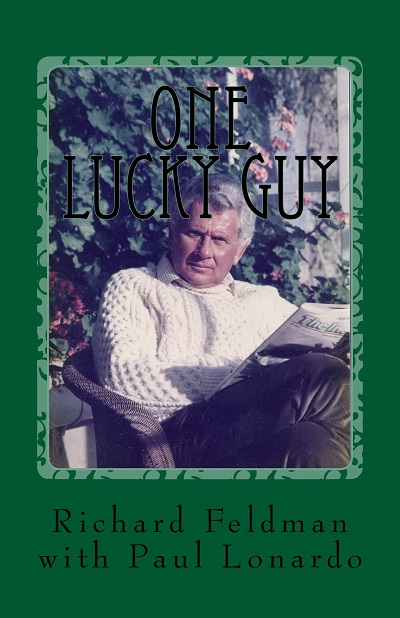
(Richard M. Feldman) Ever since I was a young boy, the only thing I wanted to be was a cowboy. I wanted to own and work on a real ranch, with cattle and horses. Especially horses.
While I never became a cowboy, considering everything I have done
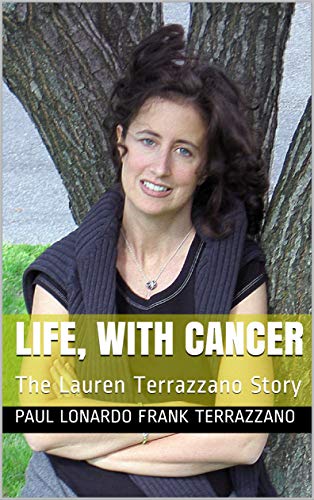
Through interviews with Lauren's doctors, along with those of other physicians, researchers, and clinicians who specialize in lung cancer, readers will have a better understanding of the disease.
With the same passion and honesty Lauren exhibite