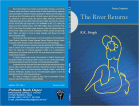
Category: Poetry Publisher: Prakash Book Depot, Bara Bazar, Bareilly 243003 India
ISBN-10: 8179771881
Type: Non-Fiction
Pages: 102
Copyright: August 2006
A Collection of tanka and haiku poetry, mostly in free form rather than the conventional 5-7-5-7-7 or 5-7-5 rhythm. The poems elevate the quotidian experiences to the level of poetry using the tanka and haiku form.
TANKA: She is no moon yet she drifts like the moon, takes care of him from the sky-- meets him for a short, waxing leave him for a long, waning At the river she folds her arms and legs resting her head upon the knees and sits as an island Drinking evening star blue green patterns before eyes no meditation no god visits to forgive the sinning soul in solitude Afternoon dancing on the waves-- receding sea then a lashing roaring wall of water, returning sea *** HAIKU: Suspended on the spider's web-- a hibiscus Taking a nap on oranges in his shop-- a fruit vendor All night trees wave with roaring winds: autumn in the courtyard Painting mom's smile with broken crayons-- smiling Winny A bulbul watching from the snapped twig-- empty street A crescent in the western horizon-- missing the moon All guests gone: after the late party night and I Too heavy these man-made machines choking weight Bathing in thousands they float lamps on her breast the river sparkles All night rain the gaping roof her shelter The evening fog: invisible her hand in my shoulder Alone the cellphone on her bed rings Weaving its nest grass blade by grass blade R.K.Singh Quoted rom The River Returns: A Collection of TANKA and HAIKU (2006)
Professional Reviews
The River Returns
The River Returns, R. K. Singh. Prakash Book Depot, Bara Bazar, Bareilly 243 003, India., 2006. 102 pp. ISBN 81-7977-188-1. Price: Rs.80.00; $US8.00.
Reviewed by Patricia Prime
All poetry is – or should be – written in love of the world. All poetry is in some sense erotic. The act of love, as opposed to lust, and the act of the imagination, as opposed to technological invention, occupy the same area of human consciousness. They are acts of mutuality and exchange, from which all participants derive value and understanding, and so are indispensable. Yet they are human endeavours too, and always contain the germ of their own impossibility and failure, which is the theme of many of the tanka and haiku contained in Ram Krishna Singh’s latest collection The River Returns.
Ram Krishna Singh is a prolific writer, authoring over 150 academic articles, 160 book reviews, and 30 books. His poems have been anthologised in over 140 publications and translated into several languages. The River Returns is divided into two parts, tanka and haiku.
At some point in his writing career Singh has taken note of the performance of language, learned to appreciate the subtleties of emphasis, tone, placement of words; of images called forth by carefully selected words. The level of diction is simple and consistent, especially considering that even though its imagery is natural, the poems are primarily made up of straightforward observations. Plain language, and repetition reinforce the simple nature of haiku and tanka, whilst simultaneously undercutting the philosophical or rational nature of the poems’ construct. In this sense, the poems may look casual and simplistic whilst disguising the fact that they are heartfelt, both emotionally and intellectually, as we see in the following tanka:
"Stains of dried dewy
tears on the eyelids tell of
the load on her mind:
clothed in spring the willow twigs
reveal the changed relation"
"Living in dust smoke
and white darkness I know
I just flicker –
stand alone like a lighthouse
lost in the fog of seashore"
This is what tanka is all about: a momentary embrace of the mystery inherent in the process of self-actualisation; a disguised direct address begging forgiveness for those tendencies towards insularity and over-intellectualisation. A celebration of the difficulties of selfhood, or whatever it is in us that calls us to a greater awareness of ourselves and the world of which we are a part, as described in the following tanka:
"Standing at the edge
I long to float with waves and
wave with instant wind:
on the dream water’s breast
I read tomorrow’s wonder"
"An insomniac
weak with desires and prayers
hears the heartbeats
rising fast with dark hours
survives one more nightmare"
In these two poems the poet casts around for some kind of relief, some sign of hope. The first tanka takes place at the moment when the poet, standing on the shore, allows his mind to wander over various thoughts. One of them is the longing “to float with waves”, another is that he sees on “the water’s breast” what the future has in store. In the second poem, Singh lies awake reviewing the day’s events, surviving through the night to face yet another day. All these thoughts and more flash through the poet’s mind. Yet neither the chattering of the mind, nor the thousands of thoughts that teem in his brain, can alter the fact that there on the foreshore, or awake at night, or in the midst of daily trauma, something of life’s beauty can still be captured.
The following poem seems to come out of nowhere:
"Drinking evening star
blue green patterns before eyes
no meditation
no god visits to forgive
the sinning soul in solitude"
The poet may speak of not knowing how, or why, he has been forsaken. He wrote the poem. It speaks from the unconscious, the hidden recesses of the mind: the proverbial experience, the forgotten, the repressed. The poem seeks to bring precise expression to something previously unstated. In this respect, then, the tanka tells us “This is what is inside you. This is what it is all about”.
For Singh, writing is an art of discovery. Some events, some people, are, for him, so charged with passionate complexity, that only the process of verbalising them allows him any measure of understanding. He writes about what he knows, getting it factually correct, then follows where the words and music lead. For example:
"His first winter –
recalls swirling snowflakes
at Chaluka
inside the fibrehut
warmth of blue waves surging"
There’s a quantitive and geographic fact: “Chaluka”, where the hard fact of “place” distinguishes the landscape and transforms it by art to a dreamlike state.
In the following tanka the action takes place on the war front:
"From the border rings
he’s stationed dangerously:
any moment war
may break out for their follies
he must kill and live ... to kill"
The images of war suggest that the soldier’s innocence is short-lived. It has the quality of a bad dream where the young man “must kill and live ... to kill”, a plot that turns on the presence of evil, cruelty, and death. Thus the tanka assume a larger role – one of discovery of self, the responsibility they bring having thus embraced humanity in all its good and all its dirt and corruption. Knowing and having lived with ill health and in darkness, the poet can savour both the light and bitter experiences that life brings. So loneliness appears microscopic as one of life’s problems:
"Awaiting the wave
that’ll wash away empty hours
and endless longing
in this dead silence at sea
I pull down chunks of sky"
Life can either get better or worse. Life’s flame can either be extinguished or kept ablaze for the greater responsibility that ensues.
In section two – Haiku – whatever the details of the short poem say about life and art can only be apprehended and expressed aslant; indirectly and, therefore, incompletely – the reader must fill in any gaps and make his/her own judgment. “Haiku moments” are everyday experiences. They are not “enlightened” in the ultimate sense of the word. They are, nevertheless, awakenings of a sort; moments in which the deeper nature of things is revealed, when one is reminded of the beauty and mystery that lie just beneath the surface of the seemingly mundane.
Haiku generally deal with everyday things – birds, flowers, the moon, nature. Yet they reveal these things to be mysterious and extraordinary. Haiku also tend to be contemplative and reflective – that is, the insights they contain and the experiences they describe are the fruits not of judgment but of quiet observation, not of self-seeking effort but of humble acceptance.
Allow me to quote just two haiku:
"The lone hibiscus
waits for the sun to bloom:
morning’s first offering"
What a lovely haiku! In these three short lines we see the poet early in the morning, watching as the flower waits for the sun to arise, then we see that this is the first offering of the day made by a religious man.
"In the well
studying her image
a woman"
For me this conjures an image of a villager, who perhaps doesn’t own a mirror, at the well drawing the day’s water. She sees her reflection in the still water and looks at in wonder and admiration.
Because, like the original experience, the sum of the details are unspecific, as in “Without washing hands / he touches hibiscus for worship / her frowning glance”, the reader is asked to make up his or her own mind about the haiku. What it means for the reader may be entirely different from the original thought of the poet. The death that is part of nature that we see in “Not sad to die / blooming after a day’s rain –/ the mushroom”, might cause us to ask: Are death and life the same thing in the context of the poem? Does Singh mean to express that the brevity of the mushroom’s life is heightened by its refreshing wash of rain, even as we can be ecstatic in the midst of the thoughts of inevitable death and decay? In fact, the poem doesn’t, I think, exclude this possibility and remains therefore true to itself.
Can art, either in writing or speech, driven to the level of the fabulous by intensity of desire, transcend mortality? Can it redeem or compensate for the indignities of ill health, physical labour or pain? These are themes that drive Singh’s haiku. The eroticism of many of Singh’s haiku have been previously remarked upon, but in this collection he puts a hard spin on traditional themes. The mortality, redemption and immortality of the poet seem to be uppermost in his mind, as in “Fearing allergies / he misses full moon party / savours white light”.
In both the poems and in everyday reality, life is crumbling into dust. Indeed, in “The long night passes / sleeplessly I deep-breathe - / mosquitoes in bed”, the poem seems to say all our lives are neither more nor less than “long nights” spent sleepless. In “the lone poet / watching his interview - / two minutes fame” there is the reprieve of “two minutes fame”, against the final collapse and there’s the possibility of, if not immortality, at least honour through art.
Singh’s Prefactory Note to The River Returns includes the sentence: “In these selected tanka and haiku – at times providing sequences – I have tried to evoke the essence of the moment in its sensory details as selflessly as possible.” Our world needs more of that awareness. We could all do with more tanka and haiku moments in our lives. We can discover these moments if we learn to live simply, sit quietly and observe with open eyes and hearts.
Perhaps dreams are all, as this collection seems to suggest: “A dead voice / calling up at dawn: / drowsy eyes”. Perhaps the work done, no matter how mundane, or how grand, is the song and the dance, and the lines and scars we bear from it dignify. And perhaps poetry honours this wild dream of living.
---Patricia Prime, 8 Te Atatu South, Auckland, New Zealand
The River Returns
THE RIVER RETURNS: A Collection of TANKA and HAIKU by R.K.SINGH. Published by Prakash Book Depot, Bara Bazar, Bareilly 243003, Uttar Pradesh, India., 2006, Price: Rs. 80/-, U S $ 8.00 , Pages 102, ISBN 81 7977 188 1
Splendid with the moon
night in silver peace dreams
through folds of light (p.95)
In a material age where modernity has become the very order of the day, how strange it is to discover that those Japanese poetry forms, Tanka and Haiku, are to all intents and purposes still ever gaining in popularity, for these universal poetry forms are now well over a thousand years old in design. The Haiku, of course, may be seen as a true development of the slightly longer Tanka. And although the purist would strongly maintain that each of these poetry forms should observe the designated original number of syllables per line, revised thinking on this issue has brought about a greater freedom and clarity of approach, resulting in the introduction and general acceptance of a newer minimalist form of each of these types of poem, composed of even fewer syllables. For the most part, the seasonal element (Japanese – ‘kigo’) has been faithfully retained, and there is, indeed, clear evidence of this in the present collection under review.
The poet, R.K. Singh, who was born, brought up and educated in Varanasi, in s a university professor, one of whose main fields of interest is Indian English Writing, especially poetry, and he is rapidly becoming well-known as a poet at international level. The glossy back cover of his collection, THE RIVER RETURNS, lists in greater detail the many literary achievements of this highly respected writer, whose lovely verse, incidentally appeals to me. He has been a well-established review writer and critic.
The collection is sensibly sub-divided into two sections to avoid the intermixing of the two poetry forms, thus availing a fine selection of R.K.Singh’s tanka verse, in its collective entirety. In traditional vein, he has made a constant recourse to seasonal imagery; furthermore, a variety of themes are thereby appropriately linked, so creating a more composite, over-all impression. And what passion, what outpourings of (at times) seemingly unrequited love, as Singh reveals the whole gamut of his emotional attachment to the lovely lady in his life:
Love is the efflux
from her body spreading
parabolic hue—
enlightens the self I merge
in her glowing presence (p. 10)
Some of these poems are erotic in approach, but ever in the best of literary taste, for this poet modifies his impassioned allusions with exemplified inclusions of the sun, the moon, man’s natural environment, and also with a repeated drawing upon the Earth’s elements, to bring greater profundity of thought to his incisive verse. The changing moods of a close loving union are subtly converted to sea imagery in one particular tanka, with suggestion of culmination in anger, or possibly a quarrel, in lines 4 and 5, despite the earlier rapture of the meeting:
Afternoon
dancing on the waves—
receding sea
then a lashing roaring wall
of water, returning sea (p. 11)
R.K.Singh’s verse writing is imbued with power, pace and imagery. Not only that, but it is characterised by sincerity and truth. His fine selection of Haiku is no less impressive, as Singh creates picture after picture with the very minimum tally of words. Take, for example, the hauntingly evocative Haiku, where not only a scene, but a whole change of situation is masterly conveyed:
After the party
empty chairs in the lawn—
new moon and I (p. 52)
Within this fine selection of Haiku, many of which are actually Senryu poems in essence, the poet deals with a number of issues: love, politics, astronomy, religion, the natural world, and even sport. Notice how well Singh conveys an aura of incompletion at the close of play on just one of the days in an India versus Pakistan Test Match:
Crossing the shadows
in the Indo-Pak match
the last ball (p. 97)
THE RIVER RETURNS is not just another recently published anthology of verses; it is an eye-opening experience! R.K.Singh is a wordsmith par excellence, who has succeeded in creating a veritable tapestry of artistic impressions with the very modicum of words used. His river is the River of Life, and this is certainly one finely edited collection to which I too shall be making due return.
Reviewed by:
BERNARD JACKSON, Hon. Secretary, Cinque Ports Poets, England.
12, Selborne Gareens, Jesmond, Newcastle Upon Tyne, England NE 2 1EY, UK
The River Returns
The River Returns: A collection of Tanka and Haiku by R.K. Singh
102 pages, 5.25” x 8.3”, Soft-bound. No ISBN. Rs.80 / $8 + postage from the publisher – Prakash Book Depot, Gangwar Complex, Karmchari Nagar Road, Surkha Chaawni, Bareilly (U.P.) 243 003, India or email: prakashbookdepot@sancharnet.in
Book Review by Dr. (Ms.) Angelee Deodhar
Ram Krishna Singh, is one of the most prolific writers amongst the Indian community writing in English. His familiarity with the short poem has been reflected in his earlier books, Above the Earth’s Green (1997) and Every Stone Drop Pebble a haiku collection, jointly with Catherine Mair and Patricia Prime, (1999).
In this collection Singh brings together a total of 445 poems in two sections: the first has 140 Tanka (four to a page) and the second has 305 Haiku (five haiku per page).
Whether Singh writes about nature or human nature he shows a keen perception, for example:
Pausing between bites
on the guava tree
the parrots
His first winter
insider a fiber-hut
swirl of snowflakes
In Singh’s haiku the reader gets a glimpse of life in India, for example:
In the moving train
sleeping on his feet
the newspaperman
Vultures waiting
for the leftovers
of the sacrifice
Some of the haiku reflect the sensuousness of the poet’s personality quite successfully:
Wet bodies
of bathing women:
full moon night
Her body
the night’s perfection
in dim light
In a pensive mood, Singh writes:
Unmoved by the wind
he sits on a rock wearing
peace of the lake
A cloud-eagle
curves to the edge
in the west
Amongst the Tanka, two memorable ones are:
Inside me
the whispers of the forest
will be quiet:
no tree will know
what the weather was like
Awaiting the wave
that’ll wash away empty hours
and endless longing
in this dead silence at sea
I pull down chunks of sky
It would have been better if the book had been arranged with just two haiku per page with more space around each haiku/tanka. Some haiku seem to have a repetitive theme which could easily have been left out. A few Hindi words for example Apsaras should have been explained with a footnote.
However, Prof. Singh is to be congratulated for his latest collection which well serves his own view, “It is also possible to elevate the quotidian experiences to the level of poetry, using the medium of haiku and tanka, provided one seeks to be visual or sensuous…”. His is a voice which deserves to be heard both at home and abroad.
Haiku is one of the oldest forms of poetry yet the form has recently been discovered and embraced by writers around the world. It is believed that in 1970’s haiku as a literary genre got highlighted internationally. Today, it is written in English as well as in several different languages and enjoyed widely in nearly 50 countries. But the actual credit for this haiku boom goes to Paul Louis who with the publication of his collection entitled Haiku, in the early 20th century, revived this genre. And since then the popularity and internationalization of haiku has kept on multiplying.
Haiku is short and light poetry with traditionally 5-7-5 sound syllables with a season word. Historically speaking, this poetic form had its roots in tanka, a kind of prayer/incantations to Gods by the Japanese. Tanka, with its 5-7-5-7-7 sound syllable count, its lofty ancestry and its shortness and ease for memorization, later became the favourite poetical form of the Japanese Imperial court. And from 9th to 12th centuries it reached the highest popularity and brilliance. However, in the 12th century a new form generated out of tanka, with the rival of an old Chinese form of linking tanka poems together in a novel way. The poem was ‘split’ in half, allowing one author to write the first three lines 5-7-5 and the concluding lines i.e. 7-7 part to be written by another, especially by men. This chain of writing did not stop there, again a new 5-7-5 was written as an answer to the previous 7-7 links and this genre was called ‘renga’ (meaning linked elegance). Renga became a fashionable form of poetry in the 14th century with two main styles: a serious, courtly style and the comic style, especially of the merchant class. Basho was a renga master of the comic style. This poetic form was not as simple to write as it appeared. Writing a good hokku i.e. the starting verse and haikai (any verse in a renga) was really a challenging task. Thus all could not meet the standards of a good hokku/ haikai. The quality of the renga tended to fluctuate with Buson and Issa and in the beginning of the 19th century M.Shiki declared renga officially dead and also ended the ongoing debate on hokku/ haikai by combining the two names into a new one- haiku.
Haiku is the smallest literary form with lot many rules and it is difficult for one to follow all the rules. Moreover, several of the rules are so contradictory with each other that there is no way to honour them all at once. Say, for example, the sound units of the three liners have a wide range of patterns-seventeen syllables in one line, seventeen syllables written in three lines, seventeen syllables written in three lines divided into 5-7-5, seventeen syllables written in a vertical (flush left or centred) line, less than seventeen syllables written in three lines as short- long- short, less than seventeen syllables written in three vertical lines as short- long- short and writing in one breath (which nearly covers 12-17 syllables). Second, the number of images and the kind of images which again do not follow any fixity- a haiku with two images that are only comparative when illuminated by the third image; a haiku with two images that are only associative when illuminated by the third image, two images that are only in contrast when illuminated by the third image and then the kind of images- images that evoke simple rustic seclusion/accepted poverty (sabi), images evoking classical elegant separateness (shubumi), images that evoke nostalgic romantic images/austere beauty(wabi),images from nature, images not from nature, season words (kigo), non-season words (muki), lofty / uplifting images. Third, the rules of punctuation- no punctuation to attain ambiguity, all normal sentence punctuation are also admissible- a colon (:) and full stop (.), a pause (;), three dots for something left unsaid, a comma for a slight pause, a dash for saying the same thing in other words, capitalizing the first word of every line or only the first word as well as the proper names according to English rules. Next, the rules of grammar-- eliminating all the possible uses of gerunds and adverbs, little use of pronouns, ending the haiku with a noun, avoiding too many/all verbs and prepositions. Finally, the rules of rhetoric-- avoiding rhymes/ bringing in rhymes by rhyming the last words in the first and third lines, using rhymes in other places within the haiku, using assonance and alliteration; and using puns and paradoxes to attain levels of meaning in haiku.
It is quite natural that with so many options, a beginner of haiku might get highly confused and find it difficult to start off with. But it is to be noted here that rules are not written in stone. Thus, it can be said that there is no one way to write a haiku, there is no one style or technique that is absolutely the best. Every writer can work out for herself. In fact, the varieties in style and technique of haiku provide enough freedom for the readers and writers of haiku to expose, expand and to investigate.
Today one can notice new trends emerging in haiku from several countries, including India as well. Now, there is no strict adherence to the old, traditional guidelines. Despite a small community of haiku writers in India, the haiku form has been widely experimented and written in several regional languages, including English and Hindi.
In India the traces of haiku can be found in the beginning of the 20th century. The Indian Nobel Laureate, Rabindra Nath Tagore, is probably considered to be the first haikuist of India. His collection of haiku like poems ‘Fireflies’ was published in English and Bengali. The names of Subramania Bharati, Prof. Satya Bhushan Verma and Prof. B.S. Agarwala are also familiar names in regional haiku in India. Among the Indian English haiku poets the few familiar names are- Dwarakanath H. Kabadi, N.V.Subbaraman, Angelee Deodhar, Kala Ramesh, K.Ramesh, Mujeeb Yar Jung, I.H.Rizvi, Urmila Kaul, D.C.Chambial, Kanwar Dinesh Singh, R.K.Singh, Mahashweta Chaturvedi, etc. Yet, not many people are aware of haiku or its intricacies because of lack of literature and/or criticism in various languages in the Indian market.
Haiku writers from all over the country, even though small in number, have contributed their lot in promoting this poetic form in India and out of the many contributors writing in English R.K.Singh as a haikuist stands apart. R.K.Singh who has been known for economy of expression and brevity for the last three decades has drawn attention of readers to his haiku, first published in trilogies Every Stone Drop Pebble (pub.1999) and Peddling Dreams (pub.2003 in Pacem in Terris), and more recently in The River Returns (pub.2006, a collection of tanka and haiku). Abdul Rashid Bijapure seems right in his observation that “perhaps it is the single-minded journey of R.K. Singh to press for brevity in expression that leads him to devote his poetic energy to the three line haiku poems.” Even Singh says “ a haiku is terse, dynamic and complete poetry, rendering the vital energy, which animates not only an individual’s small world but also the entire cosmos.” For Singh it is rather a self-disciplining spiritual exercise marked by living moment ness of a moment, imagining a moment:
After morning walk
the trio gossip each day
fresh revelation
Each day of our life is full of happenings and one such is captured here with all subtlety in the same fashion as a photographer clicks a moment.
The poem:
Ripe on the branches
mangoes fall one by one
end of the season
is highly sensuous in appeal. The reader gets an immediate image of a season. The ripeness of the mangoes can be seen and felt in the lines.
The lines:
The leaves sway
to fly like birds
free in the sky
evoke the image even before the eye blinks. Like the swaying of the leaves, the lines appear soft, light and rhythmic.
Singh’s nature poems perfectly meet the traditional haiku standards:
Smell of Kamini
In front of my house excites:
hummingbirds mate
Or
The night queen fragrance
seeps from the window
my bedroom blooms
The naturalness of the lines instantly hits the sensory organs of the readers. The two poems:
Shining from the blade of grass
a drop on earth’s breast:
tribute to sun
and
The mynahs
herald the day clamouring
for moths
reflect the honesty of the poet in creating the images. There is no artificiality or imaginary renderings in these lines. With minutest details the poet constructs a striking image and allows space for reader to create his own image and interpretations.
Singh is not only a sharp watcher of the thinginess of the things in nature but is also a keen observer of complex human nature. Running away from reality is human nature and this hollowness of human beings is described in these poems with a tinge of irony:
She hides the mirror
with rose and lipstick
and keeps her fiction
and
He closes the eyes
expanding inner space
a short – cut tour
Some of his haiku appear as if speaking directly to the reader. To quote:
Among the white hairs
a solitary black one
keeps her hope alive
and
She reads my age in
the synthetic dark of moustache
and whitening chest
Singh’s haiku have distinct local and Indian cultural flavour too:
Red oleander and
hibiscus calling morning
to Kali
The poet is unconventional in his form. He does not strictly abide by the traditional haiku rules. The adjective in the following poem depicts the unconventionality in the poet’s style:
After prolonged heat wave
sky watery explosion
earth lovely doom
The use of the adjective ‘lovely’ with the noun ‘doom’ is highly contrastive.
The poet’s experimentation with the syllabic pattern is again his break away from the rigid rules. Some of his poems are in 5-7-5 pattern, while the others are in 4-6-4, 3-5-3 and 4-7-4 patterns:
No letters today
addresses of his dead friends
graying in diary
Monsoon shower
after a long heat wave
monotony breaks
My bedroom
a maze of cobweb
spiders breed
Seeking good news
I watch the lines on my palms
taking new turns
This experimentation with the syllabic structure is actually due to the globalization of haiku and thus Singh alone is not to be blamed for it. In fact, it is to be noted here that the varied syllabic structures do not mar the haikuness of his haiku. His three liners, even though roped in different sound patterns/breathe, evoke the images explicitly.
In haiku there is no place for didacticism or philosophy. But Singh tries out even this trait in his poems. To cite-
He sweeps yellow leaves
or gathers years in a heap
burns to merge with dust
The first line gives a clear picture of the persona who is engaged in a task of cleaning the garden. The second line is suggestive of aging or nearing of death or the autumn of one’s life whereas the ‘yellow leaves’ of the first line suggests winter i.e. death. Thus both the lines focus the temporality of all existence, which further gets strengthened in the last line- ‘burns to merge with dust’. The last line sounds philosophical and recalls to one’s mind the Biblical line-‘ Thou cometh from dust and thou returneth to dust’. Moreover, the word ‘burn’ is again related to Hindu rites where the body is brought to the crematorium ground to burn on the funeral pyre. It seems that the poet was all set to bring in the epigrammatic terseness in this haiku. It is to be remembered here that haiku celebrates the beauty of the moment, the truth and minuteness of the moment with clear images rather than witty and layered meanings.
Similarly, the following haiku is highly philosophical in tone:
Long forgotten
the beginning and the end
exist in middles
Except for the three-liner haiku pattern, the lines do not fulfill any of the requirements of a haiku. Neither the reader gets an instant flash of the image nor does he come to a clear idea. He is only left with an option of reading between the lines. And if this is done to a haiku, it is then no haiku. The second line of the poem--‘beginning and the end’-- is here, probably suggestive of the cycle of life and death. And the last line depicts the mediocrity of people in the present times. Man has forgotten the essence of his existence. He is only given to materiality and his comfort zone is his ‘present’, which he never wants to leave. This haiku is a poor one. In a book review R.K. Singh comments, “It often depresses me to read in the ‘form’ of haiku moral commands, philosophical teaching, sentimental reflections and didactic expressions. Haiku is not epigrammatic poetry or short saying; nor is it intellectualizing, romanticizing, or pedantry”. The poet fails to create a haiku in those three lines; he fails to practice what he says.
Singh puts the first letter of his three liners in capital. Most of his haiku are expressed in a concise and crystallized form, in present tense with a seasonal word. The poems focus on “what is happening” at a particular moment with all its freshness and truth.
Challenging/experimenting with established/classical rules requires a lot of guts. Singh’s experiments with the classical rules of haiku and the dexterity with which he handles his haiku are sufficient enough to define his poetic talent /craftsmanship.
References:
1. Abdul Rashid Bijapure. “The Poetry of R.K. Singh,” New Indian English Poetry: An Alternative Voice, edited by I.K. Sharma. Jaipur: Book Enclave, 2004, p.161.
2. R. K. Singh. Book review. Deuce: Haiku Poems (New Delhi: K.K. Publishers and Distributors, 2001), Indian Book Chronicle, Vol. 28, no.4 April 2003, p. 5.
3. Catherine Mair, Patricia Prime and R.K. Singh. Every Stone Drop Pebble. New Delhi: Bahri Publications, 1999.
4. Patricia Prime. “Secrets Need Words: Critical Essay on the Haiku and Tanka of R.K. Singh,” New Indian English Poetry: An Alternative Voice, edited by I.K. Sharma. Jaipur: Book Enclave, 2004.
5. Urmila Kaul. “Indian Haiku and Peddling Dream,” New Indian English Poetry: An Alternative Voice edited by I.K. Sharma, Jaipur: Book Enclave, 2004.
6. Angelee Deodhar. “ Haiku: An Indian Perspective,” http://www.haiku-hia.com
This is my personal inspirational book of poetry. It contains many poems written for family, friends, and relevant life situations. Hopefully you will find some that will encourage and inpsire you in whatever arena you are found in your circle of l