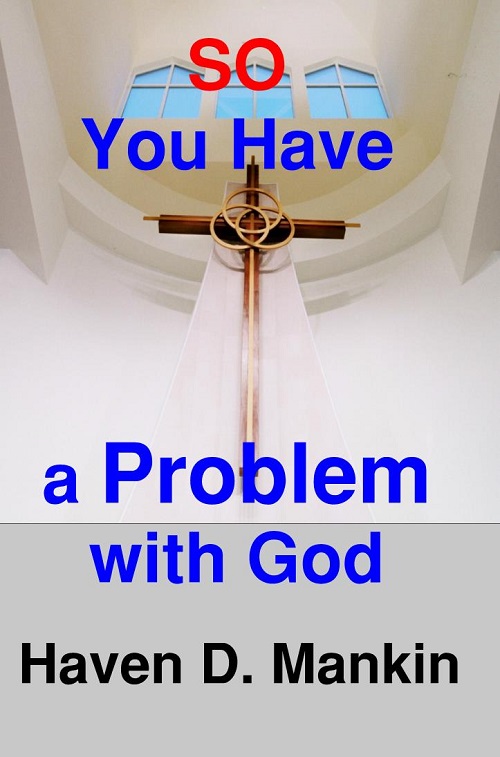
Many just don’t like what the Bible says, so they reject it, or they blame God for messing up what they want to believe and how they want to live.
Have you held the argument that God should have been able to create a world without evil, but since there is evil then God must not morally perfect. If God created morally good, then He must also have created morally evil creatures.
People think God doesn’t know what it is like to be human [ignoring the Incarnation]; they go on thinking God doesn’t know what we know; therefore, God is not all-knowing and cannot be omniscience and morally perfect, thus God could not exist.”
Dealing with omniscience, if God knows all then He knows what we know, and so detracts from His perfection. That the fact he knows what we know then “automatically makes Him a sinner”.
Since most people having a problem with God seem to not believe in the Bible nor see the Bible as God’s inerrant and Holy Word, or they simply feel that the Bible just gets in the way of what they want to do, the last two chapters in this book are important to read. Many just don’t like what the Bible says, so they reject it, or they blame God for messing up what they want to believe...the creature wants tocontrol the Creator!
Excerpt
The Paradox of the Stone
There is an old question, some call “The Paradox of the Stone”. It has a purpose, to support atheism. It goes like this: “Can God create a stone that God cannot lift?”
The obvious “trap question” setup for the unsuspecting goes like this…either God can create the stone, or He cannot create it, or He can lift it, or He cannot lift it. One or the other condition has got to be true, the atheist say. Therefore, God is not omnipotent. If He is not omnipotent, then He does not exist.
This “The Paradox of the Stone” debate has been going on for many centuries; it begs the question: Why do atheist work and argue so very hard to prove that God, they don’t believe exists, doesn’t exist? Why not let we Christians just go off into “never neverland”? It is no skin off their nose. It is like they want to win the debate, so there must be something there they are afraid of. Well, they should be afraid for judgement is coming for all of us. Let’s get back to the stone question.
Christian philosopher Rene Descartes believed that to be omnipotent was to be able to do anything, absolutely anything and everything. Thomas Aquinas, a Roman Catholic, believed that to be omnipotent, God could do anything that was possible, but He could not do something that was against mathematics and geometry. I think Aquinas limits God; why can’t God do the impossible? Who is to say what is possible and what is impossible?
Definitions of what is impossible is limited to the time of the expression. Do you suppose those folks in the middle ages thought we could actually walk on the moon? Or, in the nineteenth century we could have a watch that was a computer, a fitness monitor, calculator and a telephone, all in one? The defining of what is impossible is coming from the mind and experience of a limited being of the creation. How dare us to be caught arrogantly casting limits on what the Creator can and cannot do! Your category for the impossible things is simply limited to your knowledge, agenda & belief and to your worldview. By definition, your worldview is NOT God’s view. What is impossible to do is relative to the doer; obviously, what is impossible for an infant, is possible for an adult. As we learn in Matthew 19:26:
“Jesus looked at them [the disciples] and said, ‘With man this is impossible [to be saved and enter the Kingdom of Heaven on their own], but with God all things are possible.’”
There is no such thing as something being impossible to God. Those against the reality of an omnipotent God will argue that by adding God’s infinite power into the equation, it will still not make the “actual impossible” possible. This is strictly “political agenda talk”; people make up their minds on what they want to believe and then work to support that belief. This is all a bunch of contradictions; it is an easy way for people to confuse the arguments when they have a weak position. God is not a contradiction! God is love and not evil, so how could He create evil? God is infinite, so how can the finite impact Him? God is infallible, so how can He error? God created the creation, so how can the creation create God?
Like Aquinas, using geometry, many have argued that God cannot create a two-sided triangle or a square circle or a one ended stick. These fairly-tale examples of logically impossible undefinable things; they are simply inventions of wordplay to push one’s belief agenda of wanting to limit God. These are examples of nonexistent things; by definition, there is no such thing as a two-sided triangle or a square circle or a one ended stick. The word “triangle” defines that there are three angles and three sides; it is an impossibility for a TRIangle to have two sides. A square circle is also an absurd nonsensical argument in that a circle has an infinite number of facets and a square has only four sides. The only thing in common is that they are both two-dimensional shapes. These nonsensical positions continue as in Peter Atterton’s op-ed as he argues:
“the idea of God is self-contradictory, as logically impossible things such as colorless red things and married bachelors.”
These are all make-believe arguments that are indeed contradictions; but they are ridiculous word games. To say God is a contradiction like these make-believe concepts is really a flimsy non-scholarly approach; what a weak argument you have! If you wish to prove God is not omnipotent and therefore does not exist, at least have the guts to not be so silly!
Finally! Understand and learn from the New Testament Book of Acts.
Try James first for free
Now there is a Bible translation that is easy to read, understand, and study.
This translation is unique in that it is arranged in
A collection of 109 tract type messages, that are geared to anyone that has ever asked the question "What does the bible have to say about specific subjects that are not usually addressed in Church sermons??"
These messages deal with all fa
Three titles in one book for 1/3 the combined price
"Coping with Stress" - Help yourself or someone else learn about stress and lessen it in your live.
"Crisis Intervention/Suicide Prevention" - Help yourself or someone else through