2nd Edition to come out soon!
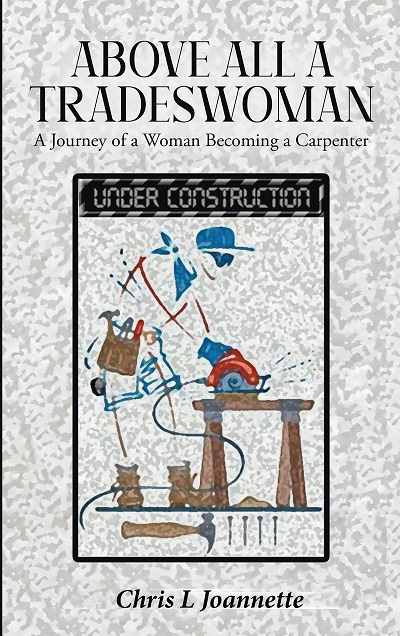
The experience of a young adult trying to figure out what they want to do for employment or education can be overwhelming. My book will give them insight to what it means to be a carpenter. And the progress unions have made in discrimination.
Get a signed copy aqcchris@gmail.com
My journey had always been to be a carpenter. I expected not only a challenging job but also the chance to be part of a historic transformation, social and economic, that would make the construction trades accessible to women. That transformation did not happen until years after I started with affirmative action laws.
It includes my many jobs I had along the way, teaching myself to become a carpenter. I knew no one in my family who where in the trades. Nor did they have any friends that were. My mother’s family Helene' came from Canada. She was one of my first role models for hard work. And I loved her dearly! But I left home at 18 years old to pursue my dreams.
I knew that it would be difficult, because I never heard of a female carpenter anywhere at my young age of 18. It was exceedingly difficult trying to find work in an all-male oriented construction industry. But my story tells all.
Even my family thought I was crazy for dropping out of college to pursue this kind of career. I was awarded scholarships in physical education and music at the University of Chicago.
There were many angry and frustrating days along my journey to success, and I sometimes took it out on the people around me. But all in all, it made me tuff for what was to come.
It was always puzzling to me also as to why I was so passionate about becoming a carpenter, but I knew I would love it because I liked working with my hands, building things and being outside. The cold never bothered me, but the heat did.
I found out later in life that it had to be biological even though no one in my family had been in trade in the United States. When I found my biological parents in Canada, I found out almost every family member was in a trade. Including an uncle who owned one of the largest commercial contracting companies in Montreal, Quebec, called “Celeb Construction Company”. My last name spelled backwards Belec.
My name was shortened from Joannette to Joanet in the United States. Then when I found out the parents that raised me where not my real parents. I found out my biological parents sur name was Belec.
I however did not find any of this out until I was almost 60 years old.
My journey took me to places and things I never dreamed I would be doing. Including fighting for the right to be carpenter as a woman thru-out the 1970’s. I found out that gender barriers were are deeply embedded in the organizations like unions and the culture of the construction workplace.
I have always been self-educated. I have written many articles online for equal rights. Developed several websites and I have owned businesses and managed construction jobsites. Including joining many other organizations along the way.
I currently live in Montreal, Quebec, Canada where I retired in 2018. Canada wanted me to use my adoptive parents surname so now it is Chris L. Joannette. I decided not to use my biological parents’ surname Belec officially, even though it is my biological name.
My story tells the rest.
Excerpt
I was born in Montreal, Quebec, Canada on October 16, 1948, and brought to the United States when I was one year old. My father, Ray, was a truck driver in Canada and would travel back and forth from there to the United States. I remember travelling in his truck at a young age with my mother, Helene, across the United States a lot. We eventually landed in Chicago, Illinois, where I lived for sixty-nine years. I was told by my parents from a young age that my mother and I were born in Montreal, but my father was born in Providence, Rhode Island, which is why I was a U.S. citizen. This will become relevant later in my story.
From a young age, I was always trying to build things out of everything and anything I could find. Usually, it would turn out a mess. In High School I wanted to take classes like Reserve Officers Training Corps (ROTC) and woodshop. But the counsellors always said no because girls could not take those classes. I’d get angry and usually say something nasty to the counsellor and then be reprimanded and/or suspended from school. I also had many questions about what I was being taught, like always asking why, but then I’d be reprimanded for asking and told to just follow the lesson plan.
After school I’d work part-time doing anything I could find to help my mother with our big family. My father had left his wife and the rest of our family in 1963. the day his last daughter, Renee, was born. My mother was left to take care of six girls, and I was the oldest. At the age of sixteen, I worked part-time for St. Jude Foundation after school to help with family expenses.
The story continues with how I became a carpenter.
Professional Reviews
Above All a Tradeswoman
Review of Above All a Tradeswoman 8-07-2026
Samuel Lawrence samuelchrislawrence@gmail.com
Chris,
I’m samuel, a reader participating in a StoryGraph reading community, and I’m writing because Above All a Tradewoman raises a question that feels particularly relevant to the reading challenge currently underway: what happens when the career a person is determined to pursue is one society has already decided they do not belong in?
What caught my attention is that your story isn't simply about becoming a carpenter. At 18, you walked away from a path that included university scholarships and pursued a trade you had barely seen women entering, while having no family network in the trades to show you the way. Then came the harder part trying to establish yourself in an overwhelmingly male construction environment while the industry itself was being pushed toward change.
There is another layer that makes the story especially interesting for a reading community. You spent much of your life trying to understand where that determination came from, only to discover decades later that your biological family had deep roots in the trades. That tension between choice, identity, circumstance, and something that may have been there long before you knew its origin gives readers considerably more to examine than a conventional career memoir.
The StoryGraph reading challenge I’m participating in is ongoing, with readers being encouraged to move beyond simply completing books and instead engage with different perspectives, discuss what they uncover, and reflect on what a story changes in the way they see the world. Your experience with gender barriers, unions, self-education, family identity, and finding a place in a profession that wasn't readily open to women fits that kind of reading particularly well.
That is why I wanted to contact you directly rather than send a general author invitation. I’m interested in seeing whether Above All a Tradewoman could become part of the conversation not as a promotional placement or an invitation for manufactured praise, but as a book readers can genuinely question, learn from, and respond to.
And perhaps the more interesting question is this: if a group of readers were given the opportunity to challenge one assumption about women, work, or the trades that your younger self had to confront, which assumption would you most want them to bring to the discussion?
Abducted Alien
Bennett Sumirah 10-01-2026
View Member's Site Hey!
I just wanted to say how much I loved your story, it was a truly amazing read. The visuals came so naturally that it felt like a cinematic experience.
I’m a professional artist
Abducted Alien
by Robin in Florida, USA
October 11, 2010
A review from a reader of my book, "Abducted Alien-A True Story of My Life and United States Immigration."
I think you did an amazing job on the book, don't stop writing. I was indeed captivated by your story. I am sure you could write another book strictly on what it was like in detail trying to break into the male dominated construction trade. I am in awe on your initiative in all the aspects of your professional life. I admire strong work ethic and I don't see it much in the younger generations. I know that when I went to work in a very male dominated industry in the late 80's that I felt like I stepped back in time about 50 years. It was a nightmare that I couldn't wake up from for ten years. The toxic environment of daily harassment and working an 80 hour week took a huge toll on my health. I don't miss it.
I had lunch today with some close friends who had similar feelings about immigration and told them that my views have changed since reading your book. (Which I have highly recommended to many people this week) We all had a great debate and discussion about the current laws and what needs to change and I was quite surprised by the end of the conversation that most of them had the not thought about all the aspects of the law. I will admit that most people, think about the illegal’s coming in from Mexico and that is all that they ever consider when thinking about immigration. There is indeed a lot of hostility in regard to the Hispanic community as a whole. I used that as my basis for the discussion today...as that is what cuts close to home in my state. We have a lot of illegal Mexicans workers here, due to the large amount of farming in Washington. It turned out to be quite the three-hour conversation but I think everyone left with a more open mind and food for thought. So your mission will spread one person at a time but it will take root. Most "straight" people find it hard to believe that those "Moral Turpitude" laws still exist. I assured them they do indeed still are used when it suits the governments’ purpose to do so.
Rosetta was born in 1909 as the youngest of ten children. The family had more laughter than money and neighbors would knock on their door to ask, "Can we come in and laugh, too?"