
Kindle Edition
Amazon
Yi Woo Ae on AuthorsDen
Category:
Sociology
Publisher: LitPrime Solutions
ISBN-10: B08NLLMB9W
Type: Non-Fiction
Pages: 272
Copyright: Oct 28, 2020
ISBN-13: B08NLLMB9W
Price: $3.99 (eBook)
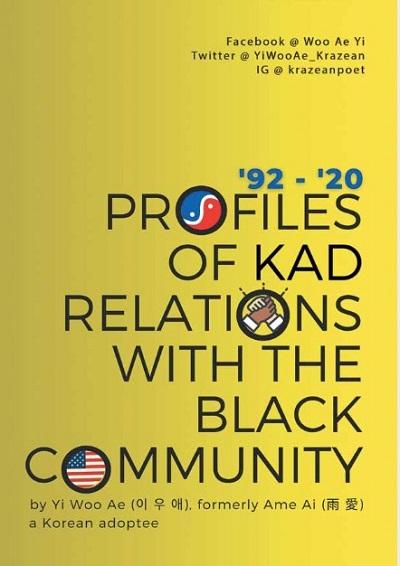
Korean adoptees (KADs) can be a bridge to the Black Lives Matter movement. Even though Black Lives Matter is about the Black community, Yi Woo Ae, a Korean adoptee, establishes that our lives are connected as minorities, and even intertwined.
Korean adoptees (KADs) can be a bridge to the Black Lives Matter movement. The Black Lives Matter movement is intended to highlight that in the US Government and in its criminal justice system, Black lives are valued less than white lives. Even though Black Lives Matter is about the Black community, Yi Woo Ae, a Korean adoptee, establishes that our lives are connected as minorities, and even intertwined. KADs, being both white adjacent and Asian, can talk with whites, Asians, and others in a way that supports the movement.
This book is divided into three parts: profiles, background history, and a how-to. Korean adoptee, Yi Woo Ae, also added a call to action. She first points out how the relationship between Blacks and Korean adoptees is better than what we see in the media, if it's in the media at all. The author advocates for the inclusion of adoption-based and race-based trauma into the Diagnostic and Statistical Manual of Mental Disorders (DSM). She shares the importance of acknowledging that trauma, as defined in the DSM, is not currently all-inclusive. Whether we believe we chose our present life or not, we are the bridge between worlds. As a Korean adoptee (or Asian adoptee), we can support the Black Lives Matter movement.
Excerpt
The craziness began before Rodney King’s verdict. In 1990, tensions were already escalating between Korean-American merchants and the Black community. Due to this racial tension, editor James Ryu of KoreAm Journal reprinted articles from the Black media because Korean-Americans wanted to know what was being said about them.
Sa-i-gu literally means “April 29th,” which was the day of the LA uprising. The anger arose from a convergence of two news stories: one about the acquittal of the policemen who beat Rodney King and another about the murder of Latasha Harlins by Soon Ja Du of Empire Liquor, over a $1.79 bottle of orange juice.
Her grandmother Ruth, who was raising her, warned her not to entire Empire Liquor because her Uncle Richard used to work there and found them to be suspicious that people were stealing from them and left when he refused to work unpaid overtime. After being dropped off by a friend who wasn’t welcome in the store, Latasha Harlins was shot by a woman, just like her mother was in 1985, a few blocks from her home (Stransky). She was buried beside her mother. This was all witnessed by Asmail Ali who saw her raise two dollars to pay for the juice when accused of stealing, and she was still holding those two dollars when she killed (McKennett). Mrs. Du was sentenced to five years of probation, 400 hours of community service, and a $500 fine instead of the maximum of 16 years of imprisonment decided on by the jury because the Judge Joyce Karlin believed Mrs. Du’s ability to act with reason was compromised by three past robberies, a drive-by shooting, and the fact that her son had been threatened by Crips unless they hired them. She is a clear example of why people with trauma should not own guns but are the most likely to buy them. She was like the older man in the movie Gook, a movie about two Korean brothers who befriend a Black girl, which was set on April 29, 1992 in Paramount, CA (Chon).
|