AuthorsDen.com   Join | Login    
Where Authors and Readers come together!

SIGNED BOOKS    AUTHORS    BOOKS    SAMPLE CHAPTERS    AUDIOBOOKS    eBOOKS    STORIES    ARTICLES    POETRY    BLOGS    NEWS    VIDEOS    SUCCESS    TESTIMONIALS

Featured Authors:  Flo Fitzpatrick, iEva Pasco, iStephen Murray, iShirley Woods, iSusan Smith, iDavid Arthur Walters, iRobert Liu, iPatricia Hilliard, iPatricia Sims, iFrank Whyte, i

  Home > Nature > Articles Popular: Books, Stories, Articles, Poetry      Authors: A B C D E F G H I J K L M N O P Q R S T U V W X Y Z     

Fawn E Caldwell

 Follow Me  

· Contact Me
· Books
· Articles
· Poetry
· Stories
· 108 Titles
· 282 Reviews
· Save to My Library
· Share with Friends!
·
Member Since: Jun, 2003

Fawn E Caldwell, click here to update your pages on AuthorsDen!


Books by
Fawn E Caldwell


See all Books
by Fawn E Caldwell


Control of Mosquito Larvae
by Fawn E Caldwell   
Rated "G" by the Author.
     
Last edited: Thursday, April 9, 2009
Posted: Monday, August 25, 2003

Recent articles by
Fawn E Caldwell

• Think for Yourself
           >> View all

This is my research work and the full report is for sale at www.lulu.com.

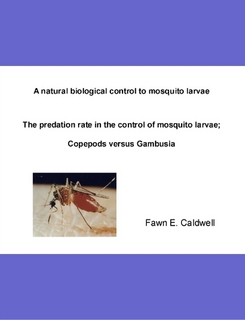
A natural biological control to mosquito larvae.

The predation rate in the control of mosquito larvae; Copepods versus Gambusia.


Fawn E. Caldwell


ABSTRACT: Control of mosquito larvae with the copepod, Mesocyclops thermocyclopoides, a natural predator, was used in this study because it is abundantly found and is wholly or primarily free-living in all natural waterways. This includes seasonal creeks and rivers.

This predator, which is better known as plankton, has shown that they can reduce the amount of mosquito larvae in its infested habitat, more effectively then that of the Gambusia affinis, either alone or in a combination.

Direct observation shows that the copepod generally eats detritus material but they prefer to eat the bellies out of the larvae instead.

The mosquito fish, Gambusia, were used for comparison purposes because past research has proven that they can considerably reduce mosquito larvae.

The use of two types of mosquito larvae (Anopheles and Culex spp.) was used to see if the copepod and/or Gambusia prefer one species of mosquito larvae to the other. No preference was noted.

Documented laboratory research conclusively proves that an enhanced level of copepods can naturally reduce the amount of mosquito larvae, to a greater extent over the Gambusia.   


Support independent publishing: buy this book on Lulu.


Want to review or comment on this article?


Need a FREE Reader Membership?
Popular Nature Articles
  1.  The Easter Skunk
  2.  Myth of the Irresponsible Male
  3.  Sanity's Loss
  4.  Anybody Home?
  5.  World Animal Day
  6.  The solar eclipse in 2 weeks
  7.  Nature Writing is for the Birds
  8.  Warblers of New Jersey and How They Si
  9.  Disoriented Birders Trapped in Net!
  10.  Human Nature and Jobs! People apply fo
  11.  America's Most Endangered Rivers
  12.  November 13, 2008 Full Moon In Taurus
  13.  A Personal Fox
  14.  Buried Alive
  15.  Full Lunar Eclipse on Winter Solstice!
  16.  Help A Child Enjoy Nature
  17.  America’s Summer of the Wild Horse and
  18.  SKID MARKS ?
  19.  Summertime! x 3
  20.  Wild Horse Day
  21.  The 2010 Rubber Dodo Award
  22.  Auyumn After theHurricane
  23.  David and Goliath
  24.  The Bird Expert
  25.  A First Hand Report From The Gulf

Free Book Review Program
Select a book to read and review today!

Songbirds and Roses (paperback edition) by Aberjhani

Explore the mystery of how nature makes unexpected gifts of creative wonders to an unsuspecting caregiver one late night and early morning in southeastern Georgia, USA.  
Member BookAds

Virusphere by Frank Ryan

The book that tells you all you need to know about viruses, and more.  
Member BookAds

Terrorforming Your Environment by RickthePoetWarrior

Never to leave well enough alone our attempts at managing our society, culture, and environment are recycled, re-used, and just generally regurgitated  
Member BookAds