AuthorsDen.com   Join | Login    
Where Authors and Readers come together!

SIGNED BOOKS    AUTHORS    BOOKS    SAMPLE CHAPTERS    AUDIOBOOKS    eBOOKS    STORIES    ARTICLES    POETRY    BLOGS    NEWS    VIDEOS    SUCCESS    TESTIMONIALS

Featured Authors:  Darryl Jenkins, iArmineh Ohanian, iTeresa Walker, iSusan Smith, iDebashish Haar, iMatt Miller, iLinda Alexander, iGary Caplan, iDonald Beaulieu, i RickthePoetWarrior, i

  Home > History > Articles Popular: Books, Stories, Articles, Poetry      Authors: A B C D E F G H I J K L M N O P Q R S T U V W X Y Z     

JC Pinkerton

 Follow Me  

· Contact Me
· Books
· Articles
· News
· Stories
· Blog
· Messages
· 34 Titles
· 31 Reviews
· Save to My Library
· Share with Friends!
·
Member Since: Jul, 2004

JC Pinkerton, click here to update your pages on AuthorsDen.


To Become a Knight
by JC Pinkerton   
Rated "G" by the Author.
     
Recent articles by
JC Pinkerton

• Cactus Joe: The Children's Cowboy
• Old Riders Of The Range
• Robert Adam: Creator of Adam Furniture
• Young Sam Houston
• The Riders of The Pony Express
           >> View all

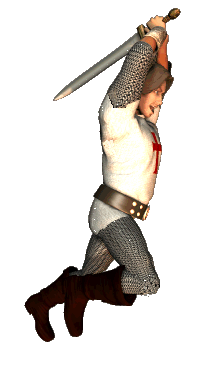
Have you ever wondered what it was like to become a knight? To do so, a young lad went from boy to manhood.


Apprenticeship:

Age Seven:
In order to become a knight, a boy must be born into a noble family. Some boys as young as seven years old would begin training as a pageboy, and move into a knight's castle.


As a pageboy, he would be taught the ways of proper conduct, and how to serve a table. He would perform duties around the castle, and learn how to hold a shield properly. He would learn about armor, weapons, and horses.


A pageboy would help serve the lady of the castle, sometimes playing chess or checkers with her.  He might sing or play instruments to entertain the lady.  Many pages were taught to read and write at the castle. He would also learn how to handle falcons and hawks.


Nine To Thirteen:
Between the ages of nine to thirteen, the pageboy was considered a "valet," and now he could take on greater skills such as riding a war-horse.


Fourteen:

At age fourteen he could begin to serve as a "squire."


A squire served as a special servant to a knight. Although he still served the table, he could now go into battle with his knight, and learn the ways of the sword and lance. If the knight was wounded in battle the squire was responsible for tending to his knight's wounds. The squire would handle falcons, hawks, and learn how to cut up a deer. Pages and squires would learn archery, and sword fighting.


Eighteen and Twenty:
Between the ages of eighteen and twenty, a squire was ready to become a knight. On the night before the great ceremony, the squire would soak in a hot bath full of soap and herbal perfumes.


He would confess his sins so he could be pure for the ritual of knighthood. He would keep watch over his weapons in the chapel all night, known as Vigil.


The next morning, he would dress in symbolically colored clothes: red - for his blood, white - for purity, and brown - for his return to the earth upon death.


At the ceremony, the squire knelt before the knight who trained him, or the king, and was dubbed (christened) by placing a sword to each shoulder.  From that day forward the new knight was declared "Sir." The king sometimes knighted squires before battle to increase the number of knights.


Knighthood:
There were different classes of soldiers, some were known as the foot soldiers, but the king's knights were known as the czars of the battlefield. In other words—knights ruled. In the earliest part of the Middle Ages, kings had little influence, so the finest knights dominated the land.


Many simple men, or ailing men unable to fight had to put themselves under the refuge of the knighthood. The knights worked in alliance with their king but "Sir Knight" was always allowed to do as he pleased. Not one man or woman in the whole kingdom would ever dare to stand up against a knight.


Bib:

Gravett, Christopher. The World of the Medieval Knight.
Peter Bedrick Books. NY. 1996.
Hills, Ken. The Crusades. Marshall Cavendish Corp. NY. 1991.
Levibiel, Timothy. The Crusades, World History Series. Lucent Books, Inc. San Diego, CA. 1995.
Ross, Stewart. A Crusading Knight: How They Lived. Wayland Publishers. England. 1986.


 ©1999 jcpinkerton


Want to review or comment on this article?


Need a FREE Reader Membership?
Popular History Articles
  1.  Recalling the Unforgettable 25 Years L
  2.  A history of Soviet Project 651 (Julie
  3.  A Brief History of the Leather Jacket
  4.  Dogs in Space: The Soviet Canine Space
  5.  ICAN Invitation
  6.  The Gold and Azure Frontier
  7.  Forward Facing the New South, a New De
  8.  Disposing of Luxuries
  9.  JFK and America in England
  10.  Queen Liliuokalani's Fateful Constitu
  11.  How to Ruin a Poem in One Easy Step
  12.  America 250: Benjamin Franklin
  13.  The Deep History of Pockets
  14.  What Makes History Come Alive
  15.  Delaware’s Anabaptists Balance Traditi
  16.  Osterville Historical Museum’s town sp
  17.  Red Ruffing’s Dover Chapter: From Mino
  18.  The American Liberty League’s Stand Ag
  19.  Last History Lesson
  20.  Shakespeare's Secret Messiah--Book Rev
  21.  And The Pope Visited Us
  22.  From Wobbly Watts to Broadcast Brillia
  23.  American lawyers have lost their audie
  24.  Kennedy and Lincoln...
  25.  A Brief History of the Mountaineering

Free Book Review Program
Select a book to read and review today!

Patrick’s Pastbook A New Abolitionist are-Founding of American Histo by Dr. Patrick ODougherty

A Viconian Cycle/ Babylonian Captivity Memory Silence Re-Founding of Southern history out of Dublin GA and the KBPS7 Trial. In psychology this is a Wounded Pride case.  
Member BookAds

The Stockholm Syndrome Project--A Subordinated Epistemlogy. by Dr. Patrick ODougherty

Do you take on the attributes of the oppressor?  
Member BookAds

Manifest Destiny: A Legacy of Genocide by Sharon Brunner

The history of Native Americans from when the first Europeans set foot in North America to the present and the hardships they faced.  
Member BookAds