Fidel Castro fell down on the job.
Prosiga con cautela, Fidel!
Let's face it, despite the dominance and alleged difference of the two major parties who rotate at the political-economic hog trough in the United States, one "pragmatic" party controls the United States, the Party representing the relatively comfortable but anxious majority who depend on a large underclass for many of their comforts.
Most of us want to be comfortable at least. We understand why comfortable people naturally believe that they deserve their deserts. Those deserts, whether justly or unjustly obtained, are always at risk, and even more so in volatile times. Comfortable people have just cause for anxiety lately given the terrifying attack on their military-industrial complex. The sudden high volatility indicates an imminent, broader and more drastic move in the political-economic circumstances.
If only we can read the right signs, we might go long or sell short, and thus take personal advantage of the coming advance or decline in our civilization. Prosiga con cautela, reads the sign on Metromover steps at Miami's Omni Station. Proceed with caution, indeed.
Por ejemplo, Fidel Castro, a socialist bastion, stumbled and fell down flat on his face the other day. He apologized for the bad move, and joked that he was rehearsing for those who look forward to his burial. Hundreds of thousands of folks in and around Miami wish he were dead, not to mention the proponents of neoliberal corporatism around the globe.
The Miami Herald prides itself in reflecting the "market need" of its audience, which is on this particular subject, is the market need of the right-wing Cuban exile community. Thus only one perspective on Castro appears in its pages, whether news, news analysis or opinion - Castro is the devil incarnate. Several persons were selected to comment on Castro's tumble. Luis Fernadez, a purse vendor at El Palacio de los Jugos, said:
"He's really old already, indisputably, he will die. And then the people will smile and Cuba will become the Cuba it was before Castro." (10/22/04).
That Cuba was, as we may recall, a mafia gambling house, a drug den and brothel for visiting American businessmen, as well as a slave-labor puppet state owned by the U.S. interests and presided over by a brutal dictator propped up by the United States government.
I for one do not wish Fidel Castro dead, for I hope to have a few glasses of glasnost with him at one of his famous seances, so that I might, either directly or by subliminal suggestion, present him with El Dialoguero's Habla Libremente por Cuba program for constructive criticism, in hopes that he will make it his own and therefore Cuba's as well.
Yes, we should proceed with caution. We might soon suffer a hard turn to the left of right. We need to sit down and be more open and honest with one another; we need to speak freely; we need to lay down our arms and speak the truth as we see fit; we need to take up the dialectical spirit of the Revolution again, or the Revolution shall leave us behind. And who are we? We are the most nervous among the anxious ones. Where may we speak out? Our truths are not heard in the Establishment's media because it sells one truth, Pravda, the propaganda organ for the Party.
We recall for good measure the famous speeches of Michail Gorbachev, General Secretary of the CPSU Central Committee, at the 19th All-Union Conference of the CPSU on the subjects of glasnost, or 'openness, publicity', and perestroika, or 'restructuring,' which came to imly political restructuring in addition to economic restructuring based on khazraschot, the profit-system requiring income to exceed costs in every enterprise - that is, each step in the production process should add value to its product. Glasnost let the cat out of the bag. Impatient Boris Yeltzin was the biggest fly in the ointment of the reasonable, responsible, and gradual change that Gorbachev championed. Gorbachev implied after the fact that he had intended the collapse of the Soviet system all along; we doubt that, although there is some merit to the view that both he and his friend Ronald Reagan wanted to dismantle their respective governments.
Gorbachev responded to Yeltzin's scathing criticism at the All-Union Conference. Yeltzin had intially spoke out in favor of perestroika, said Gorbachev, but Yeltzin criticised his colleagues for doing nothing except talk about perestroika, as if talk alone could fix things, instead of analyzing the stagnation for its causes and effecting revolutionary transformation. Yeltzin of course was duly privileged by glasnost to speak frankly about perestroika, Gorbachev asserted, but his rash criticism must in turn be soberly criticized. Gorbachev cautioned against taking dangerous "revolutionary leaps forward." Gorbachev had himself made an effort, from the top down, to hurry up the pace of perestroika, and with disastrous effects. He observed that Yeltzin had intially worked actively for positive change, but then something went wrong:
"Comrade Yeltzin, instead of relying on Party organization, on people, and on collectives, adopted peremptory attitudes and command methods."
We are familiar with the outcome, the revolutionary leap forward much applauded by all those who were averse to the gradual transformation of Ronald Reagan's "Evil Empire." Yes, the leap was dangerous, said some, but the prevailing view assured us of good results in the long run. Wherefore Uncle Sam rushed a lot of advice and a little money to Russia's aid and relied on the Invisible hand to do the rest. Millions of people immediately suffered as a consequence of the revolutionary leap forward in the hands of the dregs of capitalism. But It is quite all right if impoverished people suffer more poverty in the short run as their social benefits are reduced and the means of production are grabbed by a few mobsters. After all, that suffering will eventually lead to prosperity, as is evident in the United States, where organized crime is perfectly legal at the highest levels, levels protected, of course, by a "national socialist" police power. A great deal of wealth has been distributed in the United States, not only because of the exploitation of the country's vast virginal natural resources, but also in part because of the reasonable response to the Red Scare - welfare capitalism. Today, however, the last bastion of democracy, the middle class, is shrinking, and it dares not complain too much lest it bites the hand that feeds it; in fact, in its craving for the prosperity of the filthy rich, it votes for its own demise.
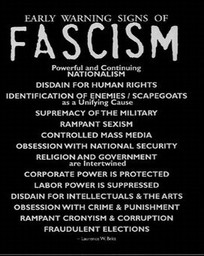
Yeltsin, as we recall, was popular: he won his leadership from the people at the polls, and he was not the only candidate. He favored Vladimir Putin as successor, and Putin was popular because of his fight against Chechen freedom fighters. Uncle Sam befriended Vladimir Putin, for better or worse. They drew even closer together when they were terrorized by attacks on The System. Ironically, the former opponents of Communism and Fascism have as of late adopted anti-democratic methods in the holy name of the idol Democracy, and are both referred to as "fascists" (those who espouse right-wing or profitable authoritarian methods) by liberal-minded thinkers. President Bush is a proponent of top down, heavy handed methods, in order to free the world for Democracy whether the world likes it or not; but Bush, short of a national emergency, would never get away with Putin's return to the peremptory command methods disparaged by Gorbachev. Which reminds us of the Comintern's 1933 definition of fascism.
"... the openly terroristic dictatorship of the most reactionary, most chauvinistic and most imperialistic elements of finance capital."
The People of the United States will attempt to recover some of their traditional democratic composure during the presidential elections. If Uncle Sam does not right himself soon, there will be a dangerous reaction if not a revolutionary leap forward, instead of illiberal, pseudo-conservative ('neoconservative') backsliding. Of course the regressive faction, hired by the power elite and supported by the comfortable majority who aspire to their luxury, is violently opposed to progressive movements. Vladimir Putin is too, and he has moved towards a restoration of a fascist Totalitaria - fascism never entirely forsakes the profit principle.
Which leads us to conjecture on the signs we see around us today, including the Castro's fall, and say that the greatest threat to the world today is not the criminal terrorism of Islamists but the legalized terrorism of the Neofascists. At least that seems to be the trend. When Fidel Castro falls down for the last time, Cuba will most likely take a hard turn to the right and come almost full circle to right-wing government of mobsters financed by right-wing U.S. interests. We who are welfare capitalists are not so romantic as to seek a Red restoration to protect ourselves from the dark forces of corporate-board tribalism. Still, as much as we might dislike the symbolic Fidel Castro, we do not wish for his death but hope for some reconciliation of our variously misunderstood principles.
Prosiga con cautela, Fidel!
Excerpt from Gorbachev's remarks on the press at the 19th All-Union Conference of the CPSU:
"Today, the mass media are a powerful outlet for public opinion. They have done a lot to resotre the truth of history, to restore justice, to criticize faults and ommissions, to propagate the experience of perestroika, and to cultivate people's ability to think and act along new lines, creatively with a purpose. But now we must go further. We need a party press of a new quality. It's role of political educator, its organizing role, must acquire that new quality. While continuing to criticize everything that hinders the progress of perestroika, our press today must thrust deep into the ongoing processes, and analyse the intricate dialectic and conflicting nature of the emrgence of a new society in all areas of life. And for that we need more knowledge, more competence, and a more constructive and responsible approach. The press can attain this objective only if it involves broad segments of society and propagates the experience of all who may be called real foremen of perestroika [Boris Yeltzin?] No longer is it necessary to argue that there can be no renewal without glasnost, that without it we could not have analyzed the reasons for negative phenomena and the ways of coping with them in so short a time, and that without it we could not have created a new moral and olitical climate in society, or given precedence to the ideas of perestroika. Glasnost presupposed a plurality of opnions on all questions of home and international policy, a free play of different points of view, and discussion. It cannot fulfil its social role, it cannot serve the interests of the people and socialism, in the absence of such an approach. But like anny other feature of democracy, glasnost presupposes a high sense of responsiblity. It is incompantible with any claim to monopoly of opinion, with imposition of dogmas in place of those we have rejected. It is incompatible with group interests, and doubly so with any distortion of facts and with any settling of personal scores.... It is totally impermissible to use discussions, meetings, the press, and the television screen for squabbles or insults, and for name-calling."
|